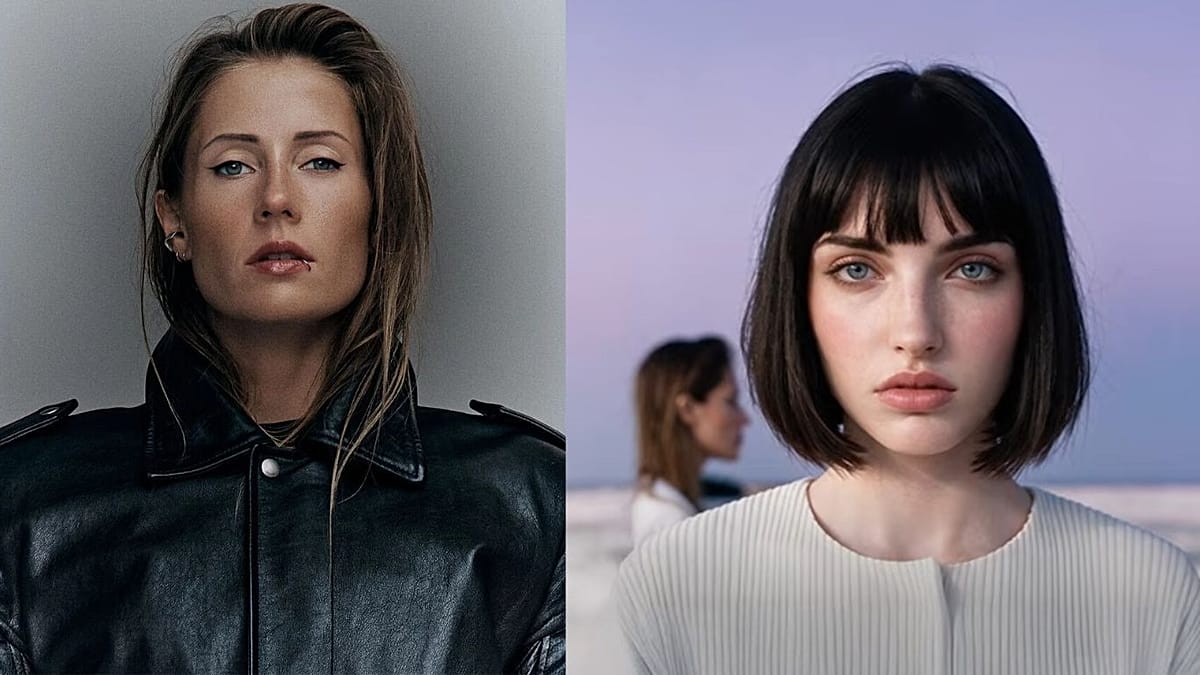
Belgian techno DJ Charlotte de Witte has long been a dominant force in electronic music, but her latest release has ignited a debate that goes beyond the dancefloor. On 5 November, the 34-year-old producer dropped a new EP titled Azadi — Persian for “freedom” — on her own label KNTXT. The three-track release, which includes “Omid” (“hope”) and “Tales of the Desert,” sticks to the acid techno sound and 140 BPM energy that have defined her career. What is different this time is the voice: for the first time, de Witte has collaborated with an AI-generated singer named NAVA.
NAVA was developed by Farbod Mehr, a British-Iranian digital artist, and is presented as a virtual representation of Iranian women who are legally forbidden from performing as solo singers in front of mixed audiences. In a statement, de Witte said the EP is “a small act of resistance” and that all proceeds will go to FEMENA, an NGO supporting women’s rights activists in the SWANA region and Asia. The project is not entirely AI-produced; only the lead vocal is synthetic, while the music and production remain human.
A symbol or a substitute?
The intention behind Azadi is clearly political. Iranian women have faced severe restrictions on public performance, as illustrated by the case of Parastoo Ahmadi, who in June was sentenced to 74 lashes, a two-year travel ban, and a two-year suspension from artistic activity after streaming a concert on YouTube without a headscarf. NAVA is meant to give voice to those who cannot sing openly. But the choice has not been universally welcomed.
Many fans have expressed discomfort with using an artificial voice to represent real women who are fighting for the right to perform. On Reddit, one user wrote: “I have completely stopped enjoying her music. There are other ways to give voice to Iranian women, without resorting to ‘an artist’ created by artificial intelligence.” Another commenter acknowledged the good intentions but questioned the approach: “Apparently, artificial intelligence is supposed to represent Iranian women living under oppression, but is it really possible that there were no Iranian artists in the flesh to sing on the track?”
Criticism has also come from within the Iranian techno scene. AliPink, a DJ and producer who founded the label Techno Tehran Records, called the decision “deeply questionable” in an Instagram post later shared by Tehran Herald. He argued that there are already Iranian artists with talent and stories to tell, and that using AI risks turning real struggles into a promotional concept. “There is a fundamental difference between raising awareness of the difficulties faced by Iranian women and using their struggles as a concept to promote music generated by artificial intelligence,” he wrote.
Yet the project also has defenders. Some point out that featuring a real Iranian singer could put that person in danger. One Instagram user commented: “Wow, as a Persian woman and artist, this really hits me deeply. People do not realise how much Iranian women have to fight, much harder, just to do what artists in other countries are free to do every day.” Another wrote: “I have been waiting for this release, thank you Charlotte, for highlighting the voices of Iranian women, who are repressed by their government and denied the chance to express themselves creatively.”
The debate is not simply a clash between AI supporters and opponents. It touches on deeper questions about representation, solidarity, and the ethics of using technology to speak for marginalized groups. For some, NAVA is a missed opportunity to amplify real voices; for others, it is a necessary tool when direct participation is impossible.
This controversy fits into a broader conversation about AI in music. Generative tools are now capable of producing convincing vocals and compositions, raising concerns about job displacement and creative authenticity. Streaming platforms like Spotify have already moved to require clear labeling of AI-generated content, and some artists have spoken out against unauthorized voice cloning, as seen in the recent case of Angolan-Portuguese singer IAMDDB condemning an AI video using her likeness. The music industry is still navigating these uncharted waters, and Azadi has become a flashpoint in that ongoing discussion.
For de Witte, who was voted the world’s No. 1 techno DJ for the seventh consecutive year in the DJ Mag Top 100 DJs 2026 poll, the EP is a bold artistic statement. Whether it will be remembered as a clever act of solidarity or a misstep remains to be seen. What is clear is that the conversation it has sparked is as important as the music itself.