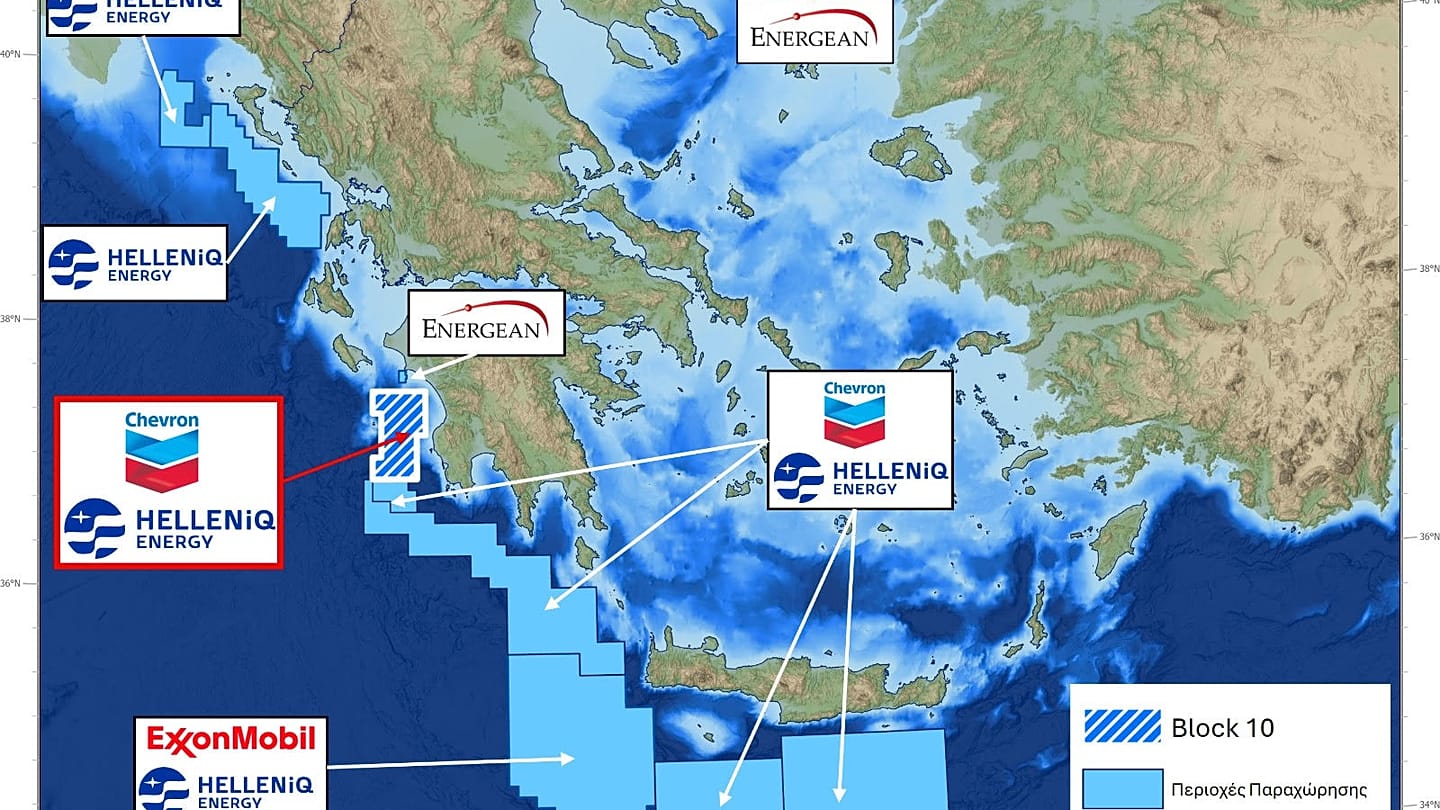
Chevron, the US-based energy major, has submitted a formal application to participate in offshore gas exploration in Greece's Block 10, located in the Ionian Sea west of the Peloponnese. The bid signals growing international interest in the Eastern Mediterranean as a potential alternative source of natural gas for a continent urgently seeking to diversify its energy imports.
Block 10 covers approximately 1,800 square kilometres and is considered one of the most promising unexplored areas in Greek waters. The Greek government has been actively promoting hydrocarbon exploration in the Ionian and south of Crete as part of a broader strategy to attract foreign investment and reduce energy costs for households and businesses.
Strategic shift eastward
Chevron's move aligns with a wider reorientation of European energy policy. Since the onset of the war in Ukraine, Brussels and national capitals have prioritised reducing reliance on Russian pipeline gas. This has pushed exploration and infrastructure investment toward the Eastern Mediterranean, where discoveries off Israel, Egypt, and Cyprus have already reshaped regional gas flows.
Greece, with its strategic location and existing LNG terminal at Revithoussa near Athens, is positioning itself as a transit hub. The country has also advanced plans for a floating storage and regasification unit off Alexandroupoli in the north, which could supply gas to Bulgaria, Romania, and further into Central Europe.
“The Ionian Sea holds significant potential, and Chevron's interest is a vote of confidence in Greece's regulatory framework and geological prospects,” said a senior official at the Hellenic Hydrocarbons Management Company, speaking on condition of anonymity because the application is still under review.
Energy security and EU policy
The European Commission has repeatedly called on member states to accelerate domestic energy production and diversify sources. In a recent statement, Energy Commissioner Kadri Simson emphasised that “every cubic metre of European-produced gas reduces our vulnerability to external shocks.” The push comes amid ongoing tensions in the Middle East, including the Strait of Hormuz crisis, which the International Energy Agency has described as the greatest energy security threat in modern history.
Chevron's application also coincides with broader debates in Brussels about how to finance the energy transition. Some member states have argued that EU Cohesion Funds could be redirected to ease the energy crisis, a proposal that has gained traction in southern and eastern Europe.
However, environmental groups have raised concerns. Greenpeace Greece and WWF Hellas have both warned that new offshore drilling could delay the shift to renewables and risk marine ecosystems in the Ionian, which is home to endangered species such as the Mediterranean monk seal and loggerhead sea turtles.
“Investing in fossil fuel exploration now is a gamble with both the climate and the region's biodiversity,” said Nikos Charalambidis, a campaigner at WWF Hellas. “Greece has enormous solar and wind potential. That is where public and private capital should flow.”
Chevron has not publicly commented on the environmental criticisms. The company has previously stated its commitment to reducing methane emissions across its global portfolio and has invested in carbon capture technologies.
Geopolitical dimensions
The Eastern Mediterranean has become a theatre of competing claims and alliances. Turkey, which does not recognise the exclusive economic zones claimed by Greece and Cyprus, has conducted its own drilling operations in disputed waters. Ankara's assertive energy policy has complicated regional cooperation, though diplomatic channels remain open.
Chevron's entry into Greek waters could also affect the dynamics of the East Mediterranean Gas Forum, a Cairo-based organisation that includes Egypt, Israel, Greece, Cyprus, Italy, Jordan, and the Palestinian Authority. The forum aims to coordinate gas development and exports, and a new major player in Greek waters could strengthen the bloc's collective bargaining power.
For Athens, the Chevron application is a welcome sign after years of slow progress in hydrocarbon licensing. Greece's previous attempts to attract international oil companies to the Ionian and south of Crete yielded limited results, partly due to the global shift toward renewables and the high cost of deepwater drilling.
If Chevron's bid is approved, exploration drilling could begin within two to three years, subject to environmental impact assessments and parliamentary ratification. The Greek energy ministry is expected to decide on the application within the next six months.