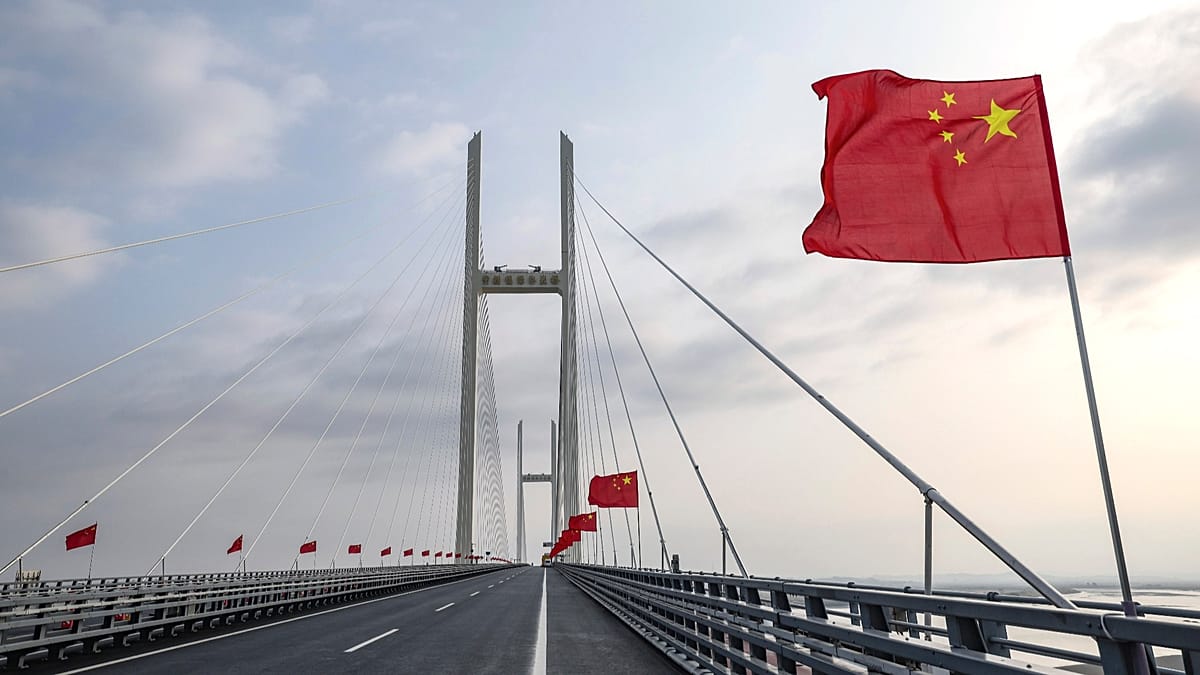
After more than a decade of delays, a new four-lane road bridge connecting China and North Korea finally opened on Thursday, promising to transform trade between the two neighbours. The 3,026-metre New Yalu River bridge, which spans the river separating the Chinese border city of Dandong from North Korea's Sinuiju, was completed in 2014 but remained closed due to missing connecting roads and customs facilities on the North Korean side, as well as pandemic border closures.
Hundreds of onlookers gathered in Dandong to witness the opening, taking selfies in front of the structure before trucks bearing the flags of both nations began crossing in both directions. Some North Korean vehicles were decorated with flowers, a sign of the occasion's significance. Local resident Yu Shuyan, who had visited North Korea before the pandemic, expressed hope that the bridge would help raise living standards across the border. Another Dandong resident, who declined to give her name, told AFP: "It's already been over 10 years. It's certainly going to be good for business."
Chinese Premier Li Qiang, speaking via video link at the ceremony, said the bridge symbolised Beijing's friendship with Pyongyang and that bilateral relations were "entering a new stage and opening a new chapter". According to China's Xinhua news agency, Li added that the bridge would "strongly boost economic and trade cooperation" and "tighten the bonds of affection between the two peoples".
A strategic upgrade for cross-border trade
The new crossing supersedes the ageing Sino-Korean Friendship Bridge, a narrow rail-and-road structure further downstream on the Yalu River that has long been the only land link between the two countries. Lim Eul-chul, a North Korea expert at Kyungnam University, told AFP that the old bridge posed safety concerns for heavy cargo such as industrial machinery, raw materials, and energy supplies. "The new crossing will make such shipments much easier and more efficient," he said, calling it a "groundbreaking development" that will substantially increase cargo traffic.
China remains North Korea's largest trading partner and most vital economic pipeline, accounting for roughly 98% of its external trade last year. The opening comes at a delicate moment in regional geopolitics. Just a month earlier, North Korea and Russia inaugurated their own road bridge across their shared border, part of a deepening partnership that has seen Pyongyang send troops and weapons to support Moscow's war in Ukraine. Experts suggest Chinese officials may have felt uneasy about that development, which underscores Russia's growing influence over North Korea.
Kim Jong-un has recently sought to balance his ties, drawing closer to Beijing to boost his country's struggling economy and to build a united front against the United States. For China, the bridge is a tangible symbol of its desire to restore its unique influence over North Korea. The two countries also share a history of friction, but the new infrastructure signals a renewed commitment to economic integration.
North Korea has not yet resumed issuing tourism visas to Chinese citizens, who once formed the bulk of its foreign visitors. The bridge, however, is expected to facilitate not only goods but also people-to-people exchanges once travel restrictions are fully lifted. For Dandong, a city dotted with Chinese and Korean shops and restaurants, the opening is a long-awaited boost to local business.
The bridge's launch also comes amid broader shifts in Europe's engagement with the region. The European Union has recently opened new accession talks with Ukraine, a move that could reshape the bloc's eastern neighbourhood. Meanwhile, EU leaders are watching North Korea's missile tests with concern, as Pyongyang continues to develop its arsenal. The new bridge, while primarily a bilateral project, has implications for regional stability and trade flows that extend beyond Asia.
As trucks began rolling across the Yalu River, the mood in Dandong was one of relief and optimism. "I hope the standard of living in North Korea can rise to the level we have here," said Yu Shuyan. For now, the bridge stands as a concrete link between two very different systems, and a reminder of the complex web of alliances and dependencies shaping the region.