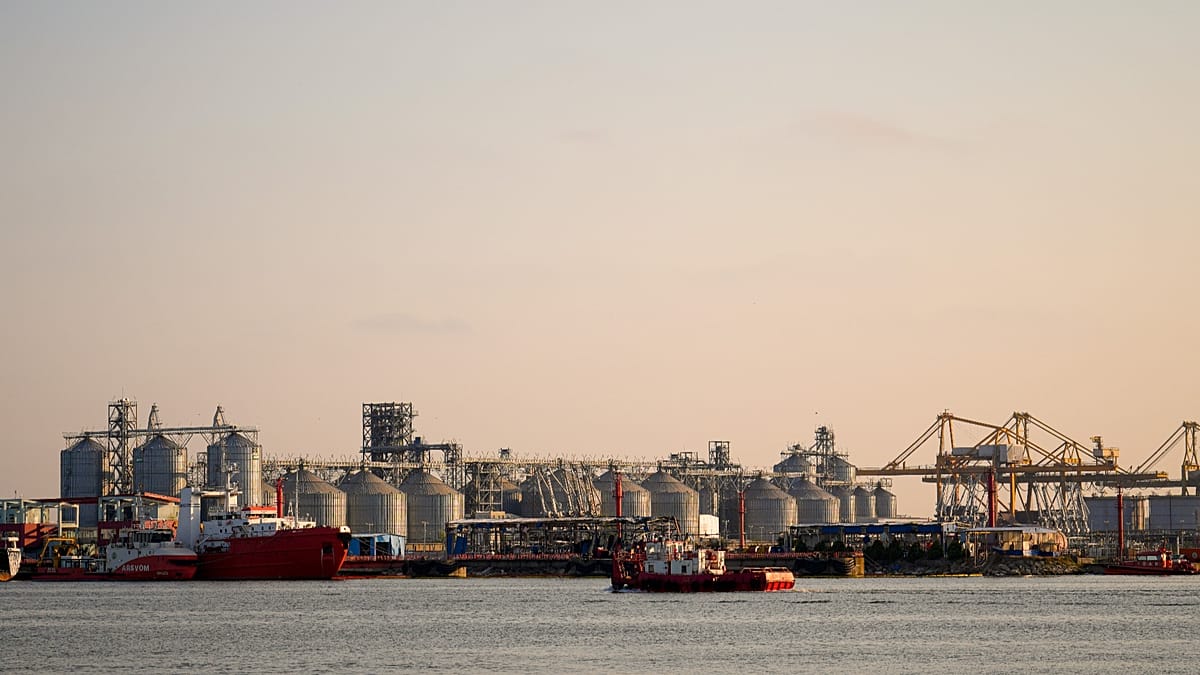
Romanian authorities said on Wednesday they are investigating a suspected drone attack on a tanker anchored in the country's Black Sea territorial waters, the latest in a series of incidents that have heightened concerns about the security of commercial shipping in the region.
The vessel, the Comoros-flagged Yara J, was positioned off the port of Sulina, close to the Ukrainian border, when Romanian rescuers were dispatched overnight. Defence Minister Radu Miruta told Digi24 television that the crew managed to extinguish a fire on board without outside assistance. "Whether it was struck by a drone or not, an investigation is currently underway," he said, adding that the incident was "a matter of significant gravity, given that such incidents are occurring in Romanian territorial waters."
The Yara J, identified by the VesselFinder tracking service as a chemical and oil products tanker, was reportedly empty and had been docked off Sulina for several days. Romania's defence ministry said it had scrambled two F-18 jets after detecting "a group of air targets" off the Black Sea coast.
Black Sea strikes
The episode follows a series of suspected Russian drone attacks on ships off the coasts of Romania and Bulgaria over the past week. On Wednesday, Bulgarian Prime Minister Rumen Radev told parliament that Russia was the likely culprit behind strikes that sank two vessels in Bulgaria's exclusive economic zone and adjacent waters, though he conceded that definitive proof was lacking. "There is no logic in Ukraine attacking its own ships and crews, given that the outcome of all these attacks favours Russia and indeed, the logic points in that direction. The problem is that we cannot prove it," Radev said.
Rescuers are still searching for 11 crew members missing after Tuesday's attacks, which also left five survivors. One of the sunken ships, the Chelsea-3, is Ukrainian-owned, registered in Odesa, and sails under the Maltese flag. The other, the Dignity, was registered in Guinea-Bissau. Four sailors from the Dignity—three Syrians and one Egyptian—were rescued and brought to the port of Varna, according to district governor Mario Smarkov. "All four appeared to be in relatively good condition and had sustained no injuries," he said.
Bulgaria has summoned the Russian ambassador to Sofia, who said she had no information from Moscow's defence ministry but did not rule out that the attacks could be "a provocation by a third party." The Bulgarian government has requested international assistance for the investigation and has called on NATO to bolster surveillance and response capabilities against drone threats.
Black Sea security
The recent incidents have renewed scrutiny of Europe's ability to protect shipping and critical infrastructure in the Black Sea, more than a year after the EU launched a strategy to strengthen security in the region. When the Black Sea Security Strategy was unveiled in May 2025, EU foreign policy chief Kaja Kallas warned that the region was bearing the spillover effects of Russia's full-scale invasion of Ukraine. "The Black Sea region is the prime target for hybrid actions. The European Union aims to boost cooperation to combat cyberattacks, disinformation, and other hostile actions," she said. "Recurring airspace violations and attacks on ports and shipping lanes highlight this reality."
The strategy was designed to secure the maritime corridor and protect critical assets such as offshore installations and subsea cables. It also promised the creation of a Black Sea Maritime Security Hub to coordinate support, enhance coast-guard cooperation, and analyse seabed sensor data to alert allies to potential threats.
These developments come amid broader concerns about hybrid attacks across Europe. As NATO warns Russia as hybrid attacks escalate across Europe, the Black Sea remains a flashpoint where commercial vessels are increasingly caught in the crossfire. The region's strategic importance is underscored by the recent French Navy interception of a shadow fleet tanker, highlighting the wider challenges of maritime security.
For Romania and Bulgaria, the immediate priority is to establish what happened and to prevent further incidents. But the broader question of how Europe can safeguard its maritime interests in the Black Sea—against both conventional and hybrid threats—remains unresolved. As the EU's strategy enters its second year, the gap between ambition and operational reality is becoming harder to ignore.