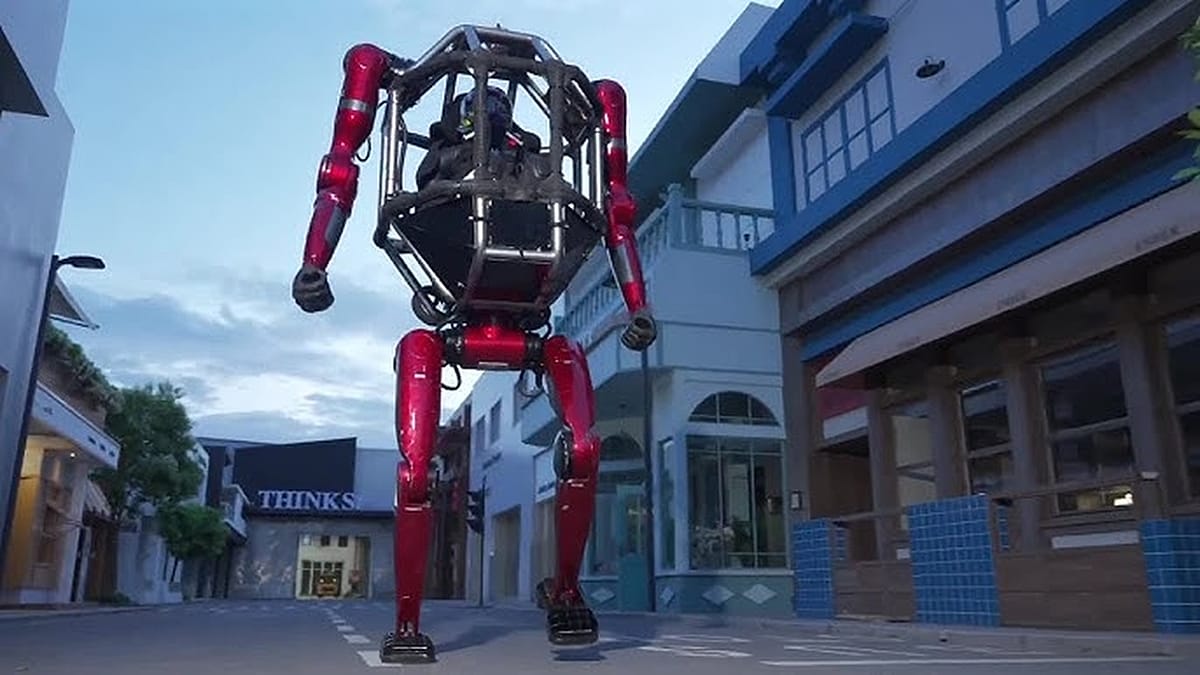
For decades, the idea of piloting a giant mechanical robot has been confined to science fiction films and anime. This week, a Chinese company turned that fantasy into a tangible—if expensive—reality.
Unitree Robotics, based in Hangzhou and known for its quadruped robot dogs, has unveiled the GD01, which it calls the world's first production-ready manned transformable mecha. Standing roughly 2.8 metres tall, the machine allows a human pilot to climb into an open cockpit in its torso and control its movements. It can walk upright on two legs or reconfigure into a four-legged stance for rougher terrain. Promotional footage even shows it smashing through a wall of cinder blocks.
The price tag, however, is steep: 3.9 million yuan, nearly €500,000. Unitree has not yet disclosed key technical specifications such as battery life, maximum speed, payload capacity, or operating duration, leaving many questions about its practical utility unanswered.
From Robot Dogs to Giant Mecha
Unitree was founded in 2016 by engineer Wang Xingxing, who built his first quadruped robot as part of a university thesis before leaving drone giant DJI to start his own company. The firm began with quadruped robot dogs inspired by research platforms like Boston Dynamics' Spot. A decade later, Unitree controls roughly 70 percent of the global quadruped robot market and in 2025 shipped more than 5,500 humanoid robots—more than any other manufacturer, including Tesla. Its robots have even appeared on China's widely watched Spring Festival Gala television show.
The GD01 is aimed at what Unitree calls "high-value markets," including industrial operations, emergency rescue, and cultural tourism. In theory, such systems could be deployed in disaster zones, collapsed buildings, hazardous industrial sites, or environments where wheeled vehicles struggle. There are also obvious military implications, though Unitree explicitly describes the GD01 as a civilian platform and warns users to operate it in a "friendly and safe manner."
The broader robotics industry has long explored similar ideas. Powered exoskeletons already exist in medicine, logistics, and defence. Companies including Sarcos Technology, Hyundai Motor Company, and Lockheed Martin have spent years developing wearable robotic systems that enhance lifting strength or reduce worker fatigue.
Humanoid Robotics Boom
Humanoid robotics is experiencing one of its biggest investment booms in decades. Companies across the United States, China, and Europe are racing to build general-purpose robots capable of working in warehouses, factories, and eventually homes. Tesla is developing its Optimus humanoid robot, Figure AI has partnered with BMW, and Agility Robotics already has warehouse robots operating commercially. In Europe, Croatia launched the continent's first commercial robotaxi service in Zagreb, signalling the region's growing interest in autonomous mobility.
China, however, is scaling up extremely quickly. In April, Chinese smartphone company Honor made global headlines when its humanoid robot completed a half marathon in Beijing in 50 minutes and 26 seconds—beating the human world record by nearly seven minutes. According to research cited by the South China Morning Post, Chinese companies accounted for nearly 90 percent of global humanoid robot sales in 2025. Official data also show that China had more than 140 humanoid robot manufacturers and over 330 models in 2025. Accelerating the development of technologies such as humanoid robots was listed as a priority in Beijing's latest five-year plan, which pledges to "target the frontiers of science and technology."
The GD01 is undeniably one of the most eye-catching products to emerge from this race so far. But whether it represents a glimpse of a genuinely useful future technology or an elaborate marketing proof of concept remains an open question for the industry. As European policymakers and businesses watch the rapid advances in Chinese robotics, the continent's own efforts in automation and AI—from training grounds for humanoid robots in Seoul to research labs in Berlin and Paris—will need to accelerate to keep pace.