New car registrations across the European Union rose 4.2% in the first four months of 2026, reaching nearly 3.8 million vehicles, according to data released Wednesday by the European Automobile Manufacturers' Association (ACEA). The figures underscore a market in transition, with electric and hybrid vehicles driving growth and Chinese automakers rapidly gaining ground.
Battery-electric cars captured 19.7% of the EU market from January to April, up from 15.3% a year earlier. Growth was led by the bloc's four largest economies: Italy saw a 25.5% increase, Spain 19.7%, Germany 6.6%, and France 2.3%. In April alone, battery-electric vehicle sales jumped 37.7% year-on-year, pushing their monthly market share to 20.6%.
Hybrid-electric vehicles remained the most popular powertrain choice in April, accounting for 36.9% of sales with a 12% rise. Plug-in hybrids added 16.4%, capturing a 9.8% share. Meanwhile, petrol car registrations fell 16.3% to under 218,500 units, and diesel dropped 17.1% to around 74,000. Combined, petrol and diesel cars now represent less than 30% of EU sales in April.
European Brands Hold Their Ground
Volkswagen Group retained its top spot with a 26.7% market share, selling just over one million units, up 2.9% year-on-year. Performance within the group varied: Škoda registrations rose 15.5%, Audi gained 8.6%, but the core Volkswagen brand slipped 3.2% across multiple segments.
Stellantis ranked second with a 17.1% share and over 648,000 units, up 7.8%, driven by a recovery at Fiat (up over 32%) and strong gains at Opel and Vauxhall, which together rose 22%. Renault Group was the weakest among the top three, declining 7.4% to around 384,250 units, with Dacia falling more than 15%.
BMW Group and Mercedes-Benz posted gains of 3.9% and 3.8%, respectively, while Toyota and Hyundai Group recorded modest declines of between 2.5% and 3.1%.
The Chinese Surge
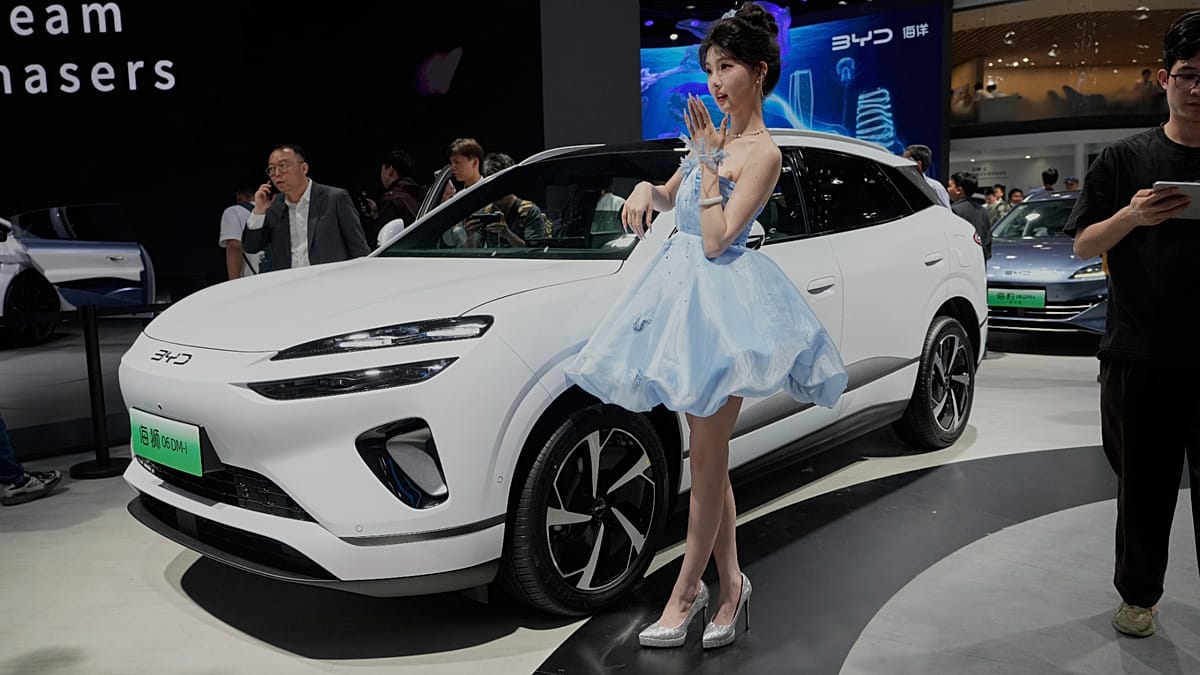
The most striking trend was the continued rise of Chinese carmakers. BYD's EU registrations more than doubled year-on-year, surging 152.9% to over 71,850 units. Chery Automobile, through its Omoda, Jaecoo, and Jetour brands, grew 267.1% to more than 48,350 units. Leapmotor, distributing via its joint venture with Stellantis, soared 558.8% to over 28,700 units. SAIC Motor, owner of the MG brand and the largest Chinese group by EU volume, added 10.4% to reach over 77,000 units.
Combined, Chinese brands accounted for around 6% of EU car registrations between January and April 2026, up from 3.2% a year earlier. Across the wider European market, including the UK and EFTA countries, their share reached roughly 7.3%, compared with 3.7% in 2025.
This growth comes amid broader geopolitical shifts, including tensions that have affected energy markets and consumer confidence. For instance, German business sentiment unexpectedly rose despite energy market strains from the Iran conflict, suggesting resilience in Europe's largest economy. Meanwhile, the rise of Chinese automakers mirrors trends in other sectors, such as memory chip manufacturing, where Asian firms are gaining ground.
The shift to electric vehicles is reshaping Europe's automotive landscape, with Chinese brands leveraging competitive pricing and advanced battery technology. As traditional European manufacturers invest heavily in electrification, the coming years will test their ability to fend off new entrants in a rapidly evolving market.