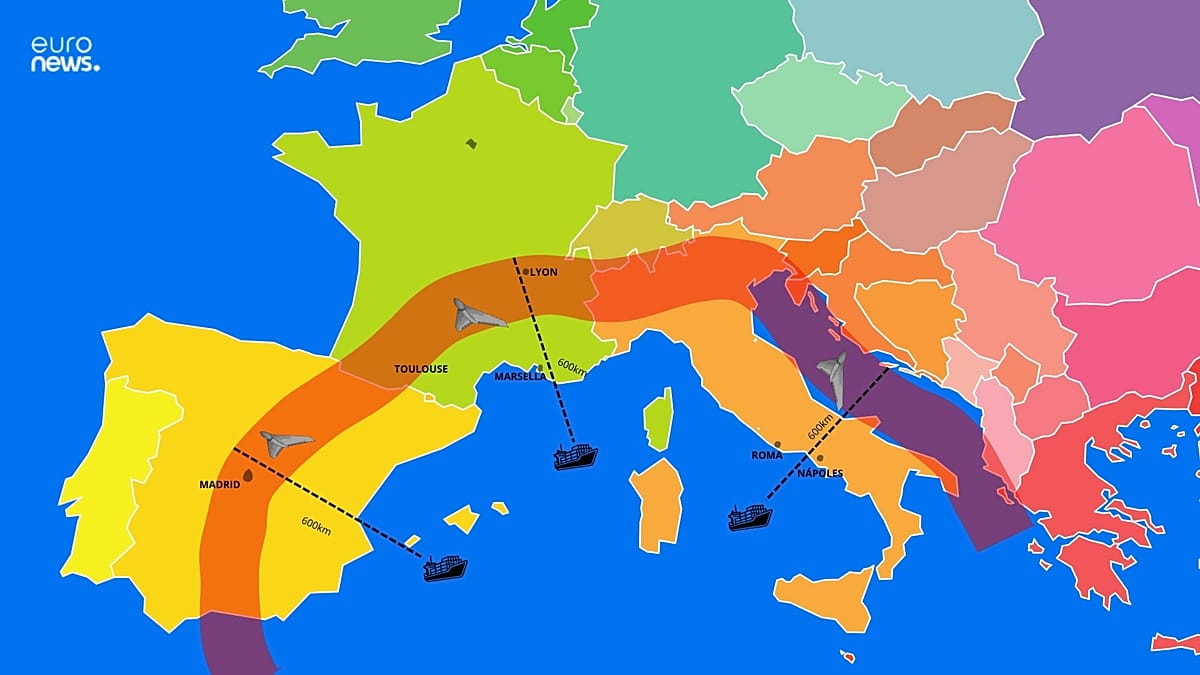
US intelligence has shared a detailed warning with several European governments about a possible Russian operation using drones against targets in Spain, France, or Italy, according to Spanish media. The alert, first reported by journalist Xavier Colás in El Mundo, traces its origin to CIA director John Ratcliffe's visit to Moscow last August and outlines a specific scenario: drones launched from merchant vessels disguised as ordinary commercial traffic.
The weapon in question is the Gerbera, a small Russian drone barely two metres long and weighing 18 kilograms, capable of flying up to 600 kilometres at around 160 km/h. Its explosive payload of just four to five kilograms is not designed for mass destruction but for symbolic and disruptive effect—temporarily shutting down an airport, starting a fire, or demonstrating that Moscow can strike at Europe's rear without crossing a land border.
This is not a distant hypothesis. In February, a Swedish naval unit detected a drone taking off from a Russian intelligence vessel in the Öresund Strait. Earlier, an armed drone attack at Leipzig airport in Germany was attributed by Berlin to Russian intelligence, and 19 unarmed drones flew over Polish airspace a year ago. These incidents show Moscow's willingness to test Europe's defences with low-cost, deniable operations.
Why southern Europe, not just the eastern flank
The Kremlin's logic, according to analysts cited by El Mundo, is driven not by geography but by political vulnerability. British expert Keir Giles, a specialist in Russian military strategy, argues that Moscow will seek out “the weakest point in Europe,” explicitly naming countries such as Spain, which lack integrated air-defence systems suited to this type of threat.
This idea echoes a warning from NATO Secretary General Mark Rutte months ago: a Russian missile would take barely ten minutes longer to reach Madrid than Warsaw. Rutte sought to dismantle the perception that southern Europe lies outside the “eastern flank” and is therefore beyond the radius of risk posed by Russia's war against Ukraine. Drone launches from the Mediterranean, slower but just as symbolic, reinforce that message: distance no longer guarantees security for any European country.
Spain, France, and Italy also share another risk factor highlighted in the investigation: all three hold elections in 2027, and each has political forces capable of capitalising on social fatigue from years of war in Ukraine. Moscow could exploit that with a low-cost action and high media impact, especially as US President Donald Trump has expressed a desire to end the conflict before winter.
Sánchez, defence spending, and tension with Washington
The report arrives at a delicate moment for Spain. Prime Minister Pedro Sánchez's government has been reluctant to raise defence spending to NATO's new threshold, a stance that has caused open tension with Washington and a near-broken bilateral relationship. At the UN General Assembly, Sánchez refused to attend a reception hosted by Trump in New York. The intelligence alert adds pressure on Moncloa, exposing the lack of investment in air-defence and anti-missile systems just as the perception of a direct threat to Spanish soil grows.
The debate about Spain's exposure to Russian interests extends beyond the military. Journalistic investigations have documented the presence of assets linked to Kremlin circles along the Andalusian coast. Among the best-known cases is that of Liudmila Ocheretnaya—formerly Liudmila Putina—Vladimir Putin's ex-wife, who with her current husband, Artur Ocheretny, owned two luxury homes in the Lomas del Rey complex in Marbella worth €2.2 million. Those reports suggested an urgent sale for fear of EU sanctions after the UK had already sanctioned her. Subsequent investigations have traced a web of companies and foundations linked to Ocheretny, though there has been no recent public confirmation of the properties' sale or of Ocheretnaya's current residence status.
The CIA report recalls that Moscow has for months operated “below the threshold of war,” combining isolated sabotage with reaction tests such as those in Poland and Germany. What is new is the possibility of this pattern spreading to the Mediterranean, shattering the false sense of distance that has long protected countries like Spain in the collective imagination. As Rutte puts it, in today's Europe a difference of ten minutes no longer separates a safe country from one at risk.
European defence planners are now grappling with the implications. The threat is not just military but political, aimed at exploiting divisions and eroding public confidence. For southern European states, the challenge is to build resilience against a hybrid adversary that operates in the grey zone between peace and war. The recent Russian helicopter incursion near Kaliningrad and the drone barrage on Kyiv are reminders that Moscow's tactics are evolving. As Europe's air defences are tested, the question is whether the continent can adapt quickly enough to deter a threat that now reaches its southern shores.