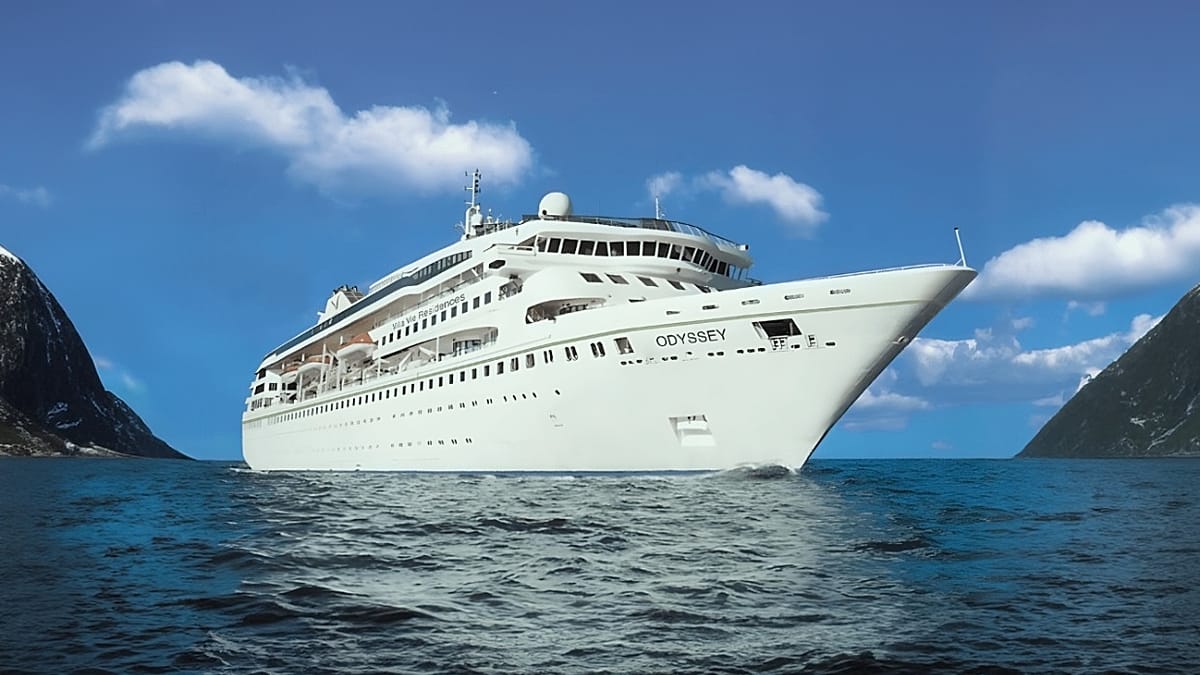
Around 200 passengers who had effectively made a cruise ship their permanent home were abruptly ordered off the vessel in a Cambodian port this week after the operator said it could no longer afford to run the voyage. The US-based company Villa Vie Residences, which operates the Bahamas-flagged Odyssey, announced it had “suspended operations in Cambodia” and was seeking to restructure its finances over the next 60 days.
The company attributed the suspension to an “extraordinary” increase in fuel costs since the Iran war began in late February, which it said had made its current operating model “extremely challenging”. In a statement, Villa Vie said it had already taken steps to reduce fuel consumption, including slowing the itinerary and spending more time in port, but that these measures had not been enough to offset the rising costs. “Passing the full increase on to residents is not a realistic solution,” the company said.
A floating home for hundreds
The Odyssey, which has capacity for 650 passengers, left Belfast in October 2024 for a continuous voyage that was originally planned to last three-and-a-half years. Residents could buy or rent cabins for holidays or for life, with some selling everything they owned to fund their place on board. Villa Vie had marketed the ship as a way to “make the Odyssey your permanent home”, with lifetime suite prices starting at around $230,000 (€206,700).
However, on 23 October, the ship arrived in Sihanoukville, a port on the Gulf of Thailand, and passengers were given roughly seven hours to disembark, according to Long Dimanche, deputy governor of Preah Sihanouk province. He said 203 guests and 156 crew had come from Thailand and were due to continue to Vietnam. “The sudden order to disembark has left many retirees and remote workers homeless thousands of miles from their home countries,” he told reporters.
Some passengers managed to book flights out, while others remained in the city. The ship itself was scheduled to refuel and leave on 31 October, though its future remains uncertain.
Passengers describe a ‘cascade of problems’
Randy Cassingham, a passenger who runs the ResidentialCruising.com blog, wrote a post titled “Abandon Ship!” describing the disembarkation order as the latest in a “cascade of problems”. Speaking to AFP, he said the Odyssey was not a luxury vessel but an affordable option – until the company started “begging for money”.
Villa Vie said in its statement that per-cabin monthly fuel expenses had risen from an average of $1,800 (€1,610) to an estimated $6,000 (€5,380) to $8,000 (€7,170) in parts of Asia. The company argued that it could not pass such increases on to residents, and that the resulting shortfall had placed its operating model under unsustainable financial pressure.
Cassingham accused the company of doing “absolutely nothing to help” stranded passengers. Villa Vie said it was “working with residents to coordinate disembarkation and identify temporary living arrangements”, and acknowledged that this was “a difficult and disruptive period” for everyone involved.
A port familiar with cruise crises
Sihanoukville is no stranger to stranded cruise ships. In February 2020, the MS Westerdam was allowed to dock in Cambodia after being turned away from five other ports due to COVID-19 fears. That ship carried 1,455 passengers, more than 600 of them American citizens. Cambodia’s then-prime minister Hun Sen permitted the docking on humanitarian grounds, earning international praise as passengers were welcomed ashore and flown home.
The Odyssey itself has a long history. Built in 1993, it has sailed under various names and operators before being laid up during the pandemic. Villa Vie Residences bought the ship in 2023 and refitted it in Belfast before launching the current voyage.
For the passengers now stranded in Cambodia, the immediate concern is finding a place to stay and a way home. Many had sold their homes and possessions to fund their life at sea, and now face an uncertain future thousands of miles from their home countries. The company’s restructuring efforts may offer some hope, but as Villa Vie itself noted, “no outcome is assured”.
This incident highlights the fragility of long-term residential cruising, a niche but growing sector that has attracted retirees and remote workers seeking a life of constant travel. It also raises questions about the financial stability of such ventures, especially in times of geopolitical turmoil and volatile energy prices. As the industry continues to evolve, passengers may need to weigh the risks more carefully before committing their savings to a life on the waves.