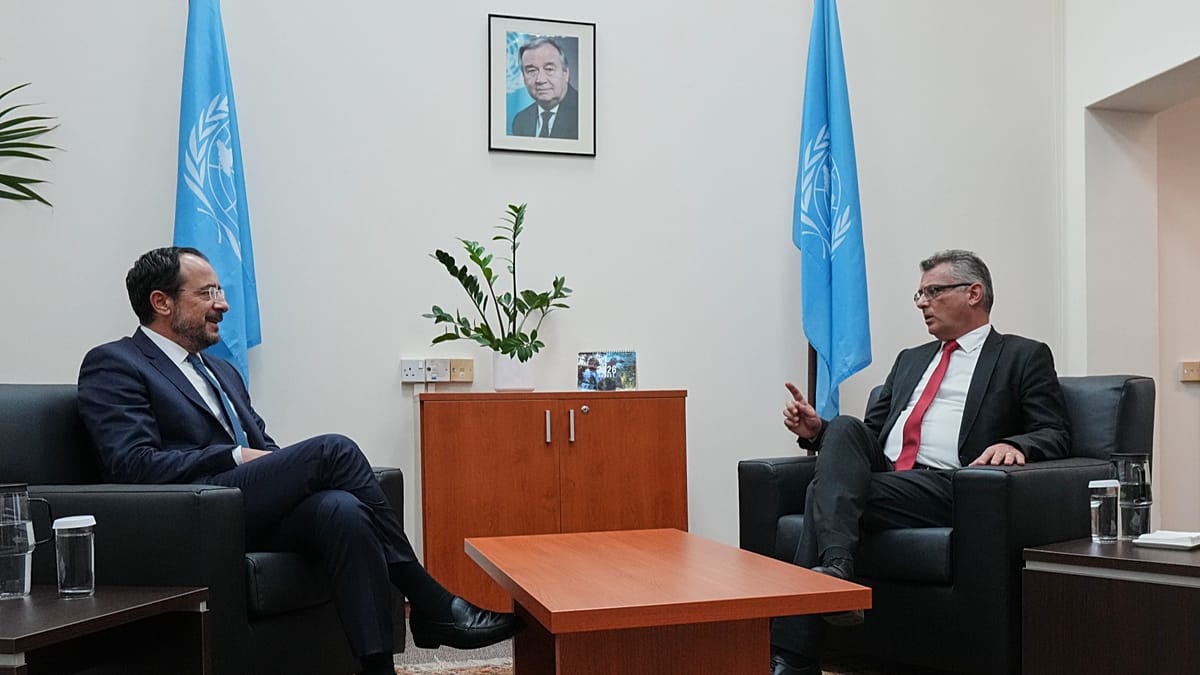
In a significant step toward reviving the long-stalled Cyprus peace process, the island's rival leaders have agreed to hold weekly meetings. The decision came after a face-to-face encounter on Wednesday in the UN-controlled buffer zone in Nicosia, the first since UN Secretary-General António Guterres visited the island in July.
Nikos Christodoulides, president of the internationally recognised Republic of Cyprus, and Tufan Erhürman, the pro-unification leader of the Turkish-occupied north, met under the auspices of the United Nations. A brief UN statement described the discussions as “constructive” and said the two men had “agreed to intensify their meetings and to meet once a week and more frequently, as circumstances may require.”
The meeting is seen as a crucial step in laying the groundwork for a renewed UN-led peace push. Guterres, who leaves office at the end of this year, has made the Cyprus question a personal priority. He has said he will convene new talks involving the island's leaders and the three guarantor powers—Greece, Turkey, and the United Kingdom—but has insisted he does not want another summit “without results.” He has demanded “adequate preparation” to build confidence and has not yet set a date for the proposed gathering.
A divided island, a decades-old conflict
Cyprus has been divided since 1974, when Turkey invaded and occupied the northern third of the island in response to an Athens-engineered Greek Cypriot coup that sought unification with Greece. Before the invasion, Turkish Cypriots made up around a fifth of the population of the former Ottoman and British colony, which had experienced years of inter-ethnic tension and violence.
Today, the island comprises the Turkish Republic of Northern Cyprus (TRNC), which declared independence in 1983 but is recognised only by Ankara, and the EU member Republic of Cyprus in the south. The last major round of peace talks collapsed in Switzerland in July 2017, and no substantive negotiations have taken place since.
Guterres's visit in July was the first by a UN secretary-general to the Mediterranean island since 2010. His personal involvement has raised hopes that the long-stalled process might finally gain momentum, though scepticism remains high given the deep divisions and the complex geopolitical interests at play.
Speaking before Wednesday's meeting, Cypriot government spokesperson Konstantinos Letymbiotis said the discussions would focus on the substance of the Cyprus issue. He also indicated that opening new crossing points across the buffer zone to improve freedom of movement was a confidence-building measure under consideration.
The weekly meetings are intended to build trust and address practical issues before any formal negotiation round. Analysts note that the involvement of the guarantor powers—particularly Turkey, which maintains a significant military presence in the north—will be essential for any lasting settlement.
For the EU, which counts Cyprus as a member state, a resolution would remove a persistent source of tension with Ankara and could ease broader EU-Turkey relations. The bloc has repeatedly called for a fair, comprehensive, and viable settlement based on a bi-communal, bi-zonal federation.
As the two leaders prepare to meet again, the international community will be watching closely. Whether this new rhythm of dialogue can overcome the failures of the past remains to be seen, but the simple act of sitting down together on a weekly basis is, in itself, a modest yet meaningful step forward.