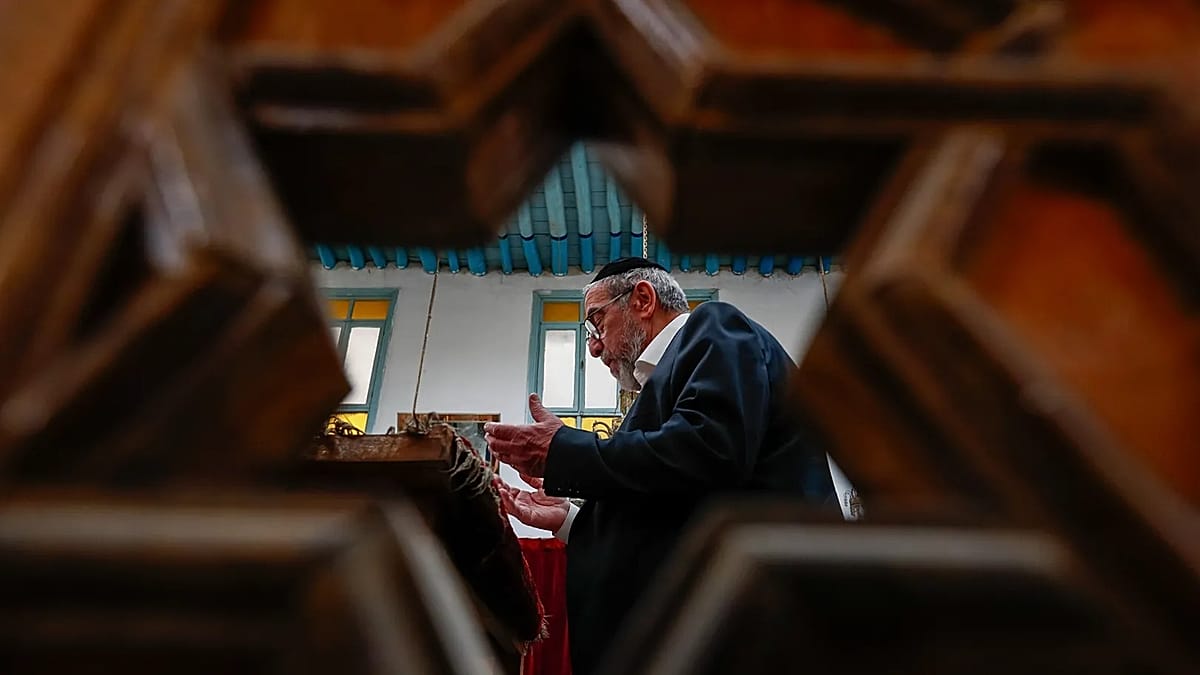
In the narrow stone alleys of Damascus's ancient Jewish Quarter, the question of how to sustain religious tradition with almost no one left to uphold it has become pressing. Nowhere is this more evident than in the search for kosher food.
Fewer than a hundred Jewish people are estimated to remain in Syria, scattered across a country where their community once numbered in the tens of thousands. Bakhor Shamntoub, head of Syria's Mussawi Jewish community, explained to Euronews how a tradition that once sustained an entire community now depends on individual effort, occasional imports from Turkey, and packages sent by relatives in the United States.
The Central Obstacle: A Certified Jewish Butcher
Kosher law permits lamb, beef, and chicken, but under strict conditions. The butcher must be exclusively a Jewish person holding official certification. That requirement alone has become the central obstacle in Damascus. “In the past, there was a Jewish man working alongside a Muslim butcher in the Al-Qassaa district of Damascus. But the Jewish butcher left the country,” Shamntoub recalled. “Regardless of how correctly the Muslim performs the slaughter, it is not considered kosher, because the condition is that the butcher must be Jewish.”
The knife used must be made of pure diamond rather than an ordinary blade, enabling a cut swift enough that “the animal does not feel pain.” Afterwards, the butcher inspects the animal for signs of disease following a specific set of rules. “They blow into it in a specific way to determine whether it is diseased. If it is sick, its meat is not eaten,” he explained. An animal injured before slaughter is also disqualified: “If a sheep fell from a truck and broke a leg — we do not eat it.”
Supply Chains and Local Efforts
Before the fall of Bashar al-Assad's regime, Syria's Jewish community imported kosher meat regularly from Turkey. That supply chain broke down after December 2024. Shamntoub now sometimes brings meat from Turkey himself, and relatives in the US send packages. Members of the Jewish community visiting Damascus on short stays occasionally arrive with supplies, which are stored in refrigerators. Shamntoub said he was planning to revive local kosher meat production in Damascus. “Again, we will bring a Jewish butcher to Damascus to do it according to Jewish tradition, and we will store the meat in refrigerators.”
The Semiramis Hotel in the Old City has sought to fill the gap by opening a section dedicated to Jewish cuisine. Meat is brought from outside Syria, while cooking is done on site. But Shamntoub was precise about the requirements: “The plates, pots, pans — everything — must be 100% new and specially prepared.” Previously used cookware cannot be used in kosher food preparation.
Tourism as a Potential Lifeline
A viable future would require tourism to grow significantly. “It could become possible to have proper slaughterhouses and certified butchers if tourism increases and members of the Jewish community from around the world begin coming regularly,” Shamntoub said. In the meantime, those without access to kosher meat can eat fish, which is not subject to the same strict rules. When eating in ordinary Damascus restaurants himself, Shamntoub opts for vegetarian dishes — hummus or ful, a fava bean stew — for the same reason.
Restaurant owners in the Old City expressed mixed views. Some objected to the concept of specialised kosher restaurants on principle, arguing that restaurants should serve everyone. Others focused on economics: the small Jewish population and low tourist numbers do not justify the investment in specialised slaughterhouses, dedicated chefs, and sterilisation equipment required for kosher preparation. Several raised security concerns. The Semiramis Hotel's announcement of its Jewish restaurant section drew an immediate wave of hostile comments and threats online. “The security situation does not allow us to open such a door,” one restaurant owner told Euronews, warning that extremists could target any establishment that did.
Others took a different view, saying kosher dining could attract members of the Jewish diaspora from around the world and help rebuild a connection to a community that has been almost entirely absent from Damascus for decades — but acknowledged that this remained very difficult. For now, the Jewish community in Damascus continues its centuries-old practices with dwindling numbers and improvised solutions, hoping that a revival in tourism might one day restore what has been lost.