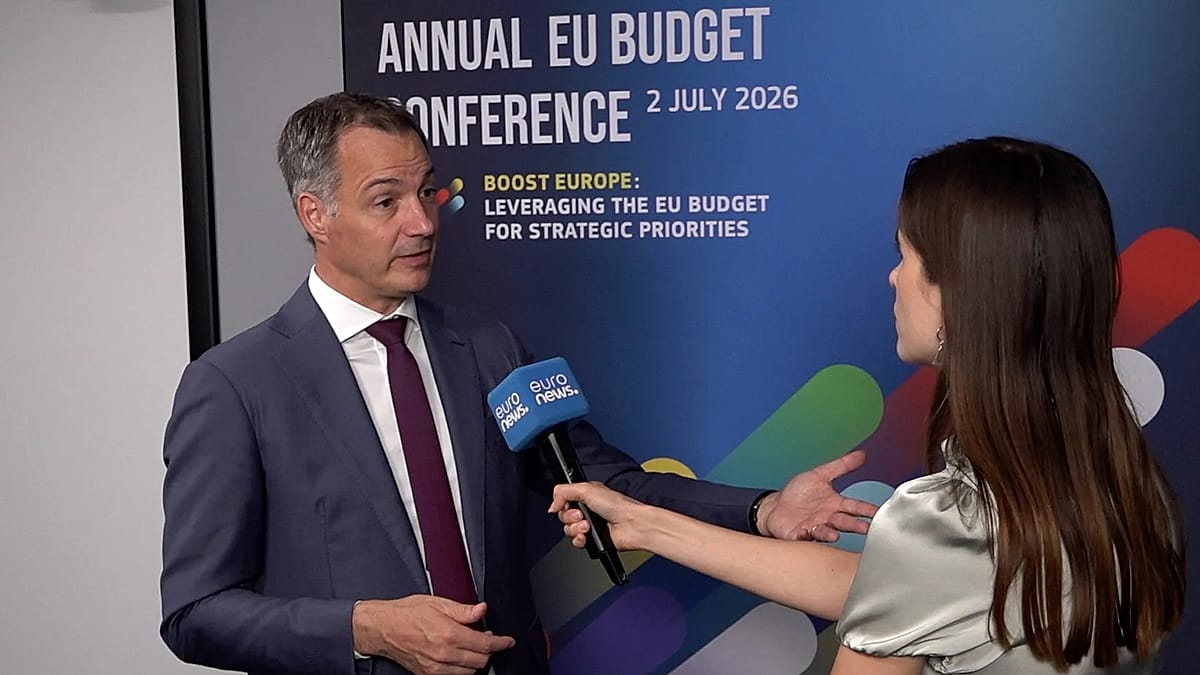
Alexander De Croo, the United Nations Development Programme (UNDP) administrator and former Belgian prime minister, has urged the European Union to treat defence and development aid as complementary priorities in its next long-term budget. Speaking on Euronews' Europe Today, De Croo argued that both are essential for European security and that neglecting one undermines the other.
“We see more military spending, and we totally understand that in the current circumstances,” De Croo said. “But if you want that military spending to be as effective as possible, you will also have to invest in preventing that conflict from arising.”
A Budget for Security and Stability
The European Commission proposed a €2 trillion multi-annual financial framework (MFF) for 2028–2034 last June. The plan, currently under debate by EU heads of state and due for ratification in the European Parliament by December, prioritises competitiveness and defence. Defence is allocated €131 billion, while development aid falls under broader headings like the Global Europe Instrument, worth €200 billion.
De Croo dismissed the notion that defence spending will crowd out aid. “Development is part of your security agenda, and development is also part of our economic agenda,” he said. He pointed to Ukraine’s eventual reconstruction as an example: “The faster you reconstruct after a war, the better it is for everyone, because it avoids that it becomes a protracted conflict and it creates also economic opportunity.”
This balancing act is particularly relevant as EU member states grapple with competing demands. Bulgaria has urged the EU to protect cohesion spending, highlighting the tension between defence, aid, and regional development priorities.
Ukraine and Gaza: Crises on Europe’s Doorstep
De Croo attended the Ukraine Recovery Conference in Gdańsk, Poland, this month, where European leaders pledged continued support for Kyiv. The UNDP has delivered electricity to more than 6.6 million Ukrainian civilians amid Russia’s intensified attacks on energy infrastructure, and provides support for veterans and de-mining operations.
“War is development in reverse,” De Croo said. “The human misery and the level of destruction in Ukraine is something which we deplore. The earlier it stops, the earlier we can bring human progress again.”
In Gaza, where De Croo visited in February, the situation is even more dire. A recent UN report described Israeli forces’ targeting of Palestinian children as “genocide.” De Croo, while not directly endorsing the report’s language, confirmed the devastation: “The circumstances on the ground are dramatic and I have not seen many worse places in the world than Gaza today. More than 80% of people lost their homes, live in constructions that one would not even call tents. The level of poverty is gigantic.”
He called on the Israeli Defence Forces to grant more humanitarian access for organisations like the UNDP, but acknowledged their security concerns: “The whole discussion is, can some of the material that you bring in, can it be abused (by Hamas)?”
The debate over defence versus aid spending is not unique to the EU. UK Prime Minister Keir Starmer recently unveiled an £80 billion defence plan that also emphasises technological innovation, while Albania’s NATO summit hosting is at risk due to defence spending shortfalls. These examples underscore the broader European challenge of aligning military commitments with development goals.
De Croo’s message is clear: Europe cannot afford to choose between defence and aid. In an era of overlapping crises—from war in Ukraine to instability in the Middle East—the two are inextricably linked.