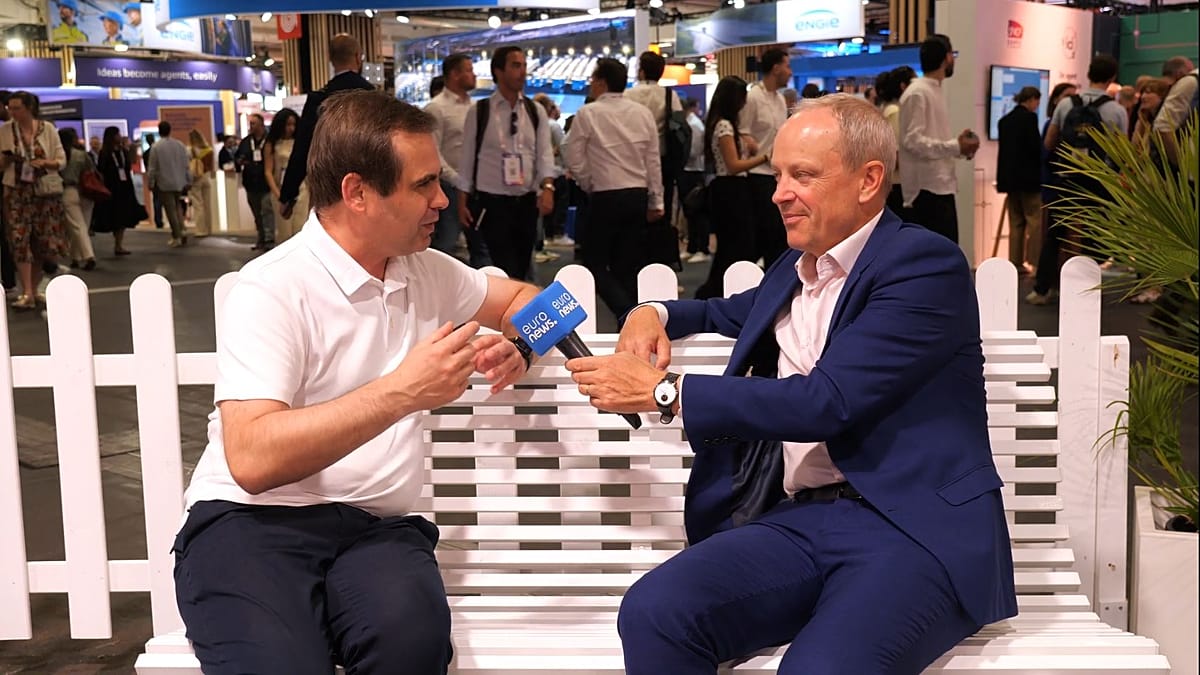
At VivaTech 2026 in Paris, Jarek Kutylowski, co-founder and CEO of the Cologne-based translation company DeepL, sketched a future where language ceases to be a barrier in international business. His vision: a meeting room where a Greek colleague speaks Greek, a Russian speaks Russian, an Egyptian speaks Arabic, and a German speaks German — and everyone hears the conversation in their own language.
Speaking with Euronews Next, Kutylowski described a world where real-time AI translation becomes as seamless as a video call. "If you are conducting an interview in Portugal, I want for you to be able to speak your language and the interview partner to be able to speak their language," he said. The goal, he added, is "a totally fluent conversation, where you both not only understand each other, but where you also feel safe and confident."
DeepL's technology is designed for everyday business use, particularly on platforms like Microsoft Teams and Zoom, where microphones and loudspeakers are already in place. "You just select the language in which you want to hear everyone... and everything else is handled magically in the background," Kutylowski explained. "You invite DeepL into your meeting."
According to a 2026 independent assessment by Slator, DeepL Voice — the company's real-time AI voice translation product — scored 96.4 out of 100 on quality, outperforming Microsoft Teams, Zoom, and Google Meet on accuracy, fluency, and reliability.
From Meeting Rooms to Conferences
Kutylowski's ambitions extend beyond small meetings. DeepL recently acquired Mixhalo, a San Francisco-based real-time, ultra-low-latency audio platform, to deploy its translation at major events like VivaTech. "The Mixhalo team has solved one of the hardest problems in live audio, which is delivering high-fidelity sound to thousands of people at once with basically zero latency," he said.
The company also aims to apply the technology to customer support and other international business workflows. Kutylowski's ultimate goal is for language to disappear entirely as a business constraint. "If you're running a French business, you can go and start selling in Germany tomorrow, and you don't have to waste a moment thinking about the German language at all," he said. "It just kind of solved transparently in the background."
This vision aligns with broader European efforts to assert AI sovereignty, as discussed at VivaTech by leaders from France and Germany. DeepL, a European champion in AI translation, is positioning itself at the center of that push.
The Limits of Translation
Despite his confidence in AI, Kutylowski is clear-eyed about its limitations. "You can't do that perfectly because certain things, it is even impossible to tell them in another culture because that culture hasn't gone through maybe some historic moments in the past," he admitted.
Born in Poland and raised between Poland and Germany, Kutylowski sees language as inseparable from culture. "It was something incredibly helpful for me to just understand these two ways of living, and these two ways of growing up," he said. That gap, he argues, is precisely why language learning still has value, even as AI improves. "It's worth learning a language because you're learning the other culture with it," he emphasized.
He compares learning languages to learning maths: schools still teach children to add and subtract by hand even though computers do it better, "because that's really essential for our growth as humans."
As for his own next language, Kutylowski has his eye on Japanese. "I think Japanese, it's a fascinating one," he said.
DeepL's vision is ambitious, but it raises a question that resonates across Europe: as AI erases linguistic borders, will it also flatten the cultural diversity that makes the continent rich? For Kutylowski, the answer is clear — technology can translate words, but it cannot translate the soul of a language.