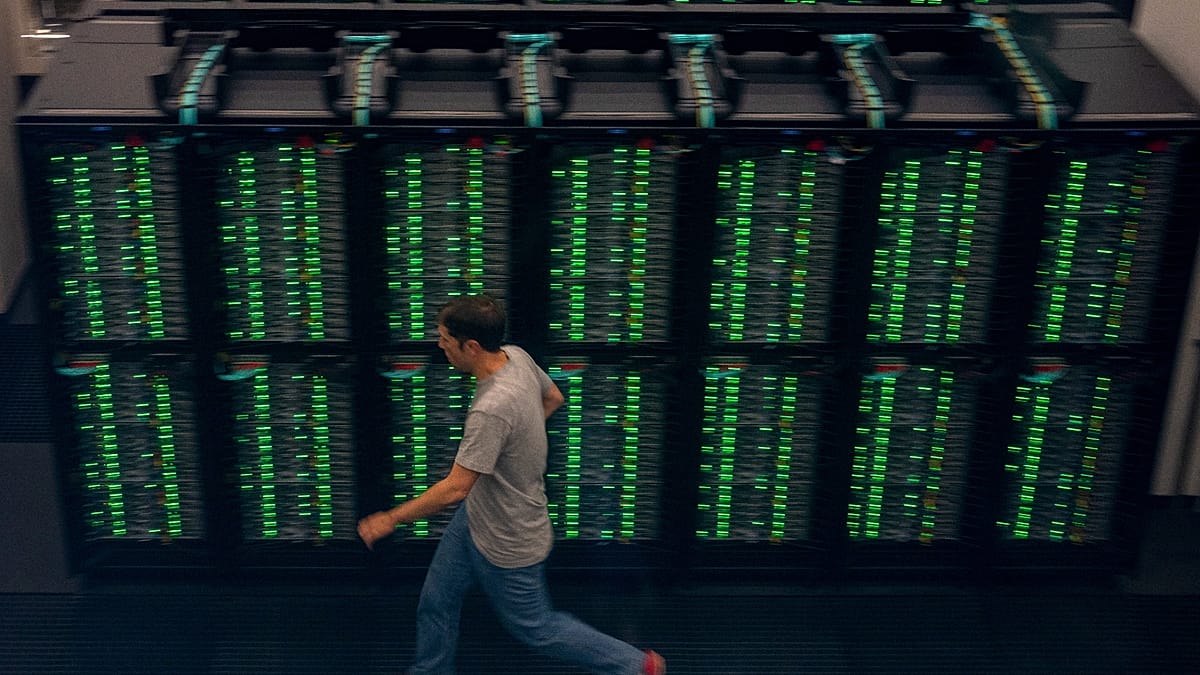
Copenhagen is doubling down on artificial intelligence infrastructure. On Tuesday, the Danish government and the Novo Nordisk Foundation announced an additional 500 million DKK (€67 million) for Gefion, one of the world's most powerful supercomputers, operated by the Danish Centre for AI Innovation (DCAI).
The investment, revealed by the Export and Investment Fund of Denmark, will support the machine's infrastructure and operations. The centre says Gefion, launched in 2024 with 1,528 Nvidia chips, is already nearing full capacity. Specific details on how the new funds will be allocated or when extra capacity will come online have not been disclosed.
This latest injection brings total public and philanthropic backing for Gefion to 1.2 billion DKK (€161 million), following an initial 700 million DKK (€93.8 million) from Denmark's state investment fund and the Novo Nordisk Foundation—the entity behind pharmaceutical giant Novo Nordisk, maker of Ozempic and other blockbuster drugs.
From computing power to economic growth
The strategic bet is that greater access to high-performance computing will translate into tangible economic benefits. Danish Minister for Business and Competitiveness Martin Lidegaard framed the investment as a catalyst for innovation and job creation.
“This gives Danish companies and researchers more computing power to translate good ideas into new solutions, companies and jobs,” Lidegaard said. “And it also strengthens our competitiveness, while ensuring that ownership of the technology of the future is not left to others.”
A key goal is to allow public institutions and private firms to harness AI while keeping control over sensitive data. To that end, Netcompany, a Danish IT firm that builds and operates public-sector systems—including for NHS England—is joining the centre's investor group. The company will contribute software for access management, monitoring, and security.
The move reflects a broader European push to secure digital sovereignty. Governments across the continent are racing to build and control the infrastructure that underpins AI development. The United Kingdom, for instance, invested £225 million (€269 million) in an AI-focused supercomputer in 2023. Finland hosts LUMI, a supercomputer jointly funded by the EU and participating countries, with a lifetime cost exceeding €200 million.
At the EU level, the European Commission in July launched a call for up to seven AI gigafactories—large data centres designed to train and run advanced models—backed by up to €10 billion in combined EU and national funding. Denmark's investment in Gefion aligns with this continental strategy, positioning the country as a hub for secure, high-performance AI in Northern Europe.
While the immediate economic impact remains to be seen, the Danish approach—combining public funding with philanthropic and private-sector involvement—offers a model for other European nations seeking to build AI capacity without ceding control to non-European tech giants. As Lidegaard put it, the goal is to ensure that the next generation of digital innovation is not left to others.