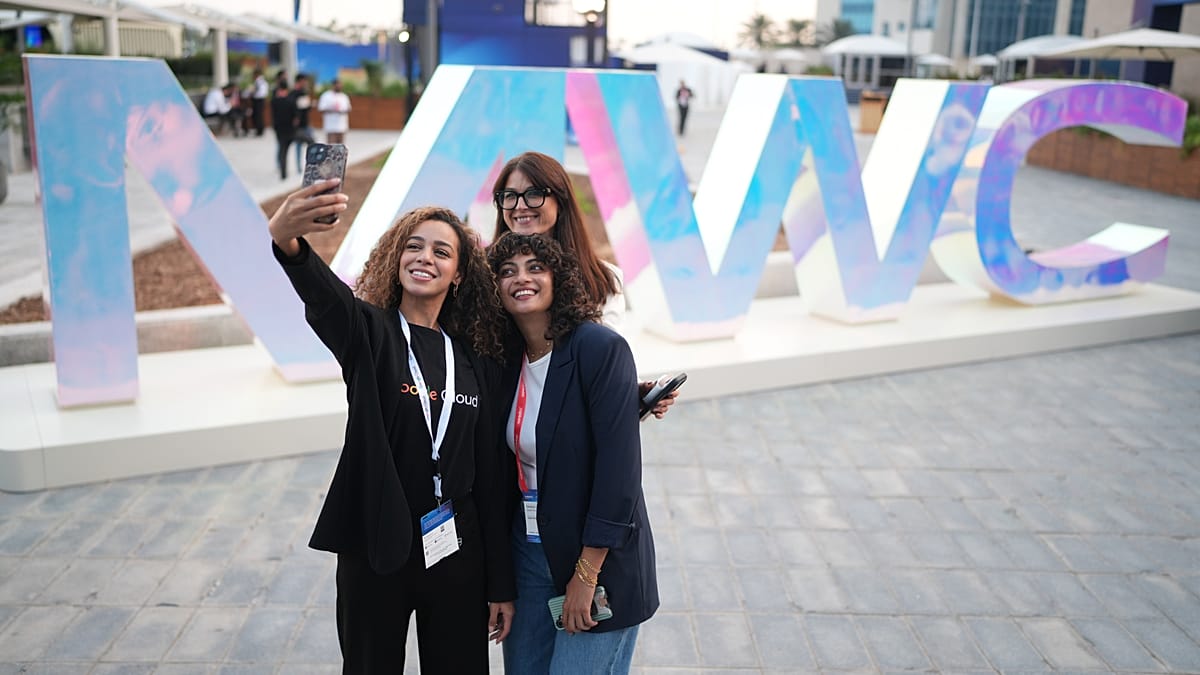
The Middle East and North Africa's mobile economy is on track to reach €421 billion by 2030, according to a new industry report. But the same study underscores a stubborn paradox: while the sector expands rapidly, nearly half the region's population still does not use mobile internet.
The GSMA's Mobile Economy MENA 2026 report, published on the opening day of MWC26 Doha, estimates that mobile technologies and services generated €340 billion in economic value in 2025. That activity supported 2.2 million jobs and contributed roughly €35.8 billion to public finances across the region.
Yet only 48% of MENA's population used mobile internet last year. The other 49% remained offline, even though they live in areas covered by mobile networks. The gap is not about infrastructure alone, but about affordability, digital literacy, and the practical ability to use the technology that is already available.
Doha at the centre of the connectivity debate
This year's MWC26 Doha carries unusual weight because it is being held alongside the International Telecommunication Union's Plenipotentiary Conference, marking the first time the two events share a venue. The convergence brings industry leaders and policymakers together at a moment when decisions on standards, digital infrastructure, and governance will shape the global digital economy for years to come.
Organised in partnership with Qatar's Ministry of Communications and Information Technology, the three-day event aims to push digital connectivity forward while also creating meaningful access for consumers. The opening-day turnout suggested resilience in the ICT sector, even as the region faces uncertainty over the future of the US-Iran conflict.
Building the infrastructure behind the AI boom
As artificial intelligence systems take on more complex tasks autonomously, the pressure on networks to provide computing power, capacity, and resilience is growing. Speaking at the opening ceremony, Qatar's Minister of Communications and Information Technology, Mohammed bin Ali Mannai, noted that the rise of AI agents is increasing the need for more robust networks and advanced computing capabilities.
GSMA Director General Vivek Badrinath framed the region's digital future as dependent not only on expanding connectivity, but also on ensuring that networks, services, and devices work seamlessly across borders and communities. “Progress only counts if everyone shares in it,” he said. “That means two things: global standards that keep networks, services and devices working across borders, and a concerted effort to connect the people who are still offline.”
In an interview with Euronews, Badrinath acknowledged that the industry had not done enough in the past year to make mobile connectivity more affordable for those who need it most. “A year ago, we were hoping to be able to bring to the market smartphones in the $50 range. That's very much impossible today with the increase of RAM prices driven by the huge demand for AI. This is an unfortunate side effect,” he said. He added that strong demand for AI is diverting resources away from entry-level phone production.
Investment forecasts remain encouraging. GSMA projects that operators will invest around €80 billion across MENA between 2025 and 2030. But the challenge is ensuring that these investments translate into services that people and businesses can actually use.
Quantitative AI: the next frontier
Connectivity is the foundation for most AI functions, but the technology is moving beyond chatbots and content generation into fields like scientific research, healthcare, materials science, and energy. Jack Hidary, CEO of SandboxAQ, told Euronews that quantitative AI approaches can tackle complex problems that traditional methods struggle to solve.
“The second bucket of AI is AI for the physical world, for the real world. We look at biomedicine, energy, financial services, these big sectors are really areas for LQM and LLMs, so it's great to see the convergence of these two now,” Hidary said. Fresh from a recent deal with Anthropic and a €449 million R&D award from the US Commerce Department, he believes these milestones will give his company leverage to innovate further. “It's a very exciting new award that we got to focus on batteries, on magnets, on the things that we need to produce semiconductors in the United States so that we can really power the economy,” he added.
Narrowing the digital divide
Extending network coverage alone will not prevent a second digital divide if governments and policymakers do not address barriers like smartphone affordability, data package costs, and the skills needed to use digital services. These barriers are becoming more consequential as AI reshapes industries and workplaces, potentially leaving behind those without the tools or training.
Abeer Shakweer, Assistant Resident Representative and Inclusive Growth and Innovation Team Leader at UNDP Egypt, echoed GSMA's call for growth that benefits all segments of society. “Globally, women, persons with disabilities, people in remote and rural areas, and vulnerable groups are often the last to benefit from digital advances,” she said. “We need deliberate policies to ensure that the digital economy is inclusive.”
The report's findings resonate beyond MENA, as similar patterns of uneven access are visible in parts of southern Europe and the Balkans. For European policymakers, the lessons from Doha may be relevant to ongoing efforts to close the digital gap within the EU, particularly in rural areas. As the continent pushes forward with its digital agenda, the experience of MENA offers a cautionary tale about the limits of infrastructure-led growth.