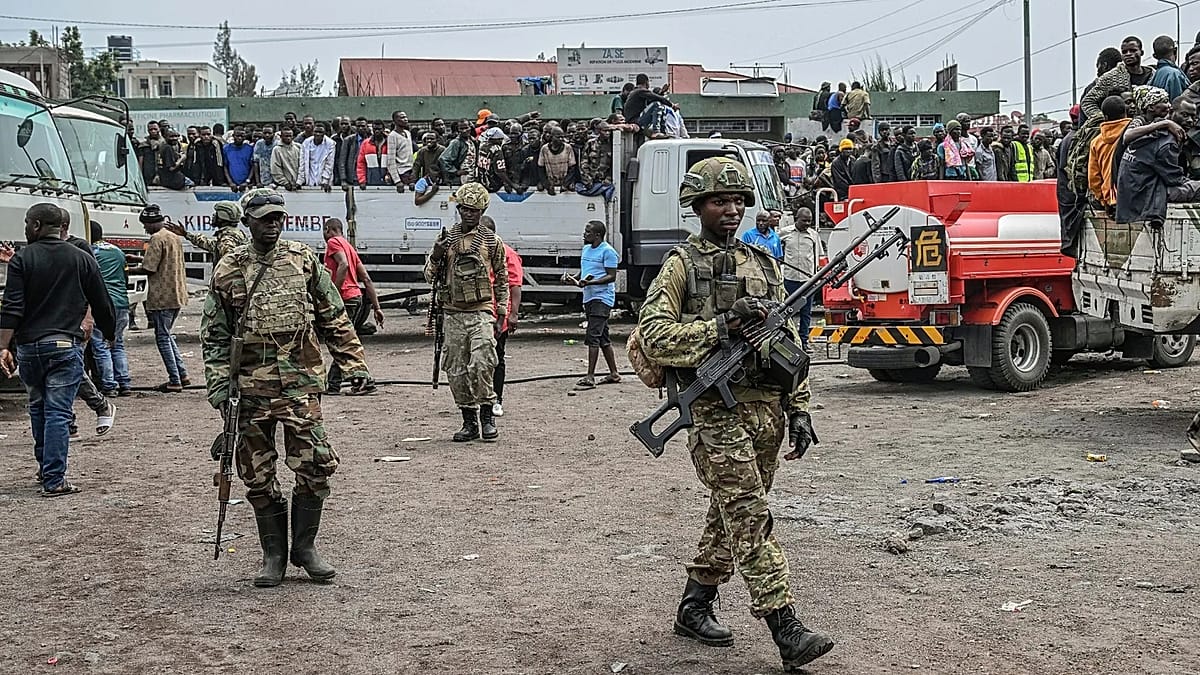
Negotiators for the Democratic Republic of Congo and the Rwanda-backed M23 rebel group have reached agreement on a roadmap for continued peace talks, according to a joint statement released on Sunday. The talks, hosted by Switzerland, took place behind closed doors from 17 to 21 August in a fresh attempt to end decades of instability in the country's mineral-rich east.
The statement, published by the Swiss government, said the two sides had "developed a roadmap setting out sequenced steps and timelines for negotiations under the Doha Framework Agreement and committed to flexibility and creativity within the existing structure." They also "reaffirmed their commitment to pursue negotiations towards comprehensive peace and conflict resolution through the implementation of the Framework Agreement."
The agreement builds on a US-brokered framework signed in Doha last year, but fighting has continued in North and South Kivu, where M23 has seized large territories and displaced hundreds of thousands of people. The new roadmap is intended to give the process clearer structure, with defined stages and deadlines.
Ceasefire verification and monitoring
A key element of the roadmap is the establishment of a standardised method for reporting alleged ceasefire violations. The two sides said they had "agreed on the importance of a standardised method for reporting allegations of ceasefire violations," and a first verification mission is scheduled to deploy to Minembwa in South Kivu on Monday.
They also agreed to create a mechanism tasked with reviewing progress and addressing challenges in implementing the obligations and commitments under the Doha Framework Agreement. This body is expected to meet regularly to keep the process on track.
The talks in Switzerland brought together representatives from the United States, Qatar, Switzerland, the African Union Commission, and Togo, which served as the AU mediator. The presence of these international actors underscores the geopolitical stakes in a region that has seen interventions by multiple neighbouring countries over the past three decades.
The conflict in eastern DRC has deep roots, involving not only M23 but also numerous other armed groups, competition over coltan, gold, and other minerals, and longstanding tensions between Kinshasa and Kigali. Rwanda has repeatedly denied direct military support for M23, though UN experts have documented its involvement.
For Europe, the situation carries particular weight. Belgium, the former colonial power, has maintained close ties with the DRC, and the EU has imposed sanctions on individuals linked to the violence. The bloc has also funded peacekeeping and humanitarian efforts in the region. The Swiss-hosted talks reflect a broader European interest in stabilising the Great Lakes area, which has implications for migration, trade, and the supply of critical minerals used in European technology.
The new roadmap does not guarantee an end to the fighting, but it offers a more concrete path than previous efforts. The verification mission in Minembwa will be an early test of whether both sides can honour their commitments on the ground.
Observers note that the Doha framework, while imperfect, remains the only internationally backed negotiation channel between Kinshasa and M23. The addition of a monitoring mechanism could help build confidence, but the underlying issues—land rights, citizenship, and the role of Rwanda—remain unresolved.
As the process moves forward, the international community will watch closely. The next steps will be crucial: whether the verification mission is allowed to operate freely, whether both sides refrain from major offensives, and whether the roadmap's timelines are respected. For the millions of civilians caught in the crossfire, the stakes could not be higher.