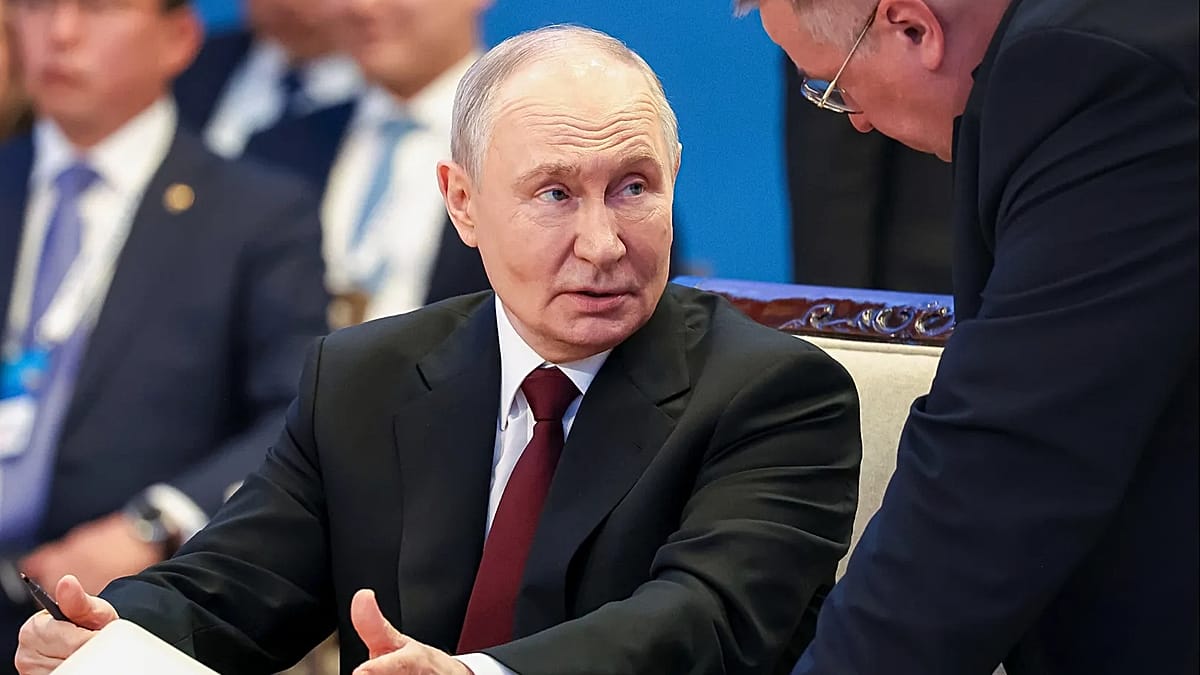
At a summit in Astana on Friday, leaders of the Russia-led Eurasian Economic Union (EAEU) issued a joint statement urging Armenia to hold a national referendum on whether to remain in the bloc or pursue membership in the European Union. The demand comes just weeks before Armenia’s pivotal 7 June elections, which are shaping up to be a geopolitical turning point for the South Caucasus.
The EAEU—comprising Russia, Belarus, Kazakhstan, and Kyrgyzstan—warned that Armenia’s EU accession plans pose “serious risks” to the economic security of all member states. They launched a formal review of Armenia’s membership, with a possible suspension by December if Yerevan does not clarify its allegiance.
Russian President Vladimir Putin, who has previously drawn parallels between Armenia and Ukraine, told reporters that a referendum would be “quite logical … to ask the Armenian citizens what their choice would be.” He added, “Based on that, we would make our own choice as well.” Putin also reiterated that membership in both blocs is “impossible,” citing the crisis in Ukraine as a cautionary tale.
Armenia’s Balancing Act
Armenia was represented at the summit by Deputy Prime Minister Mher Grigoryan, as Prime Minister Nikol Pashinyan campaigned ahead of the elections. Grigoryan told the gathering that Armenia “remains committed to constructive participation in the EAEU based on mutual respect, equal partnership, and consideration of all members’ national interests,” while also supporting “mutually beneficial cooperation.” Yerevan has consistently stated it does not plan to leave the EAEU but will continue its pro-EU course.
Russia’s Deputy Prime Minister Alexey Overchuk urged patience, describing the situation as “not so straightforward.”
Meanwhile, Moscow escalated economic pressure on Yerevan, announcing “temporary restrictions” on Armenian exports of certain fruits and vegetables, adding to earlier bans on mineral water, wines, and brandy. These measures are widely seen as an attempt to influence the election outcome, with the Kremlin threatening to cut off cheap gas and oil supplies vital to Armenia’s economy.
Putin claimed he told Pashinyan, “Everything that is acceptable and good for the Armenians is acceptable and good for Russia. Do as you think is good for the Armenian people.” But he warned that if Armenia moves closer to the EU, “we shall be forced to roll back all our economic activities in Armenia.”
US Endorsement and Strategic Partnership
The EAEU statement came just a day after US President Donald Trump gave Pashinyan his “complete and total endorsement” for re-election, calling him “a great friend and leader.” US Secretary of State Marco Rubio visited Yerevan earlier this week, signing a strategic partnership framework, a critical minerals memorandum of understanding, and a cooperation agreement on the Trump Route for International Peace and Prosperity (TRIPP)—a transit corridor linking Azerbaijan with its Nakhchivan exclave through southern Armenia.
Trump linked his endorsement to Rubio’s visit, saying the US and Armenia would “soon break ground” on the TRIPP corridor, which he said would “transform the South Caucasus” and open energy access from Central Asia to the US. Rubio described the critical minerals deal as “a reminder of another war President Trump helped settle,” referring to the Armenia-Azerbaijan peace agreement signed at the White House last year.
The competing pressures from Moscow and Washington underscore Armenia’s precarious position. As the 7 June elections approach, the country faces a stark choice between deepening ties with the EU and the West or maintaining its traditional alliance with Russia within the EAEU. The outcome will have significant implications for the region’s stability and for Europe’s broader geopolitical landscape.