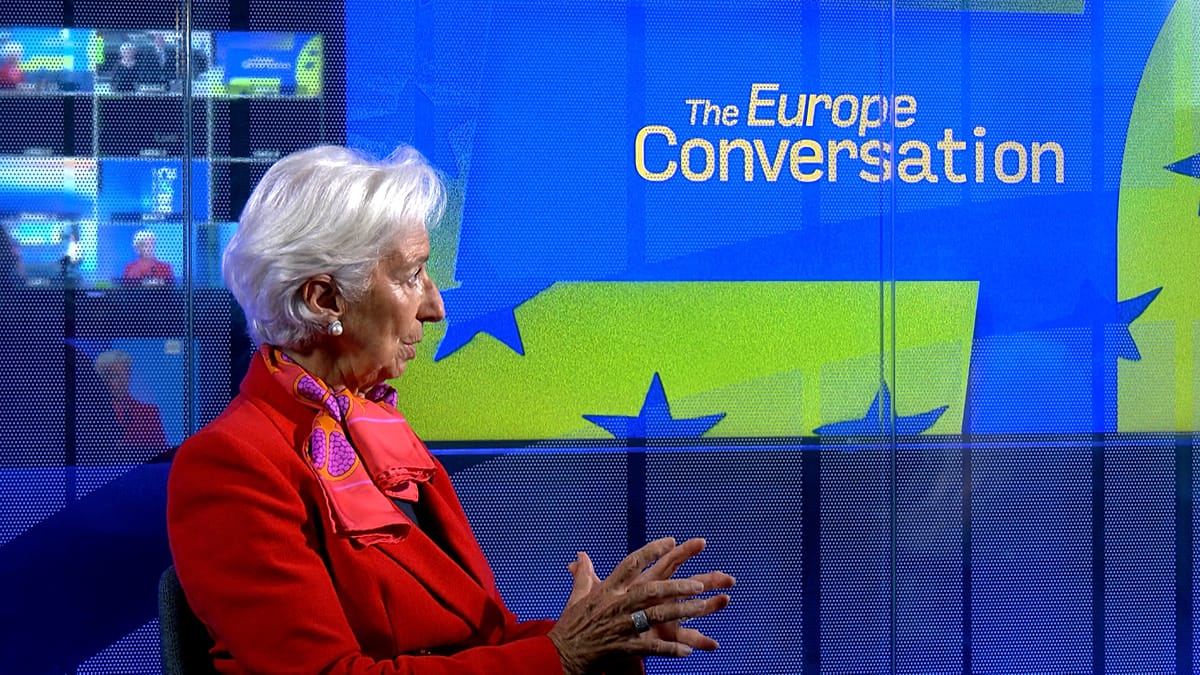
European Central Bank President Christine Lagarde has welcomed Spain's proposal for a permanent joint borrowing mechanism, telling Euronews that the plan should trigger a constructive debate among EU member states rather than reflexive opposition. In an exclusive interview, Lagarde described the Spanish initiative as a welcome departure from what she called "over my dead body" positions that have historically blocked progress on common debt issuance.
"It's great that a country like Spain, for instance, makes a proposal and puts it on the table for debate. Now it's for the others to say, 'this part we like, this part we don't like', and how that can be addressed. I think it's good to move forward," Lagarde said.
On Thursday, Spanish Economy Minister Carlos Cuerpo presented the proposal to his EU counterparts, calling for €850 billion in annual common borrowing to fund shared priorities. In separate remarks to Euronews, Cuerpo argued the plan could save billions in funding costs and reduce fragmentation in European capital markets. He expressed hope the proposal would kick-start a technical debate among member states.
The Case for a European Safe Asset
Lagarde stressed that the EU needs a financial instrument that markets perceive as safe and liquid, comparable to US Treasury bonds. "It's pretty obvious that we also need to have a European asset which can parallel with US treasury bonds, for instance," she said. "How we go about it, how the moral hazard is addressed, and how it's allocated in terms of results, to be decided."
The ECB President's comments echo those of her predecessor, Mario Draghi, whose influential report last year urged Europe to raise €800 billion in additional funding to fundamentally transform the European economy or face "a slow agony." Draghi argued that the funding should combine public and private investment.
Asked about the scale of the sums involved, Lagarde noted that the EU had already tapped markets on a similar scale through its post-pandemic recovery fund, which issued €750 billion in joint debt. "That was roughly the amount," she said. "And the Commission went to the markets, we helped in the process because we act as an agent, and it was oversubscribed." An oversubscribed bond issuance indicates investor demand exceeded supply, a strong signal of market confidence.
Lagarde also emphasized that a deep and liquid European capital market is essential to keep European savings invested in Europe rather than flowing to the United States. "To go with the capital market, you need depth, you need liquidity, and you need to entice the savings onto that market. But we need an instrument as well, and that could be one, or an elaboration, or an iteration, of that."
Political Hurdles and the Frugal Bloc
The proposal faces significant resistance from a group of fiscally conservative member states, led by Berlin and The Hague, which have argued that the post-COVID recovery fund was a one-off exception rather than a precedent for permanent joint borrowing. However, the EU is already issuing common debt through its SAFE programme, under which the European Commission raises funds on behalf of member states to finance defense spending at more favorable terms.
Lagarde urged all 27 member states to approach the debate with a spirit of compromise rather than entrenched positions. "The circumstances have changed and it should lead the leaders of the various member states to consider and to address what their concerns are. 'Over my dead body', is not the best way to deal with it. The best way to deal with it is to try to analyse what is too much of a risk and how that risk can be addressed."
The debate comes at a time of heightened geopolitical tensions and the urgent need to rearm Europe at the fastest pace since the end of the Cold War. For decades, European policymakers have considered a permanent instrument for supranational debt backed by all member states to fund common priorities, but political divisions have repeatedly stalled progress.
As the discussion moves forward, the Spanish proposal represents the most concrete attempt in years to establish a European safe asset. Whether it can overcome the objections of the frugal bloc and secure unanimous support remains to be seen, but Lagarde's endorsement signals that the ECB sees merit in the idea.