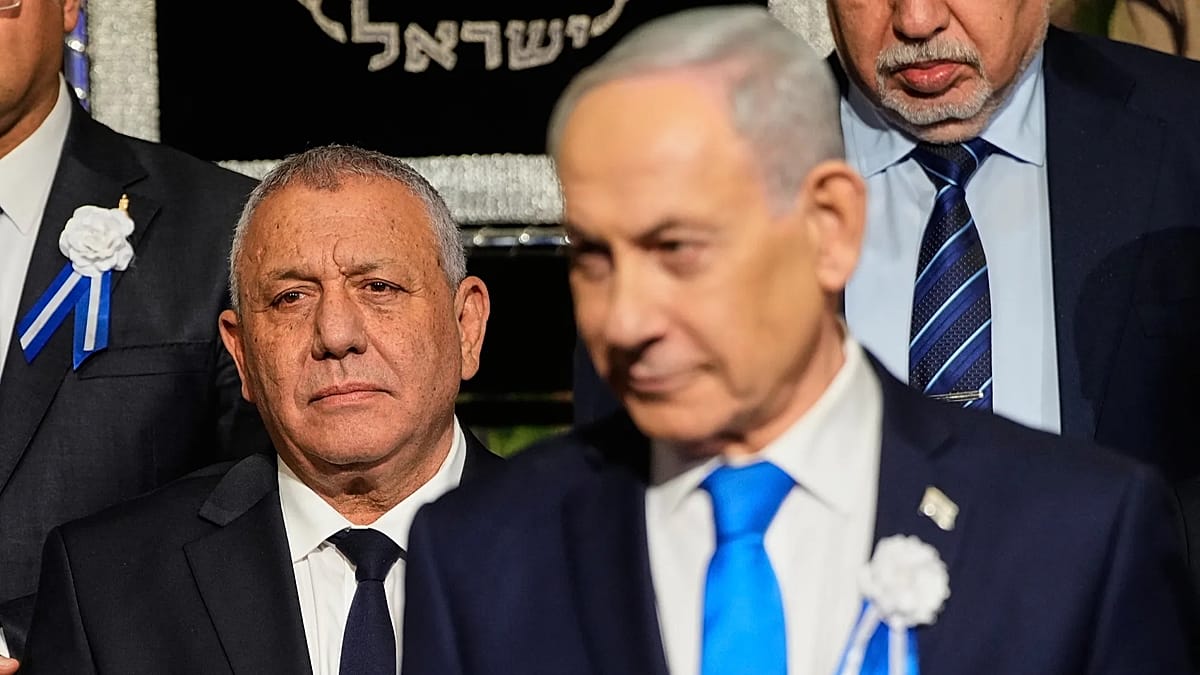
Gadi Eisenkot, leader of the centrist Yashar party, has extended an invitation to Benjamin Netanyahu's Likud for what his party describes as “marathon” coalition negotiations. The talks, set to begin on Sunday, represent a “sincere and genuine effort to form a government that is as broad as possible,” according to a statement from Yashar on Saturday.
The Israeli political landscape remains fragmented after October's legislative elections, in which neither the right-wing bloc led by Netanyahu nor the opposition under Eisenkot secured a majority in the 120-seat Knesset. Likud's camp finished with 53 seats, while Yashar and its allies garnered 48. Arab parties, which have historically been excluded from governing coalitions, won a record 19 seats, making them a potential kingmaker—though Likud has explicitly ruled out their participation.
Eisenkot, a former chief of staff of the Israel Defense Forces, has until early December to form a government. Under Israeli law, a candidate tasked with building a coalition has 28 days, extendable by the president for up to 14 additional days if necessary. The clock is ticking, and the political maneuvering has intensified.
Likud's conditions for unity
On Saturday, Likud outlined its position for a national unity government, a concept Netanyahu has championed. The party's demands include a halt to “all personal attacks and incitement” as well as political “boycotts” against Netanyahu and his government. Likud also called for a joint declaration committing to a unity government composed of “all parties that support the existence of the State of Israel as the nation-state of the Jewish people”—a formulation that effectively excludes Arab parties, which secured their highest-ever representation in the Knesset.
Eisenkot, however, has signaled skepticism about Likud's sincerity. In a social media post on Friday, he wrote: “As for the talks with the Likud, we are making sincere and genuine efforts, but unfortunately there is a wide gap between rhetoric and actions, and between the Likud's rhetoric and its actual willingness to cooperate.” He added that he intends to continue trying to “achieve a breakthrough in each of the options before us for forming a coalition that is as broad as possible,” but he does not plan to “drag this out.”
The Yashar negotiating team, for its part, has pledged to “leave no stone unturned, enable bold moves and bring about a breakthrough that will lead to the formation of a government.” The stakes are high: failure to form a coalition would likely trigger another round of elections, prolonging the political instability that has characterized Israel in recent years.
Observers note that the inclusion of Arab parties could be a decisive factor. While Eisenkot has not ruled out their participation, Likud's insistence on excluding them narrows the path to a broad unity government. The coming days will test whether the two leaders can bridge their differences or whether Israel faces yet another electoral cycle.
This political drama unfolds against a backdrop of regional and international challenges, including ongoing security concerns and diplomatic efforts. As Europe watches, the outcome in Jerusalem will have implications for the broader Middle East, a region where European interests are deeply intertwined.