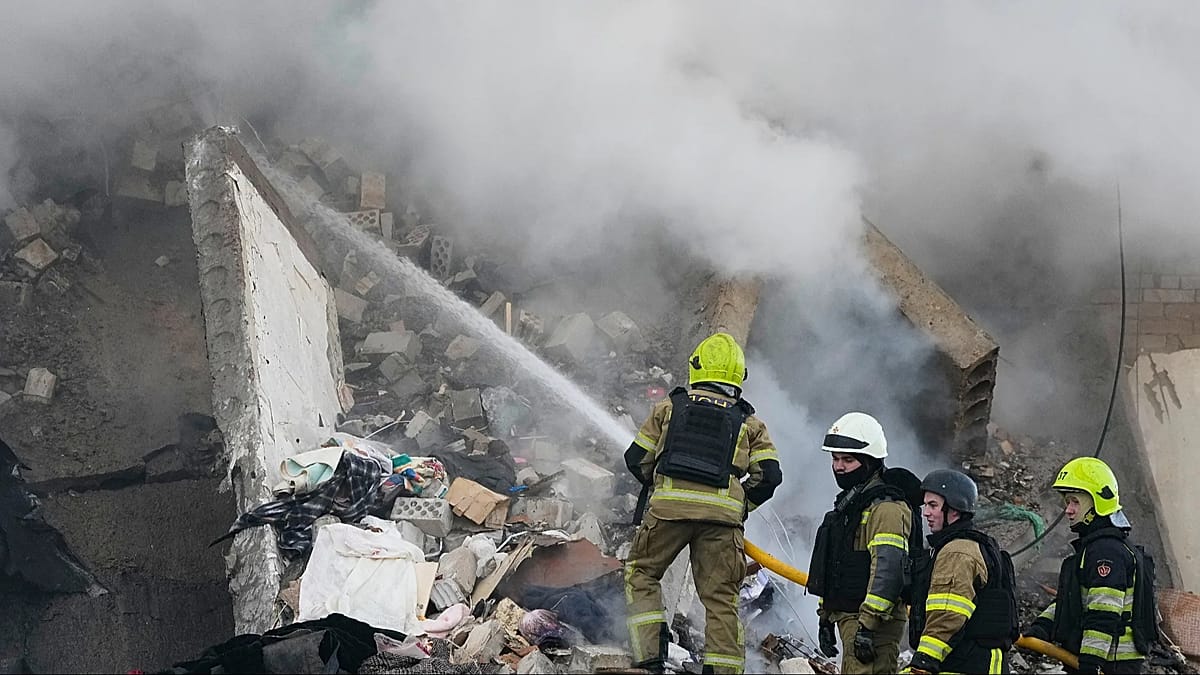
Rescue teams in the Kyiv region are combing through the wreckage of a five-story apartment building in the town of Dymer, north of the Ukrainian capital, after a Russian drone strike on Sunday left 14 people unaccounted for. Ukrainian President Volodymyr Zelenskyy confirmed the toll in a statement on X, saying that nine residents had been evacuated and the fire brought under control, but that people may still be trapped beneath the debris.
Timur Tkachenko, head of the Kyiv Regional Military Administration, said the body of one person had been recovered from the rubble and that at least three others were injured. He added that a command centre had been set up at the scene, with social workers and psychologists assisting survivors and coordinating the response.
The strike on Dymer is the latest in a series of Russian attacks that have hammered Ukrainian cities and infrastructure. From Thursday night into Friday morning, Russian forces launched more than 400 drones and over 110 missiles at targets across the country, an assault Zelenskyy described as one of the largest of the war. At least seven people were killed in Kyiv during those strikes, and key bridges over the Dnipro River were damaged.
A week of relentless bombardment
In his Sunday address, Zelenskyy detailed the scale of the week's attacks: roughly 2,700 drones, nearly 1,460 aerial bombs, and 165 missiles aimed at 20 Ukrainian regions. He noted that a significant number were ballistic missiles, including North Korean ones, which Russia is helping Pyongyang modernise to improve their accuracy. The Ukrainian leader renewed his appeal to allies to speed up deliveries of interceptor missiles, saying, "It is particularly difficult to understand the delays in supplying anti-ballistic interceptors to Ukraine." He urged Washington to authorise the transfer of interceptors already paid for through NATO's PURL initiative.
The human cost of these strikes is mounting. In a separate incident, rescue teams in Kyiv sifted through rubble after an overnight attack killed eight people. Elsewhere, a Russian missile hit Zelenskyy's hometown, killing two and wounding dozens. The attacks have also drawn international attention, with strikes damaging the Austrian and Dutch embassies in the capital, and Poland sounding air raid sirens as Russian missiles briefly entered its airspace.
As the search continues in Dymer, the broader picture remains grim. The repeated use of ballistic missiles, including those of North Korean origin, underscores the deepening military cooperation between Moscow and Pyongyang. Zelenskyy's plea for faster delivery of air defence systems reflects a growing urgency as Ukrainian cities endure near-daily bombardments.
For the residents of Dymer, a town that has seen relative calm compared to frontline areas, Sunday's strike is a stark reminder that no corner of Ukraine is safe. Emergency crews worked through the day, carefully removing debris in the hope of finding survivors. The psychological toll is evident, with social services on site to support the traumatised community.
The international community has condemned the attacks, but calls for action have yet to translate into tangible changes on the ground. As Europe watches, the need for a coordinated response to Russia's aggression becomes ever more pressing.