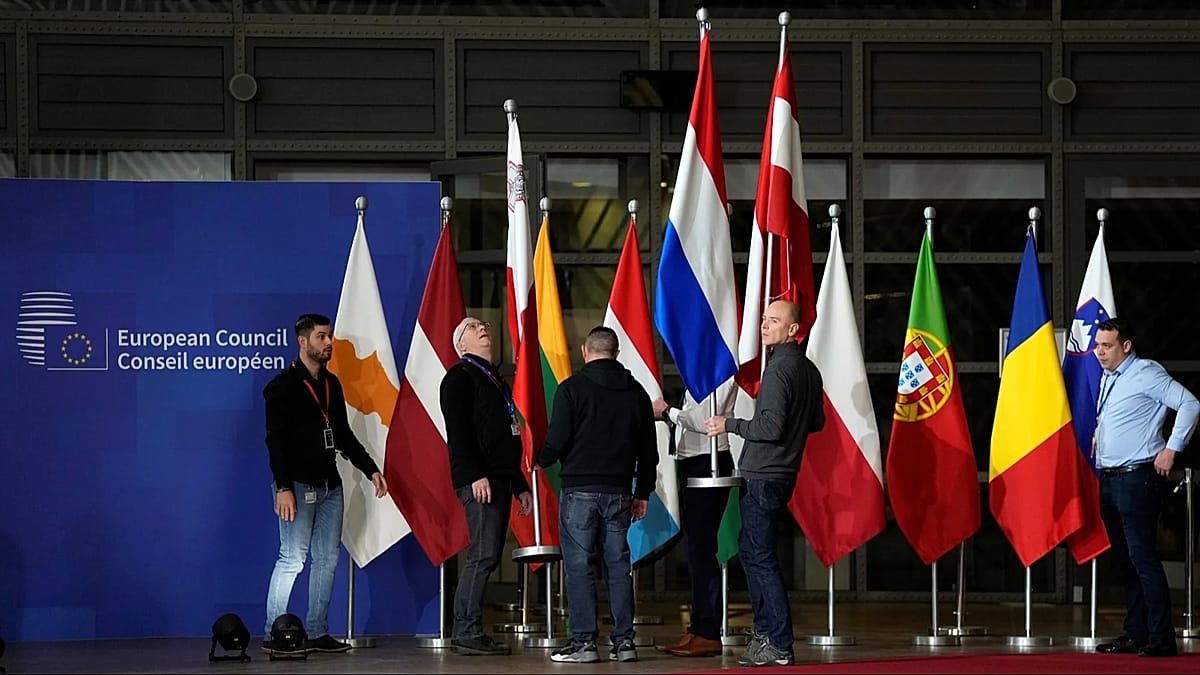
A coalition of eleven European Union member states has formally called for an end to the "obstructive" vetoes that have repeatedly stalled the bloc's external action, arguing that the principle of sincere cooperation must take precedence over the current unanimity requirement.
In a letter addressed to the EU's High Representative for Foreign Affairs, Kaja Kallas, and seen by Euronews, the countries acknowledge the value of consensus but insist it must not become a barrier to action. "The Union's culture of consensus is an important source of its legitimacy. Therefore, we continue to strive for consensus wherever possible," the letter states. "But we must also ensure that this culture of consensus fosters common action rather than preventing it – otherwise we will have legitimacy but no strength."
The signatories are Austria, Denmark, Belgium, Finland, France, Germany, Luxembourg, the Netherlands, Romania, Spain, and Sweden. Germany, the bloc's largest member, has been at the forefront of efforts to reform the EU's foreign policy decision-making.
The letter, also sent to the member states that did not sign, paints a stark picture of the current geopolitical environment. "The Union's external action faces a fundamentally changed landscape, shaped by strategic competition, growing instability and attempts to undermine the rules-based international order," the document reads. "In this environment, the Union's ability to defend its values and interests hinges on whether it can mobilise its collective political, economic and diplomatic weight quickly and effectively."
Under the EU treaties, foreign policy decisions require unanimity, meaning a single country can block the other twenty-six. This dynamic was exploited repeatedly during the sixteen-year tenure of Hungarian Prime Minister Viktor Orbán, who used his veto power to extract concessions and advance his own agenda. Earlier this year, Orbán triggered an unprecedented crisis by blocking a €90 billion loan package for Ukraine over an unrelated dispute concerning the Druzhba oil pipeline.
Five principles for reform
Drawing on the lessons of the Orbán years, the eleven countries outline five principles they believe should guide the EU's common foreign policy:
- Uphold the principles of sincere cooperation and mutual solidarity.
- Increase the use of constructive abstentions to replace vetoes.
- Refrain from linking foreign policy decisions to "substantially unrelated" matters.
- Explore options within the EU treaties to move from unanimity to qualified majority voting.
- Provide "substantiated vital reasons" to block such a move.
The letter insists that the legal framework for these principles already exists. "It is solely up to us to put them into action and thus advance our foreign policy," the signatories write.
The idea of activating the so-called "passerelle clause" under Article 31 of the Treaty on European Union – which would allow a shift from unanimity to qualified majority voting – has been debated in Brussels for years, gaining momentum after Russia's full-scale invasion of Ukraine. The switch could be applied on a case-by-case basis rather than across the board.
Proponents argue that qualified majority voting would speed up decision-making and prevent a single member state from holding the bloc hostage. Opponents, particularly smaller member states, view the veto as a vital last-resort tool to protect their national interests against the weight of larger countries. They also warn that abandoning unanimity could undermine the democratic legitimacy of EU foreign policy.
The "passerelle clause" itself presents a Catch-22: moving from unanimity to qualified majority voting would itself require unanimity, meaning opponents could block the reform. The joint letter calls for "meaningful" consultations to resolve potential disputes and reach a compromise.
The push for reform has gained traction following Orbán's electoral defeat, which many see as a window of opportunity. However, the window may close if Marine Le Pen, a staunch Eurosceptic, wins the French presidential election next year. The outcome of that vote could determine whether the EU finally overhauls its foreign policy machinery or continues to grapple with the paralysis that has characterised recent years.