Estonia, a NATO member sharing a border with Russia, fields a relatively small army. But as one of Europe's most digitally advanced nations, it is compensating with technology. Its defence industry is now producing a range of cutting-edge equipment, battle-tested in Ukraine and ready to scale: jamming-resistant drones, portable launch systems, and passive sensors that detect aerial threats.
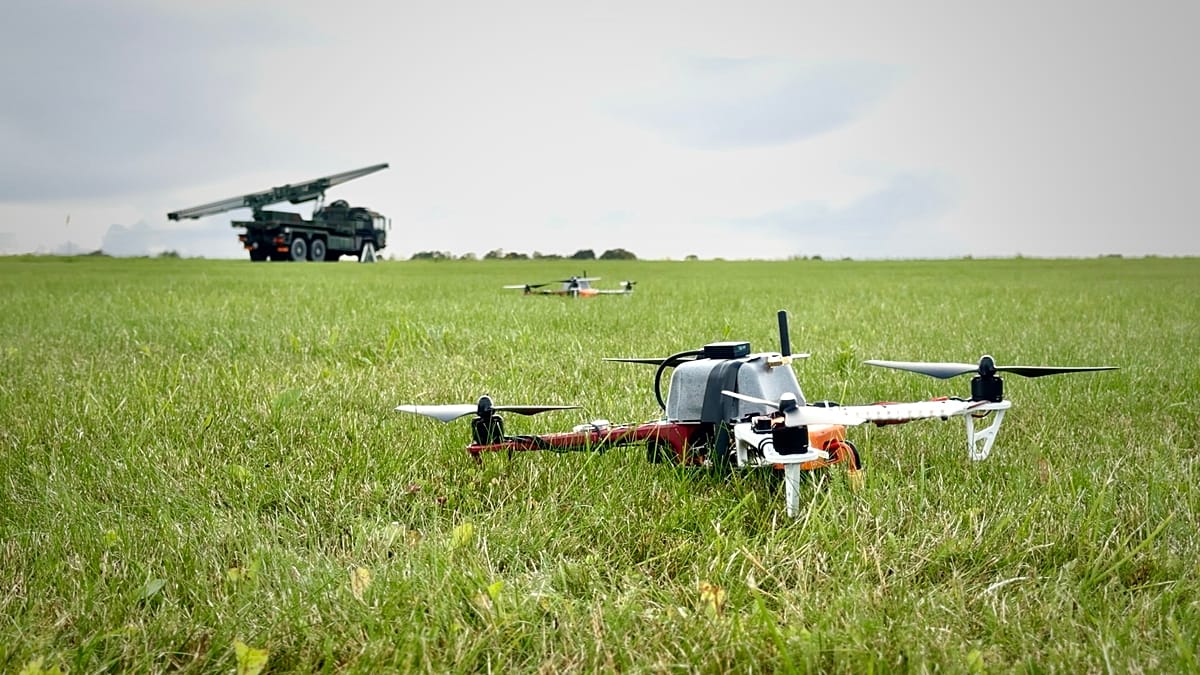
At an undisclosed location near Tallinn, Euronews Next witnessed a demonstration of these Estonian-made systems. KrattWorks showcased how a single operator can control a swarm of drones, each capable of carrying explosives. The company's philosophy is to amplify the effectiveness of every soldier.
“The Estonian army is about 40,000 strong, but the adversary is quite a lot bigger. So we need to multiply our soldier [count],” said Karmo Saar, Head of Sales at KrattWorks. In Ukraine, he noted, one operator already manages seven of their drones.
The drones are designed to operate without a constant link to their operator. “The systems we develop in Estonia are fully autonomous,” Saar explained. “If they are being jammed and the connection is lost, they have all the computing power on board and they finish the mission themselves.”
Battlefield feedback shapes design
Estonia's defence industry is almost entirely private, and many firms supply Ukraine while refining their products based on frontline feedback. Threod Systems, which makes surveillance drones, says that feedback has been transformative.
“If you lose the GPS, what will the aircraft do? Previously it mostly crashed somewhere,” said Margus Allas, Test Engineer at Threod Systems. “Nowadays, our product is that safe that it comes home — you can take it over and land safely. So that was a key feature that came from Ukraine.”
Ukrainian users also pushed the company to test in harsher conditions. “In real life we want to use the aircraft in bad weather,” Allas told Euronews Next. Operators are often exhausted and may have gone days without sleep, so the software must be simple to use.
That experience has steered Estonian firms toward flexible, lightweight, and affordable solutions. One example is the “Cata B” pneumatic catapult, also produced by Threod and widely used in Ukraine. It can be set up in minutes and needs only diesel fuel to launch drones.
Detection is as crucial as the drones themselves. Rantelon, a radio-frequency technology company, demonstrated a passive drone detector that emits no signals and only listens, making it difficult for an enemy to locate. “The advantage of being passive is that your enemy can't tell where your systems are,” said Kaspar Põder, Sales Project Manager at Rantelon. The device can track multiple drones across different radio bands, covering both military and civilian models. Põder noted applications range from border protection to critical infrastructure and large public events. “Drones are here to stay, and the market is growing,” he added.
Cheap, local, and scalable
Electric Wings Group showed a 10-inch FPV drone designed to carry a munition to its target. The drone uses radio frequencies and is “not jamming proof,” according to Jordan Vähesoo, Sales Manager at Electric Wings Group. But jammers are expensive and not everywhere, he said: “If one [drone] breaks down or gets jammed, you just open a new one from the box and you go again.”
The company can produce about 10,000 units a year now and says it can scale up from there. Frames, propellers, and motors are made in Estonia, and batteries are assembled locally. “I think it's important that every country has its own manufacturer. A lot of components right now are still coming through China,” Vähesoo said. Chinese parts are cheaper, but European tenders increasingly ask for European electronics. “I would like to see that switch,” he added.
The state is backing the push. Estonia wants to become a global hub for testing and building drones, and the government aims to triple defence industry revenue to €1 billion between 2023 and 2030. This ambition aligns with broader European efforts to bolster defence capabilities, as seen in EU defence ministers' recent talks on Ukraine aid.
The armed forces are adapting too. Hugo Urbla, Director of Operations at the Estonian Defence Forces' Force Transformation Command, told Euronews Next that Ukraine has shown how cheaply damage can now be done. “A bang has become cheaper, because it costs [just] a few euros to fly something now,” he said.
The Force Transformation Command coordinates cooperation between the armed forces, industry, research institutions, and international partners. “Things that are produced by Estonian companies, be it for dual use or for only military purposes, are being actively tested by the Defence Forces on major exercises but also on a day-to-day basis,” Urbla said. “This does not mean that these systems are off-the-shelf ready. A technological system will always need direct feedback from soldiers who are using it. Only this way can the system actually become one that is worth something to a soldier.”
Estonia's approach offers a model for other European nations looking to enhance their defence industries. As the continent grapples with security challenges, the emphasis on innovative technology and local production is gaining traction. The Baltic state's experience on the front line of digital defence could prove invaluable for the wider European security architecture.