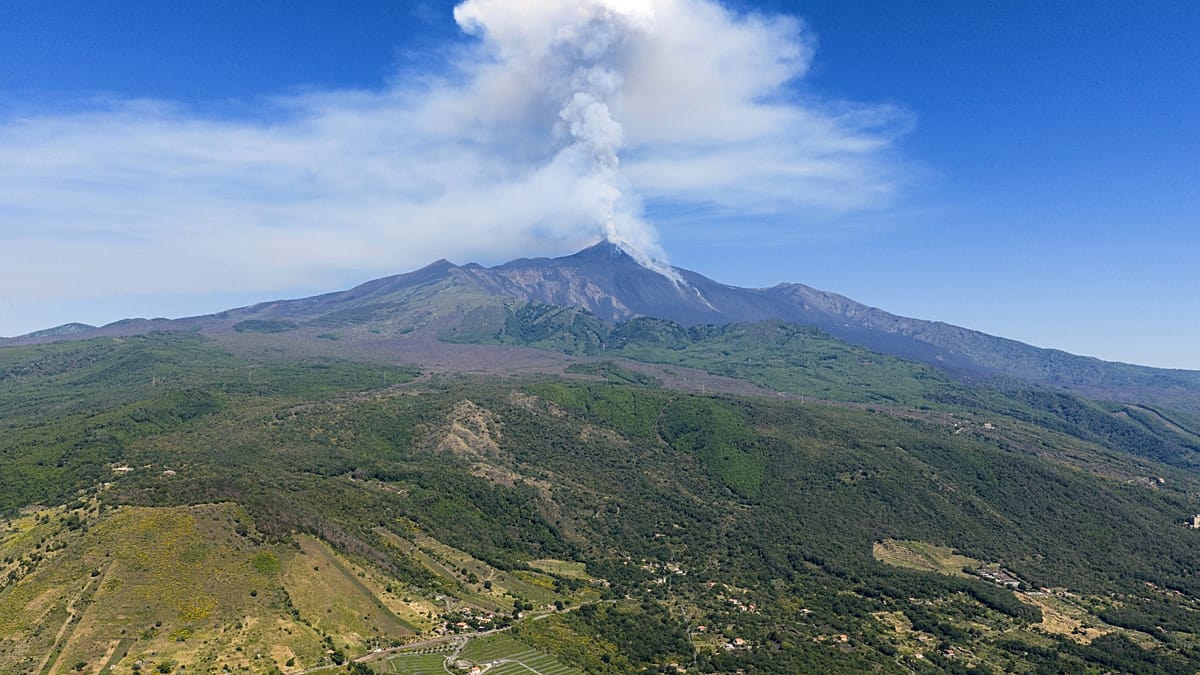
Catania's Vincenzo Bellini Airport has halted all incoming flights until 17:00 on Monday, 10 August, as Mount Etna's ongoing eruption sends a plume of volcanic ash across Sicilian airspace. The airport operator, Sac, announced the measure in a statement, citing the need to close the affected airspace to protect aircraft from ash ingestion.
Sac described the situation as having a "severe operational impact" and urged passengers not to come to the airport without first checking their flight status directly with their airline. The company added that the situation is being continuously monitored, with further updates to follow depending on how the volcanic activity and weather conditions evolve.
Volcanic activity remains intense
Etna's activity has been disrupting operations at the airport for days, with the volcano alternating between different phases, including explosive eruptions at the Voragine crater. On Sunday, the Italian news agency Ansa reported that during the most intense phases, volcanic "bombs" can be observed falling in the summit area, along with abundant ash emission. The ash is currently dispersing towards the south-south-east.
According to Ansa, vents at 2,750 and 2,360 metres above sea level are active, feeding multiple lava flows that are forming complex lava fields, in places overlapping in the barren Valle del Bove and Valle del Leone. Due to weather conditions, the exact position of the most advanced active fronts could not be determined, but they remain confined around 2,100-1,850 metres.
The disruption at Catania is the latest in a series of travel headaches across Europe this summer. While the ash cloud is a natural phenomenon, it adds to the operational pressures faced by airports and airlines already dealing with security incidents and drone scares at other European hubs.
Passengers with bookings to or from Catania are advised to contact their airlines for rebooking options. The airport's operator has stressed that the situation is fluid and that the resumption of arrivals will depend on the volcano's behaviour.
Etna, one of Europe's most active volcanoes, frequently disrupts air travel in the region. Its eruptions are closely monitored by Italy's National Institute of Geophysics and Volcanology (INGV), which provides real-time data to aviation authorities.
The suspension of arrivals at Catania is a reminder of how vulnerable European travel can be to natural events. As the continent's airports grapple with recurring security challenges, the volcanic ash adds another layer of complexity to the summer travel season.
For now, the airport remains open for departures, though passengers are urged to verify their flight status before heading to the terminal. The situation is expected to be reassessed later on Monday, with updates from Sac and the Italian civil aviation authority.