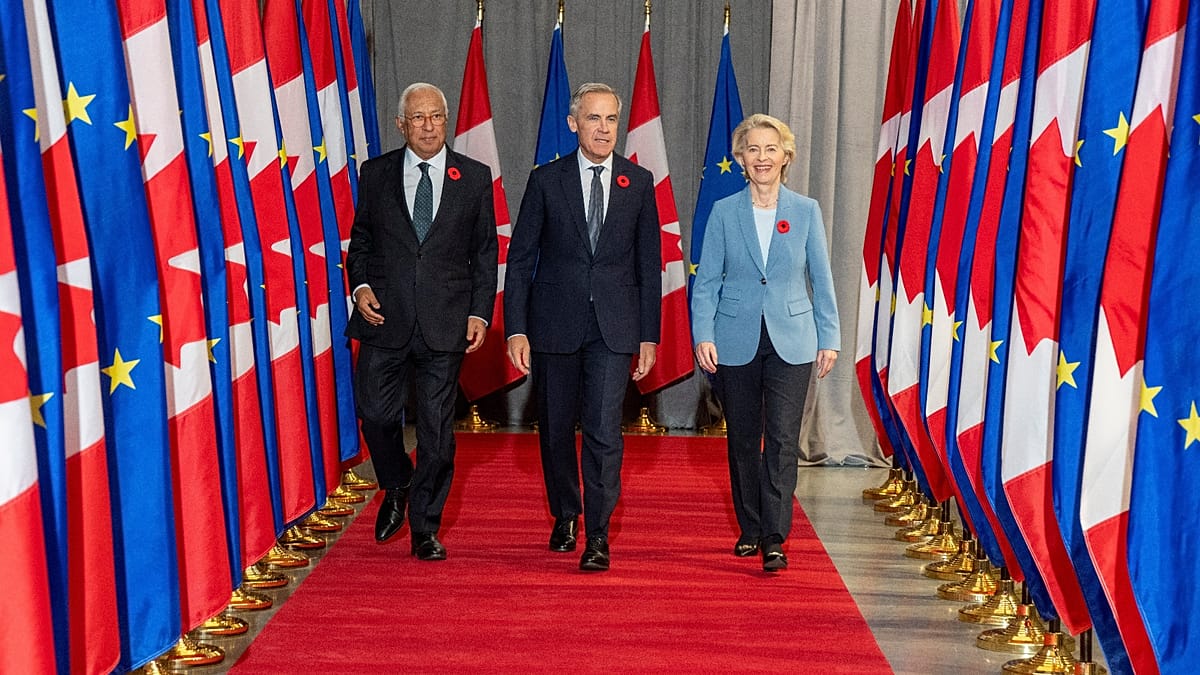
The European Union and Canada have long been natural partners, bound by shared values and a commitment to democracy. That relationship is now entering a new phase, with concrete cooperation expanding across trade, critical minerals, defence, and education. As Canadian Prime Minister Mark Carney told the European Parliament: “Our commitment to the rule of law, and our unyielding defence of human dignity, individual freedom, and democracy share the same deep roots, the same unwavering dedication.”
Those values are translating into tangible results. Since the provisional application of the Comprehensive Economic and Trade Agreement (CETA), bilateral trade in goods and services has grown by around 80%, from €72.1 billion in 2016 to €130 billion in 2025. The agreement has opened new markets for European businesses and Canadian exporters alike, and both sides are keen to build on that momentum.
Critical minerals and defence: a strategic partnership
One of the most promising areas for deeper cooperation is critical raw materials. Europe is seeking to reduce its dependence on China for minerals essential to batteries, semiconductors, defence, aerospace, renewable energy, and telecommunications. Canada, with its abundant resources and democratic governance, is an ideal partner. It is a major producer of uranium, cobalt, nickel, and zinc, and the world's leading producer of potash.
Defence and security are also high on the agenda, particularly in light of Russian aggression. Canada has stood firmly with Ukraine and contributes directly to European security through its leadership of NATO operations in Latvia. Its defence spending reached 2.0% of GDP this year, with a federal budget path towards more than 4% by the end of the decade—a commitment that brings it closer to the level of investment seen in frontline allies like Poland.
Earlier this year, Canada became the first non-European country to join the €150 billion defence procurement instrument, SAFE. While this is a significant step, more remains to be done to integrate Canada into European defence markets and industry development. The shift of German auto suppliers to defence illustrates the broader trend of European industry adapting to new security realities.
Education and research: new horizons
Education offers another avenue for mutual benefit. Canada consistently ranks among the strongest OECD countries in international assessments, outperforming most EU member states in science and reading in PISA 2025. To deepen this relationship, Canada is poised to become the first non-European country associated with the Erasmus+ exchange scheme, following the launch of formal negotiations at the recent Canada-EU Summit in Montréal. This would open up study and training opportunities for thousands of students on both sides of the Atlantic.
Research cooperation is also advancing. In 2024, Canada became associated with Pillar II of Horizon Europe, which supports collaborative research across a wide range of scientific and technological fields. While this is an important milestone, negotiations are underway to strengthen Canada's participation further, and the European People's Party (EPP) fully supports closer integration.
The human ties between Europe and Canada are deep. Generations of Europeans have made Canada their home, contributing to Canadian society while maintaining links with their countries of origin. These communities help sustain cultural connections, facilitate business, and create opportunities for younger generations to study and work on both sides of the Atlantic.
The case for a stronger EU–Canada partnership is clear. From critical minerals and trade to defence, education, and research, there is considerable scope to work together. As the strongest political force in the EU, with majorities in the Commission, the Council, and the Parliament, the EPP is an effective broker. “We are determined to drive the renewed political momentum between the EU and Canada forward,” say four EPP members in the European Parliament. In an increasingly uncertain world, Europe and Canada have every reason to stand together.