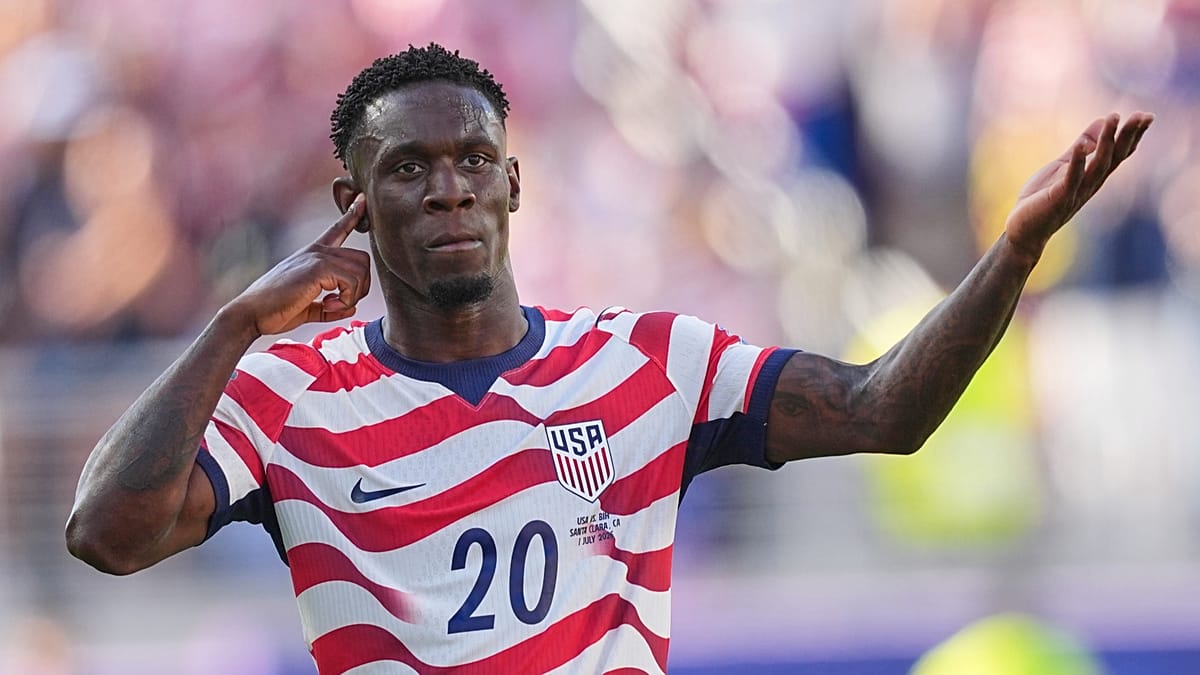
The European Commission has weighed in on the controversy surrounding FIFA's decision to overturn a red-card suspension for US striker Folarin Balogun, urging the global football body to uphold principles of fair play and transparent competition. The reversal, which came after a direct phone call from US President Donald Trump to FIFA President Gianni Infantino, has triggered widespread criticism across Europe, particularly in Belgium.
"We respect the autonomy of sports," a Commission spokesperson said on Monday in response to a question from Euronews. "We respect the right of sport federations to decide on the criteria under which participants compete. And any such decision should obviously be made on a set of objective, transparent criteria. We support the principle of fair play and transparent competition."
While the spokesperson declined to comment on Balogun's specific case, the remarks are widely seen as an implicit rebuke of FIFA's handling of the matter. The controversy erupted after Trump called Infantino and asked him to undo Balogun's one-match ban, which had been triggered by a straight red card for stepping on the foot of a Bosnian defender during a round-of-32 match. Under FIFA rules, such a ban is automatic and cannot be appealed by the player's team.
FIFA stunned fans on Sunday by announcing that the suspension would be suspended for a year, allowing Balogun to play in the US's knockout match against Belgium. Trump later thanked Infantino for "reversing a great injustice."
European Outrage and Political Fallout
The decision has provoked fury across the continent, with the Belgian Football Federation launching a formal challenge against Balogun's eligibility. UEFA described the reversal as "unprecedented, incomprehensible and unjustifiable." The anger was particularly intense in Brussels, where the European Commission is headquartered and where many fans see the move as a blatant example of political interference in sport.
Commissioner Glenn Micallef, whose portfolio includes sports, was more scathing in his condemnation. "I have always been clear. Decisions on sporting rules and sporting matters belong to sporting bodies, not politicians. Influencing sporting decisions would undermine the autonomy of sport," Micallef wrote on social media. "Our focus should instead be on the real governance challenges facing sport, including the weaponisation of sport for political purposes."
It is highly unusual for the European Commission to comment on football events, but the scale of the backlash has forced the institution to respond. The incident has also reignited debates about the integrity of international sports governance, with critics pointing to the growing influence of political figures in decisions that should be left to independent bodies.
For Belgian fans, the timing could not be worse. The Red Devils are preparing for a crucial knockout clash against the United States, and the prospect of facing a player whose ban was overturned by a presidential phone call has added a bitter edge to the match. Belgian fans have voiced their frustration, questioning the fairness of a system that appears to bend to political pressure.
The controversy also highlights broader concerns about the relationship between sport and politics. The European Commission's call for transparency echoes similar demands in other areas, such as EU pay transparency rules that aim to expose systemic inequalities. In this case, the demand is for clear, objective criteria in disciplinary decisions, free from external interference.
As the World Cup continues, the Balogun case serves as a stark reminder of the challenges facing international sports bodies. For the European Union, the message is clear: the autonomy of sport must be respected, but so must the principles of fairness and transparency that underpin it.