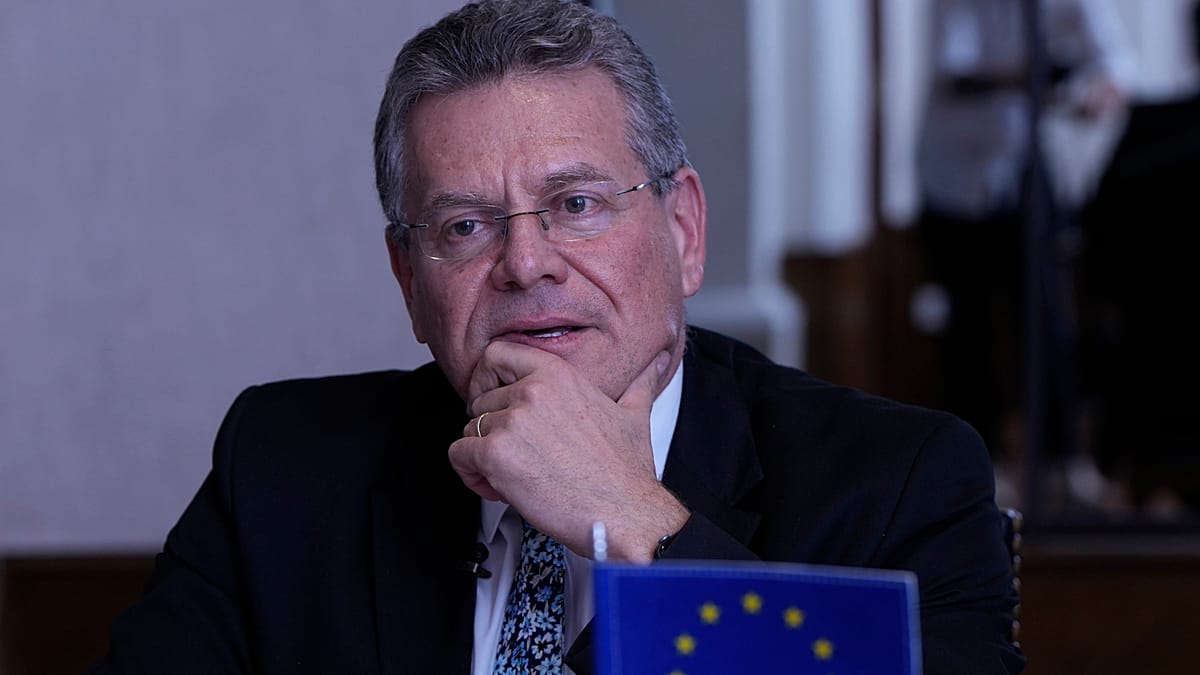
EU Trade Commissioner Maroš Šefčovič touched down in Beijing on Thursday for what Brussels hopes will be a decisive round of negotiations with Chinese officials. The stakes are unusually high: the European Union is running a record trade deficit with China of roughly €1 billion a day, and low-cost Chinese imports are putting pressure on entire industrial sectors across the bloc.
Šefčovič’s mandate is to secure concrete commitments from Beijing to rebalance the trading relationship. The European Commission is pushing for product quotas that would limit Chinese imports into the EU, but China has already rejected the idea of so-called “voluntary export restrictions” on electric vehicles. That leaves Brussels with limited room for manoeuvre, and the commissioner is under pressure to return with tangible results before EU leaders gather in Brussels next week.
Rare earths: China’s leverage
One of the most sensitive issues is rare earths. China controls the vast majority of global production and processing of these critical minerals, which are essential for green technology, defence, and the automotive industry. This gives Beijing significant leverage in the talks, as it has demonstrated in the past by using export controls to assert its dominance—most notably during its trade war with the United States in 2025.
The EU is seeking to secure access to rare earth imports while simultaneously reducing its dependence on Chinese goods. It is a delicate balancing act, and Šefčovič’s task is made harder by the fact that every EU member state now records a trade deficit with China. The commissioner’s discussions in Beijing are expected to focus on market access, intellectual property, and the possibility of a more structured dialogue on trade imbalances.
Analysts note that the EU’s approach is complicated by internal divisions. Some member states, particularly France and Germany, have been pushing for tougher measures against China’s trade practices, while others are more cautious about provoking a response from Beijing. The European Parliament has also urged a more assertive stance, calling for a unified strategy that links trade with broader geopolitical concerns, including Ukraine.
UK seeks a place in European supply chains
Before heading to Beijing, Šefčovič met with UK Minister for European Relations Hamish Falconer in Strasbourg. Falconer used the occasion to warn that Europe risks weakening its own industries if the UK is excluded from European supply chains as a result of the EU’s “Made in Europe” policy. The EU is considering introducing preferences for European manufacturers in public contracts, a move designed to shield domestic industries from unfair foreign competition.
Prime Minister Andy Burnham, who has opened the door to the UK’s re-entry into the EU, is pushing for UK industries to be treated as European under the scheme. “I think it is vital that we don't do things to make European industry weaker,” Falconer said. “It would not be in either of our interests to see new barriers arising in our economic relations.”
The UK’s plea highlights the interconnectedness of European supply chains and the potential unintended consequences of protectionist measures. As the EU seeks to bolster its strategic autonomy, it must also consider the impact on its closest neighbours.
Spain mourns Maricarmen, and politics shifts
In Spain, the death of Maricarmen Abascal has sent shockwaves through the country. The 87-year-old, whose eviction from her Madrid home in late September triggered widespread protests and prompted Prime Minister Pedro Sánchez to call a snap election, died in hospital on Wednesday. Her passing has intensified public anger over the housing crisis.
Demonstrators camping on Madrid’s Puerta del Sol lit candles in her memory, and the Madrid Tenants' Union issued a statement saying that “although a historic agreement was reached that would have allowed her to return home, this solution came too late. It was an entirely avoidable situation following a harrowing ordeal.”
The political fallout is likely to be significant. Sánchez called the November 29 election as a gamble, hoping to mobilise left-wing voters by putting housing at the centre of the debate. Maricarmen’s death could now reshape the campaign, with housing activists and opposition parties demanding more radical action.
Rubio’s Athens warning draws protests
US Secretary of State Marco Rubio, speaking from the base of the Acropolis in Athens, urged European and Western allies to return to their “civilisational roots.” He criticised the fashion for prioritising the “global community” over one’s own people, saying that “there was nothing selfish or wrong about fighting to defend its interests above all else.”
His visit, part of a three-leg tour that began in Iceland and will end in Portugal, was met with protests. Around 1,500 demonstrators gathered in the Greek capital, and the trip was overshadowed by allegations of misconduct against US Ambassador to Greece Kimberly Guilfoyle. Senior US lawmakers have accused her of suggesting that Washington could bring down foreign governments, a claim that has added to diplomatic tensions.
Albania’s EU path under scrutiny
Meanwhile, the EU’s justice chief Michael McGrath is in Albania today, meeting Prime Minister Edi Rama. McGrath’s message is that “there is still important work to do” on reforms, particularly in the areas of judicial independence, anti-corruption, and the rule of law. “Albania needs strong checks and balances,” he said.
Tirana is considered a frontrunner in the EU accession queue, but has often struggled to implement the required reforms. The EU is now proposing new institutional “safeguards” to prevent any new members from backsliding on core values, which could include suspending voting rights for up to 15 years after accession. These measures are part of a broader effort to ensure that enlargement does not weaken the bloc’s internal cohesion.
As Šefčovič’s talks in Beijing unfold, the EU is walking a tightrope between defending its economic interests and maintaining constructive relations with a major trading partner. The outcome of these negotiations will have far-reaching implications for European industry, supply chains, and the bloc’s global standing.