Across southern Europe, the cost-of-living crisis drew thousands onto the streets on Saturday, with coordinated marches in Lisbon, Paris, Barcelona and Madrid underscoring a continent-wide frustration over wages, housing and public services.
In Portugal, the capital's main demonstration was organized by the CGTP-IN, the country's largest trade union federation. Despite heavy rain, workers from across the country converged on Lisbon, with special trains from Porto and buses from Aveiro and Faro bringing protesters to the center. The union is demanding higher wages and pensions, lower prices for essential goods, and urgent measures to make housing affordable.
“They talk about the economy, but they don’t know what it’s like to stretch every penny to pay the rent and electricity bills. They don’t know what it’s like to have to choose between buying medicine and putting food on the table,” the CGTP-IN said in a campaign video shared on its Facebook page.
Many demonstrators said their salaries no longer cover everyday expenses, particularly housing, food and energy. The protest also targeted the government's proposed 2027 state budget, which critics argue fails to address the squeeze on households. The union has called another rally outside the Assembly of the Republic for Tuesday, 24 November, when the budget faces its final vote.
France: sixth Saturday of protest, lower turnout
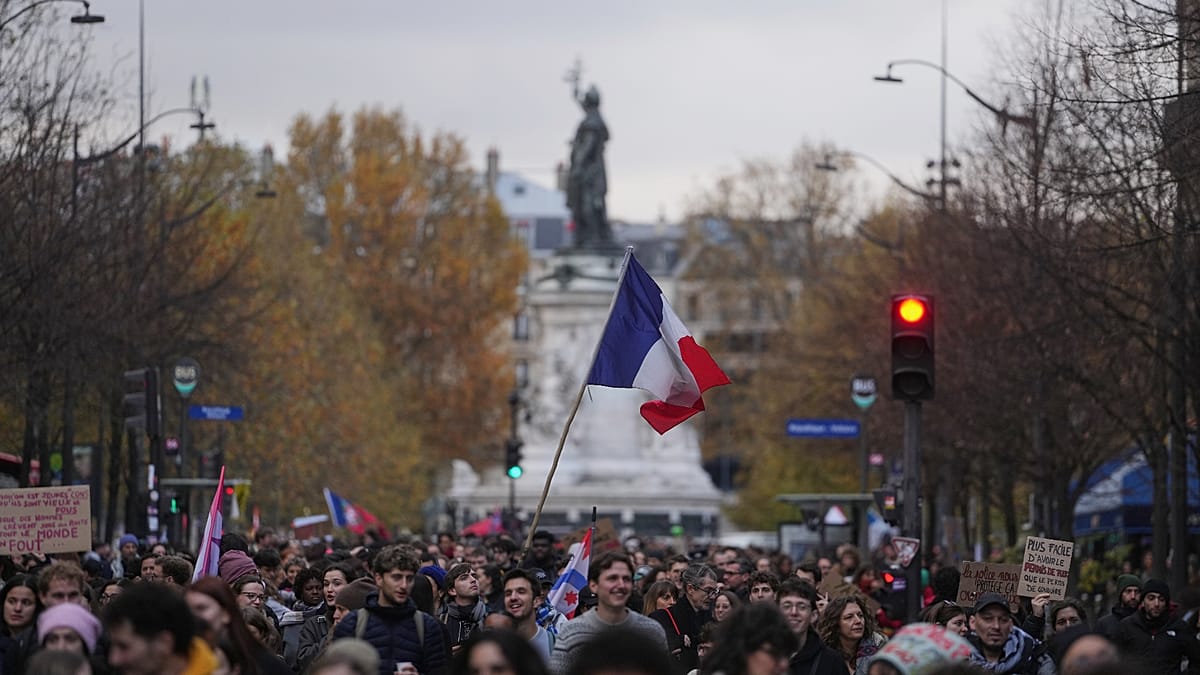
In France, demonstrations over living costs, student rights and police violence continued for a sixth consecutive Saturday, though turnout fell from the previous week. The Interior Ministry counted 82,500 participants nationwide, including 21,500 in Paris; organizers put the total at 150,000, with 45,000 in the capital. A week earlier, official figures had been 106,000 and 200,000 respectively.
In Paris, marchers moved from Place de la République to Place de la Nation, waving flags and wearing trade union T-shirts, alongside the movement's iconic yellow vests. The protest coincided with the eighth anniversary of the Yellow Vest movement, which began in 2018 over fuel taxes and evolved into a broader challenge to social inequality.
In Lyon, where demonstrations were banned across a large area, several unauthorized marches attempted to reach the city center. Police dispersed the groups with tear gas, according to an AFP journalist. In Marseille, 4,600 people took part, matching the previous week's numbers; the march later split, with one group continuing as an unauthorized protest. Around 70,000 police and security personnel were deployed nationwide. The protests were largely peaceful, though sporadic incidents of violence were reported, including in Marseille.
Spain: housing and care home justice
In Barcelona, thousands marched for affordable housing, better-funded public education and stronger public services. Police estimated the turnout at 3,000, while organizers claimed 5,000. The demonstration was part of a wider wave of student and worker protests that swept more than 20 European countries on Friday, 20 November.
In Madrid, a separate protest focused on the treatment of elderly people in care homes during the first wave of the Covid-19 pandemic. Organized by the Marea de Residencias (Care Homes Movement), demonstrators demanded justice for the 7,291 residents who died in care homes in 2020. They denounced the controversial protocols introduced under the regional government of Isabel Díaz Ayuso, which restricted hospital transfers for certain elderly residents, and called for care homes to be fully publicly owned and run.
The protests come as Europe grapples with a housing affordability crisis. In Portugal, house prices have more than doubled since 2017, and rents for new tenancies have risen sharply. According to Eurostat, average annual earnings in Portugal in 2025 were 37% below the EU average. Similar pressures are felt across the continent, from Italy's looming nationwide strike to rising inflation in the UK.
The demonstrations highlight a growing political challenge for governments across Europe, as citizens demand that economic growth translate into tangible improvements in living standards. With the cost of unrest mounting, the pressure on policymakers to respond is unlikely to ease.