Trade relations between the European Union and China have entered a period of heightened tension as Brussels attempts to address a ballooning trade deficit and reduce its dependence on key goods from the Asian giant. European leaders increasingly view Beijing's state-driven economic model—marked by industrial overcapacity and extensive subsidies—as a source of unfair competition that has contributed to job losses and industrial decline across the continent.
The European Commission's response, the Industrial Accelerator Act launched in March, aims to bolster EU industrial competitiveness through measures including a 'Made in Europe' procurement preference and accelerated decarbonisation of energy-intensive industries, net-zero technologies, and the automotive sector. Beijing reacted sharply, arguing that such rules would create investment barriers and discrimination, and hinting at possible countermeasures.
EU Trade Commissioner Maroš Šefčovič pushed back last week, telling Euronews that Brussels would defend its industrial policy and “fight tooth and nail for every European job, for every European company, for every open sector, if we see they are treated unfairly.” The question now is which side will blink first in a clash between two economic superpowers that together account for roughly a third of global GDP and 30% of world trade.
A Trade Relationship Under Strain
The numbers are stark. In 2025, the EU exported €199.6 billion worth of goods to China while importing €559.4 billion, leaving a deficit of €359.9 billion, according to Eurostat. EU exports fell 6.5% compared to 2024, while imports rose 6.4%. Over the longer term, since 2015, EU imports from China have surged 89%, far outpacing export growth of 37.1%. Key imports include solar panels, lithium-ion batteries, and magnesium—materials critical to Europe's green and digital transitions.
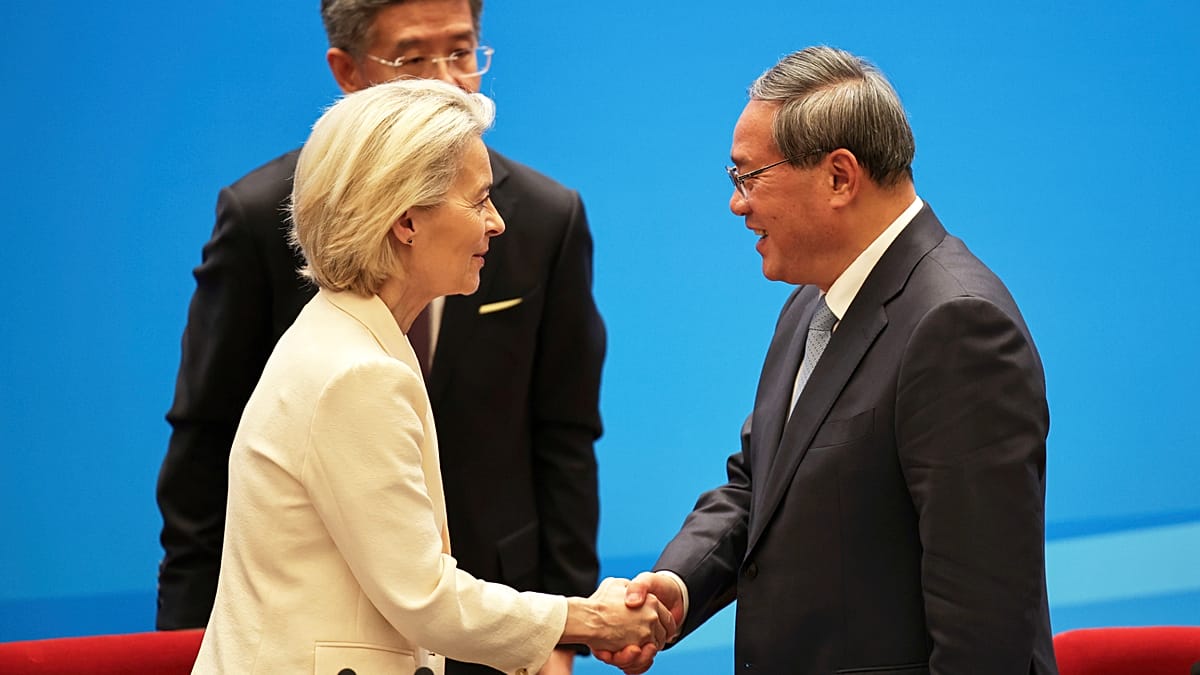
Brussels has sought to diversify supply chains through trade deals with Mercosur, India, and Indonesia, but the broader geopolitical context complicates matters. US President Donald Trump's tariff war has pushed many European leaders to reconsider their trade strategies, with some turning to China as a potential partner to offset losses from the US market. A string of EU leaders—including France's Emmanuel Macron, German Chancellor Friedrich Merz, Irish Prime Minister Micheál Martin, Finnish Prime Minister Petteri Orpo, Portuguese Prime Minister Luís Montenegro, and European Commission President Ursula von der Leyen—have visited Beijing in the past year.
Yet internal divisions persist. EU member states have failed to agree on a unified approach to push back against Chinese practices. Talks in Brussels have intensified over the need to de-risk or decouple, with industry groups now being consulted on whether to deploy the Anti-Coercion Instrument—the bloc's so-called 'trade bazooka'—to counter Beijing's pressure for greater market access and address overcapacity. Final plans are expected to be discussed at a European Commission debate on China scheduled for 29 May.
The EU has long sought a comprehensive trade deal with China, building on a 2020 agreement in principle that aimed to improve market access for European investors, set rules for state-owned enterprises, and ban forced technology transfer. But as China's global trade surplus hit a record $1.2 trillion at the end of 2025, the urgency for action has grown. The outcome of this standoff will shape not only Europe's economic future but also its ability to assert strategic autonomy in a world increasingly defined by great-power rivalry.