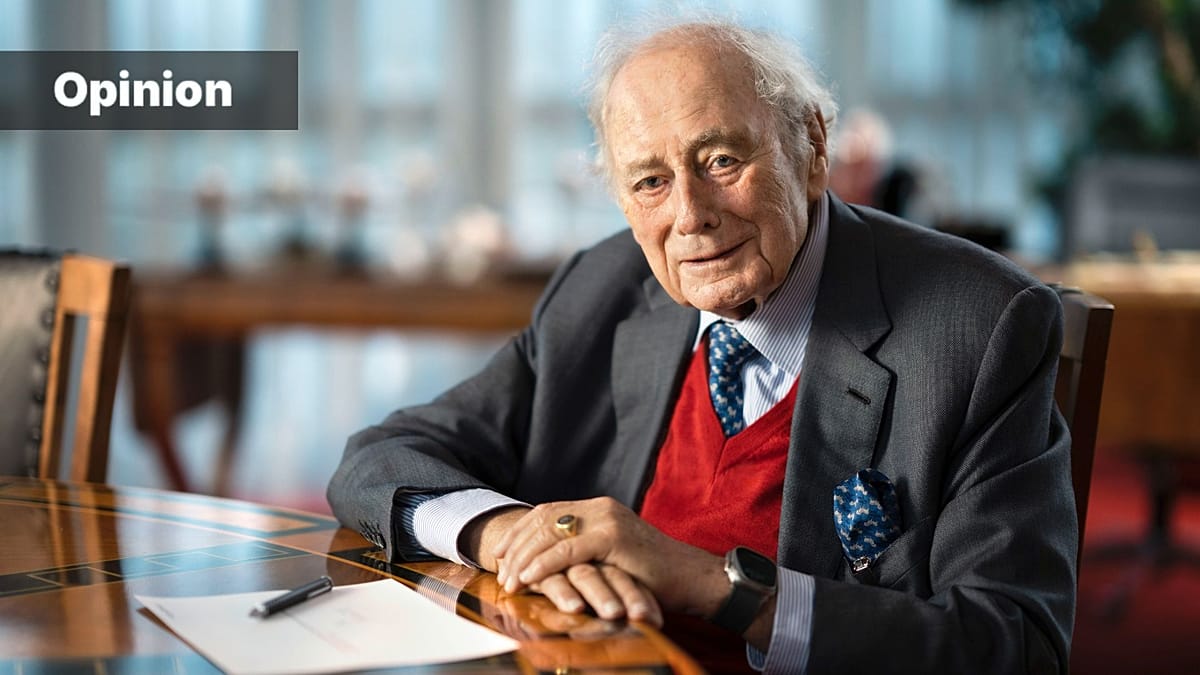
Reinhold Würth, the 91-year-old patriarch of the Würth Group and one of Germany's wealthiest individuals, has issued a stark warning: the country is trapped in a downward spiral of deindustrialisation. In an opinion piece published by Euronews, Würth argues that decades of complacency and a pampered younger generation have left Germany's economic immune system dangerously weak.
Würth, whose company generated more than €20 billion in sales in 2025 and employs 86,000 people worldwide, draws a direct line from the post-war reconstruction to the present crisis. He recalls joining his father's two-man business in Künzelsau as an apprentice in 1949 and taking over at age 19 after his father's sudden death in 1954. Under his leadership, the company grew at an average annual rate of 19.3%.
But the prosperity that followed, he writes, bred a culture of comfort. The children and grandchildren of the baby boomer generation, he says, have come to expect well-being without effort. 'They love comfort and protest that Friday afternoons should not be part of their working lives, but rather part of the weekend,' Würth writes. 'This used to be the Saturday afternoon!'
Uncompetitive production costs
Würth points to a concrete economic reality: unit production costs in other EU countries are up to 50% lower than in Germany. 'Most production companies in this national economy are no longer competitive due to the unreasonable wage demands of the trade unions,' he argues. The result is that products made in Germany are losing ground on global markets, and workers at factories that close are losing their jobs.
To reverse the trend, Würth proposes a bold pivot: Germany must compete head-on with US giants like Google and Apple in electronics, IT and artificial intelligence. 'Building up domestic clouds and innovating in the artificial intelligence segment like there is no tomorrow' is the only way to avert disaster, he writes. He acknowledges the immense challenge posed by China's rapid progress in AI.
Würth also laments the fractious mood in Germany, which he says poisons the country's ability to act. '50% of macroeconomic success is simply emotion, the general mood, and the citizens' opinions,' he notes. He contrasts the euphoria of the fall of the Berlin Wall on 9 November 1989 with today's 'morally narrow-minded and petty carnage' of public discourse.
In a call for national unity, Würth urges Germans to rearm 'democratically, ideologically, and militarily' to deter threats and preserve peace. He points to ongoing labour disputes, such as the recent strikes at Lufthansa over company pensions, as evidence of a lack of consensus. Lufthansa's record revenue has not insulated it from such conflicts.
Würth's warning comes at a time when Germany's economic model faces multiple pressures, including the risk of recession linked to prolonged Middle East conflict and potential US tariffs on European cars. The country's ultra-rich club has grown 26% in five years, but that concentration of wealth has not translated into broad-based industrial resilience.
Concluding his reflection, Würth writes: 'Now, in the 92nd year of my life, I know that I will pass away from this Earth and our country within a rather brief period of time.' His message, however, is intended for those who will inherit the Germany he helped build.