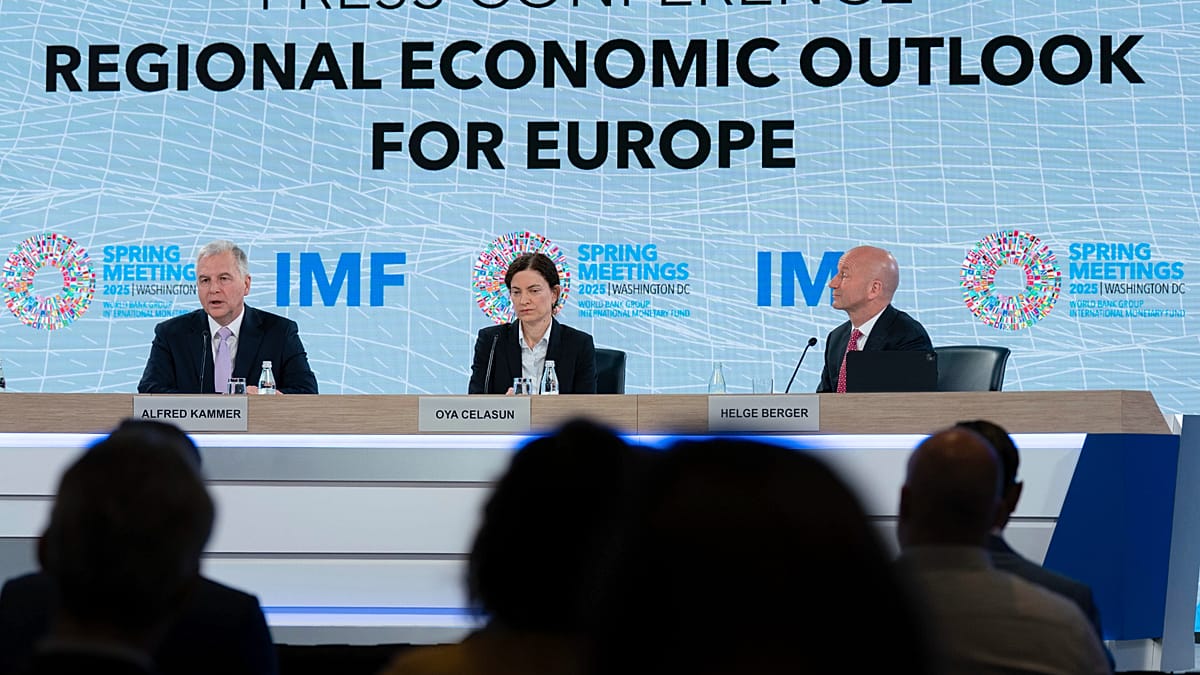
The International Monetary Fund has issued a stark warning: Europe’s economic outlook hinges on the duration of the conflict in the Middle East. A short crisis might limit damage, but a prolonged disruption could push the continent into recession, the institution said in its latest report.
Energy prices have surged dramatically since the US-led military campaign against Iran began on 28 February, with oil prices rising by roughly 70% and European gas prices remaining about 45% above pre-war levels. Although less severe than the 2022 energy shock, these increases are expected to weigh heavily on growth, the IMF cautioned.
Growth Forecasts Downgraded
The euro area is now projected to expand by just over 1% in 2026, down from around 1.4% before the conflict, according to IMF projections. Inflation remains elevated, reflecting persistent cost pressures from energy and supply chain disruptions. Europe’s long-term shift towards renewables—which now account for over half of electricity generation—has softened the blow, but the IMF says it offers only partial protection.
European industry was already paying two to three times as much for energy as competitors in the United States and China before the war. This structural vulnerability, the IMF warns, is not a temporary imbalance but a deep-seated challenge.
“Overall economic impact will depend on how the conflict in the Middle East will evolve, particularly on energy supplies and infrastructure,” said Economy Commissioner Valdis Dombrovskis at a press conference following a meeting of eurozone finance ministers. He stressed that the bloc cannot afford to “repeat the mistakes of the past,” urging that any support measures be temporary, targeted, and not add to aggregate demand.
Energy Reforms and the ETS
The IMF report urges the EU to stay committed to its carbon market, the Emissions Trading System (ETS), which had been on the brink of collapse but is now seen as supporting continued progress in wind and solar adoption. Abandoning the ETS, the IMF warns, could jeopardise hard-won decarbonisation gains.
Beyond that, Europe must complete its internal energy market. The European Commission’s grids package, proposed last December, is described as an “important step.” Commission President Ursula von der Leyen has asked the Parliament and the Council to reach a political agreement on the proposal by the summer. Revamping electricity grids and storage capacity will dominate EU policymaking—and likely political feuds—in the coming months.
Protectionist Risks
The IMF also examined the Commission’s proposed Industrial Accelerator Act (IAA), noting it contains useful measures, including efforts to diversify supply chains. However, it warned that “Made in Europe” procurement rules and foreign investment conditions linked to local value creation could distort markets and weaken comparative advantage. Protecting strategic industries is a legitimate objective, the IMF says, but it must be guided by disciplined cost–benefit analysis, with interventions limited to cases where markets alone cannot adjust effectively.
The report comes as Europe navigates a complex geopolitical landscape. The EU has already faced tensions with the US over trade, as Von der Leyen warned Trump that the EU is ready for retaliation over auto tariffs. Meanwhile, the conflict in the Middle East has driven up shipping costs, threatening refugee aid across Africa, as the Iran conflict drives up UNHCR shipping costs.
The IMF’s message is clear: Europe’s economic resilience is being tested, and the path forward requires swift, coordinated reforms. Whether the continent avoids recession depends not only on the guns falling silent in the Middle East but also on the political will in Brussels, Berlin, and Paris to modernise energy infrastructure and resist protectionist temptations.