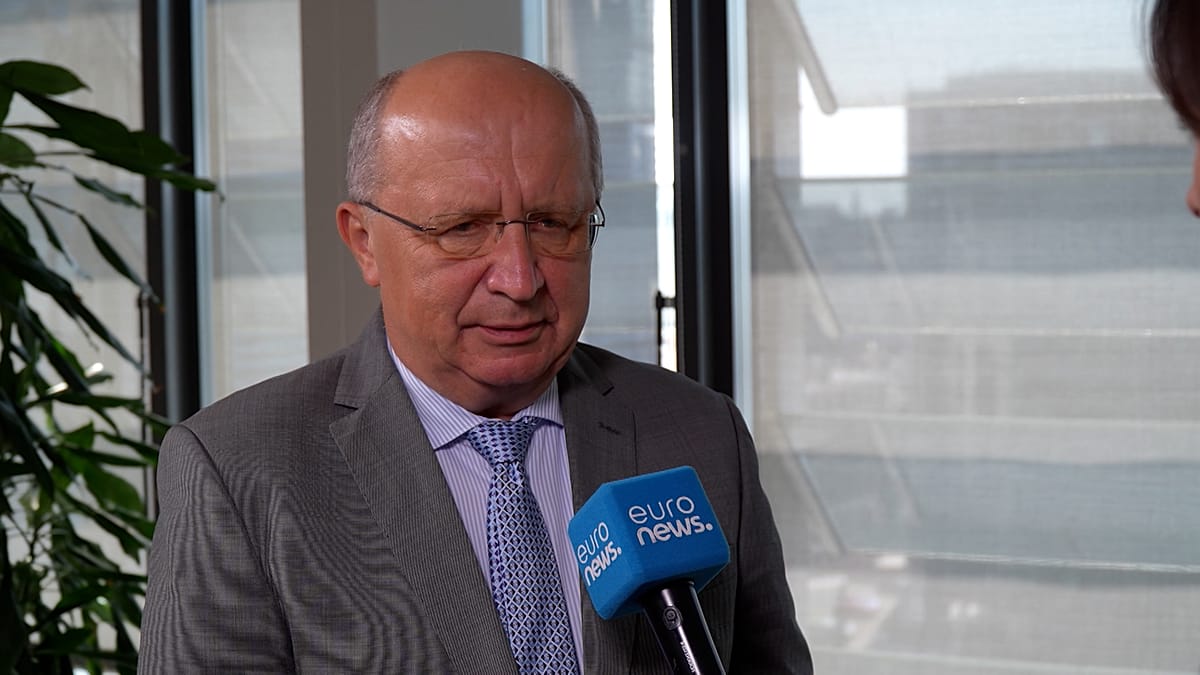
European Commissioner for Defence Andrius Kubilius has stated that Ukraine's recent military successes—particularly deep strikes against Russian naval vessels and energy infrastructure—should compel President Vladimir Putin to enter serious negotiations. Speaking on Euronews' Europe Today, the Lithuanian commissioner described Ukraine's advances over the past six months as remarkable and a clear signal that Moscow cannot achieve its war objectives.
“It's remarkable what Ukraine managed to achieve during the recent half a year with deep strikes,” Kubilius said. “Such kind of development should be a clear argument for Putin and his surroundings—that he is not able to achieve any significant development in his war aims, and that is the moment when real negotiations on just peace should start.”
The EU is backing Ukraine with a €90 billion loan package, of which €60 billion is earmarked for defence. Commission President Ursula von der Leyen visited Kyiv this week to finalise a drone deal, underscoring the bloc's continued support. For more on the domestic pressures facing Ukraine's leadership, see our report on Ukrainians Stage Rare Wartime Protest After Zelenskyy Fires Popular Defence Minister.
European Defence Ambitions and Fiscal Realities
On the broader European defence front, Kubilius expressed concern that some EU member states are scaling back their initial ambitions for the bloc's €150 billion defence loan programme, known as Security Action for Europe (SAFE). This initiative is part of the EU's push to rearm by 2030—a date widely cited by security agencies as a potential window for Russian aggression.
Kubilius noted that 19 countries have had their loan agreements endorsed by the European Commission, but some are now revising their proposals downward. “We see that some countries are, a little bit, diminishing their, let's say, initial wishes,” he said. “Some countries are a little bit more cautious to take the money. Usually, the reason is the fiscal situation, or fiscal limits in the country, so that is what we see.”
Poland secured the largest SAFE loan, approximately €43 billion, though President Karol Nawrocki—from the conservative Law and Justice (PiS) party—initially claimed the money would impinge on national sovereignty. Similar disputes have emerged in Romania, where the Commission and Bucharest finalised an approximate €16 billion loan after internal wrangling over allocation and after drones entered Romanian airspace.
The eastern flank, which bears much of the EU's security burden, has taken the lead in using SAFE funds. The Baltic states—Latvia, Lithuania, and Estonia—have combined loans worth €12 billion, with a strong focus on drone and anti-drone capabilities. Kubilius emphasised that these countries have assumed the “biggest responsibility to spend SAFE loans.”
Responding to Trump's Greenland Rhetoric
Kubilius also addressed US President Donald Trump's renewed pledge at last week's NATO summit in Ankara, Turkey, to control Greenland, the autonomous Arctic territory within the Kingdom of Denmark. Danish Prime Minister Mette Frederiksen reiterated that “Greenland is of course not for sale.”
Kubilius dismissed the remarks as not new, adding that the EU's response is clear: “Denmark was promised all the support from our side.” He characterised Trump's public statements as sometimes “emotional” and urged the bloc to learn how to manage its reactions. “During the years of President Trump being in power, we have to say, we see some kind of difference in his public statements, in sometimes emotional statements,” he said. “We need to learn how to mitigate on our side, our reactions.”
In April, after Trump reiterated his annexationist rhetoric, Denmark announced the purchase of the SAMP/T NG ground-to-air missile defence system—a French-Italian system widely seen as Europe's answer to the American Patriot. Denmark, France, and Italy have placed orders, and Ukraine joined the list on Monday. Asked whether this was the appropriate European response, Kubilius said “each country decides what they want to procure.”
The interview comes amid a broader debate about European strategic autonomy and the continent's ability to defend itself without relying on the United States. For more on the EU's evolving defence posture, see our analysis of EU Defence Chief Urges Negotiations as Ukraine Gains Military Edge.