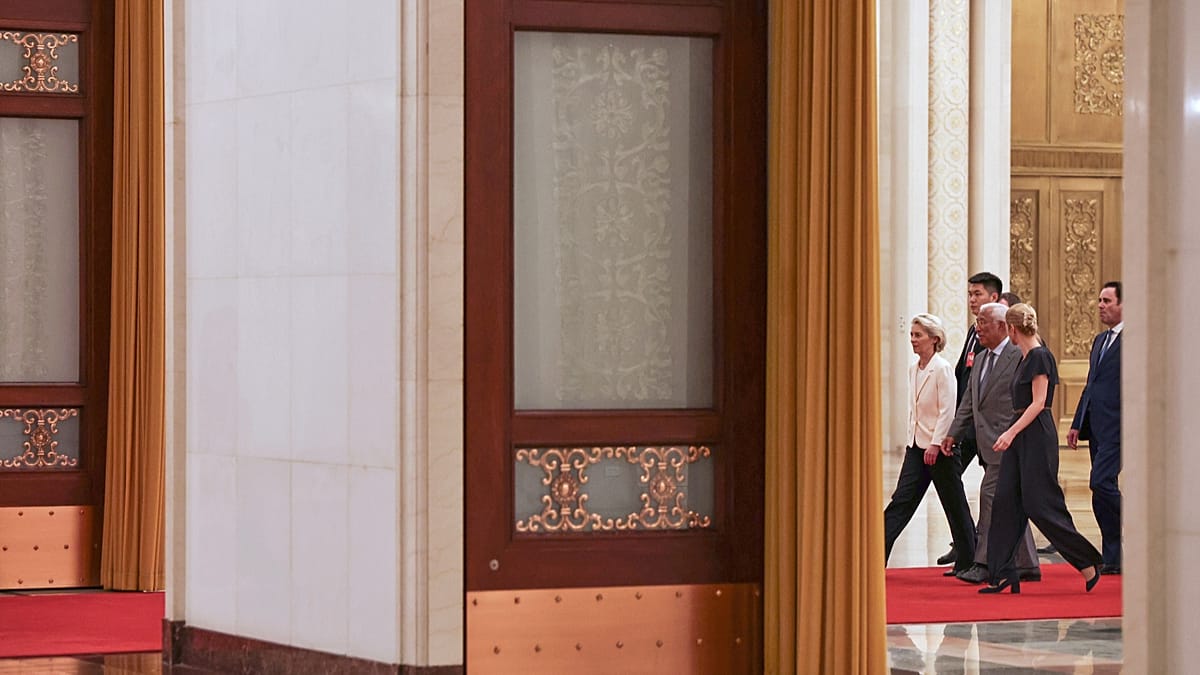
As the European Union heads into its summer recess, the bloc finds itself caught between the competing pressures of Washington and Beijing. In the span of 24 hours, the US imposed new tariffs citing forced labour concerns, while a delegation of MEPs returned from a fact-finding mission in China grappling with a widening trade imbalance. Meanwhile, the EU's 21st sanctions package against Russia was finalized, but not without significant concessions.
US Tariffs and Digital Fines
Late Thursday, US President Donald Trump announced new tariffs on at least 60 international partners, including the EU, over allegations of forced labour. The duties, ranging from 10 to 12.5%, replace the earlier global 10% tariffs that expired at midnight. Bernd Lange, the EU's top trade negotiator, described the measures as “crazy” on Euronews' Europe Today. “This forced labour issue, so that we as Europeans are not respecting the fight against forced labour, is crazy. We have wonderful legislation, even stronger than the United States,” he said.
European Commission deputy chief spokesperson Olof Gill noted that the bloc “takes note of the publication by the US” and that the new regime establishes a uniform 10% tariff rate for the EU, while reintroducing exemptions for items like cork and diamonds, alongside existing ones for aircraft parts and generic medicines.
The tariff escalation coincides with the European Commission's €890 million fine against Google for breaching the Digital Markets Act (DMA). US Trade Representative Jamieson Greer argued that the DMA endangers the fragile EU-US trade deal, stating, “The EU often claims that it is looking for stability and predictability in our trading relationship, but these actions are driving massive uncertainty for US exports of goods and services to Europe.” Google's president of global affairs, Kent Walker, claimed the DMA continues to “break” everyday products. The company has 60 days to comply or face further penalties.
Commission spokesperson Thomas Regnier preempted criticism by asserting, “Our digital legislation is not up for negotiation.” Notably, last year Trade Commissioner Maroš Šefčovič reportedly advocated postponing the antitrust fine to avoid derailing the Turnberry trade agreement, finalized one year ago this week.
Beijing Mission and Trade Deficit
Nine MEPs, led by Foreign Affairs Committee chair David McAllister, completed a fact-finding mission in China on Thursday, aiming to thaw an eight-year freeze in parliamentary ties. The trip was complicated by EU sanctions targeting Chinese nationals allegedly involved in producing dual-use technologies found in Russian weapons in Ukraine. Another pressing issue is the EU-China trade deficit, which ballooned to nearly €360 billion in 2025, surpassing the €312 billion gap of 2024. At a June summit in Brussels, EU leaders agreed to move beyond dialogue, with an October deadline for concrete results.
European Vice President Javier López told Europe Today that triggering the EU's anti-coercion instrument—the so-called trade bazooka—may not be the answer. “This volume of trade surplus of China—of unbalanced trade—that it's one billion (euros) per day, that it has to be addressed, and we should find mechanisms, solutions in this regard,” he said. “We have negotiations ongoing and what we expect is results and deliver solutions through these negotiations, through dialogue and cooperation.”
Sanctions Saga Continues
The EU's 21st sanctions package against Russia, finalized by EU ambassadors on Thursday, includes notable exemptions. Greece secured a carve-out to continue shipping Russian liquefied natural gas to non-EU clients. The proposed ban on entry visas for former Russian combatants was significantly weakened, and the price cap on Russian oil was frozen at $44 per barrel for one year—a move that removes uncertainty as US-Iran tensions escalate and Urals crude prices rise.
The package targets 33 banks, 14 crypto platforms, 41 shadow fleet vessels, and 218 individuals and entities accused of supporting the invasion. As tensions with Iran mount, the US has threatened to tap frozen Iranian assets for Gulf shipping damages, adding another layer of geopolitical complexity for Europe.
For a deeper look at how AI is reshaping European labor markets, see our analysis on AI Jobs Spread Beyond Tech Roles Across Major European Economies. Meanwhile, the EU's balancing act between US and Chinese interests shows no signs of easing as the summer break begins.



