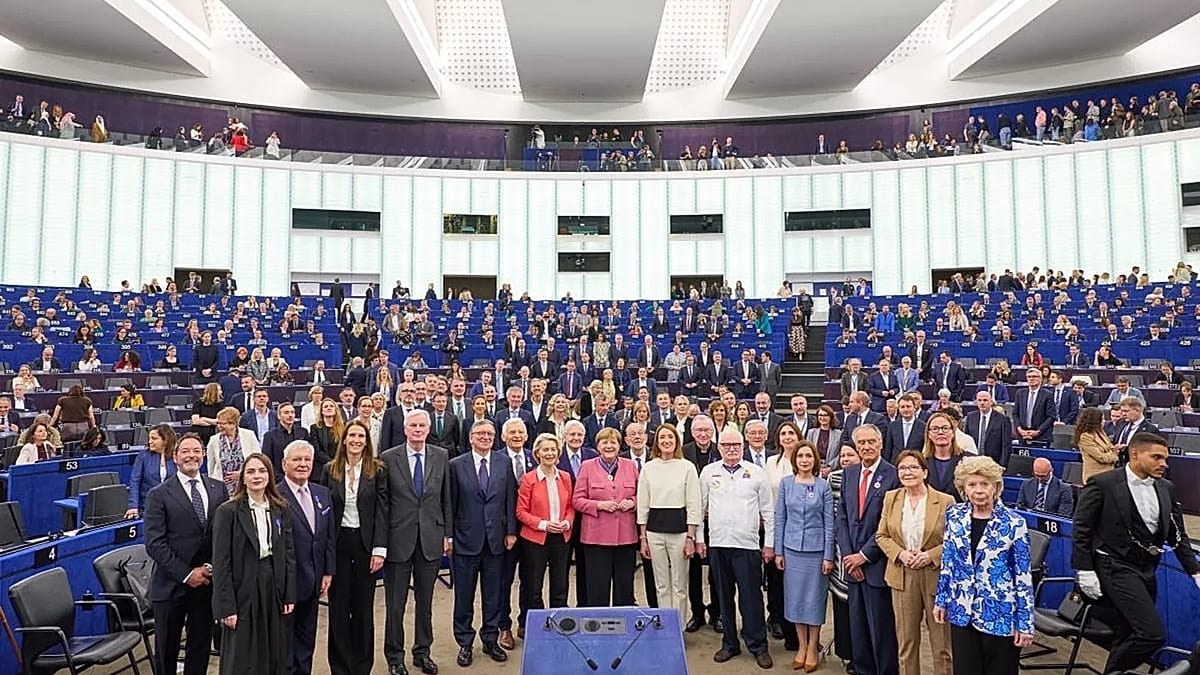
In the Strasbourg hemicycle on Tuesday, the European Parliament hosted the inaugural conferral of the European Order of Merit, a new award intended to honor those who have shaped the European Union and inspire future generations. Yet the ceremony, marked by the presence of a predominantly older cohort of laureates, left many observers questioning whether the EU is celebrating its past at the expense of its future.
Of the twenty laureates selected, only thirteen attended. The majority were retired statesmen and women, including former German Chancellor Angela Merkel and former Polish President Lech Wałęsa. Ukrainian President Volodymyr Zelenskyy, awarded the highest honor, did not appear. Other contemporary figures such as rock star Bono, chef José Andrés, and basketball player Giannis Antetokounmpo also declined to be decorated in person.
The result was a subdued affair that felt more like a reunion of old friends than a forward-looking celebration. As the Anthem of Europe played, a cluster of grey-haired figures on stage seemed to symbolize an aging continent struggling to project a vibrant future.
Merkel’s Candid Assessment
Angela Merkel, the most anticipated guest, did not shy away from acknowledging the EU’s shortcomings. “To be honest, we are a long way from these promises,” she said, referring to the founding ideals of peace, economic prosperity, and democracy. Her remarks drew only half-hearted applause from MEPs, many of whom openly dispute her political legacy.
Other speeches evoked a bygone era of European influence. Former EU Foreign Affairs chief Javier Solana recalled the bloc’s role as a global mediator, while former Parliament President Jerzy Buzek described the EU as “a dream” and “a game of imagination.” Yet these nostalgic reflections felt increasingly disconnected from today’s geopolitical and economic realities, as Europe faces a hostile economic order marked by G7 tensions and an energy crisis.
Voices of the Present
The most emotionally resonant moments came from laureates grappling with current challenges. Moldovan President Maia Sandu recalled how her people voted for Europe despite Russian threats, while Ukrainian human rights lawyer Oleksandra Matviichuk tearfully declared: “Europe, we are back.” Their interventions underscored the contrast between the ceremony’s backward-looking tone and the urgent struggles on the continent’s periphery.
As the event wound down, one MEP leaving the hemicycle told Euronews: “These awards seem to me self-serving and out of touch with the feelings of ordinary people.” A Parliament official added: “Probably next year, there should be a better mix of laureates,” noting that EU governments often nominate individuals instrumental to their country’s accession or integration.
Launched on the 75th anniversary of the Schuman Declaration, the European Order of Merit aims to “honour acts of courage and inspirations” so they can be repeated by other Europeans. But if Tuesday’s ceremony is any guide, the EU may need to look beyond its founding generation to find the leaders who can carry that vision forward. The contrast with the EU's new Order of Merit for Merkel, which signaled stability amid transatlantic strains, only deepens the question of whether the award can truly inspire a new generation.