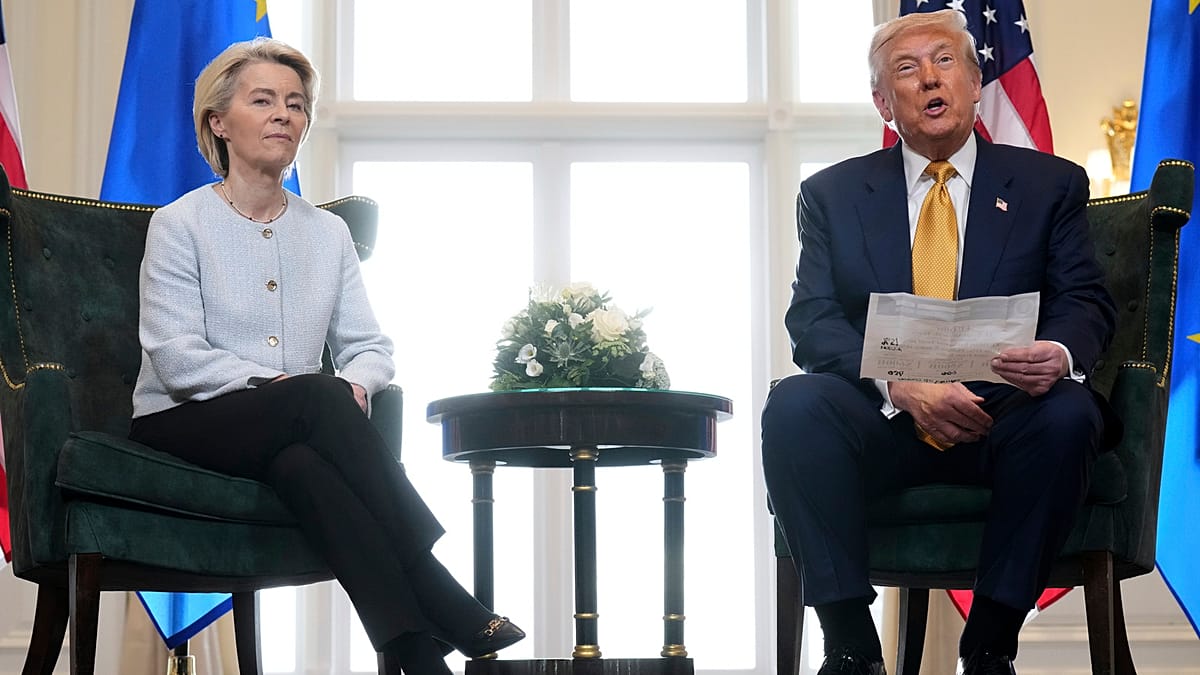
In the early hours of Wednesday, EU lawmakers and diplomats in Strasbourg reached a breakthrough on the controversial trade agreement concluded with the United States last summer. The deal, which aims to ease soaring transatlantic tensions, remains fragile as long as US President Donald Trump continues to wield tariffs as a political weapon, our trade correspondent Peggy Corlin reports.
Key Provisions and Safeguards
The negotiations concluded two weeks after Trump threatened to impose 25% tariffs on EU cars unless the bloc implemented the agreement by 4 July. Critics note the deal is heavily tilted in Washington's favour: it slashes tariffs on US industrial exports to zero while keeping a baseline tariff of 15% on most EU exports.
The European Parliament had pushed for stronger safeguards to protect the deal from further unilateral threats. A compromise includes a so-called “sunset clause” allowing the EU to terminate the agreement unless renewed by 31 December 2029 — after Trump is due to leave office. Bernd Lange, the Parliament’s top negotiator, told our Europe Editor Maria Tadeo that this creates a “safety net” and “gives predictability for our consumers and our industry”.
Crucially, the deal also permits the European Commission to suspend preferential tariffs on US goods if the Trump administration fails to deliver on its promise to lower duties on EU steel and aluminium to 15%. Currently, the US levies a 50% tariff on European steel. EU trade chief Maroš Šefčovič has shuttled between Brussels and Washington for months without securing a breakthrough on steel.
Members of the European Parliament had previously frozen the deal over threats to EU “sovereignty” after Trump repeatedly expressed a desire to forcibly seize Greenland, a Danish autonomous territory. The mention of territorial integrity has been removed from the text, despite renewed tensions this week: Greenlandic Prime Minister Jens-Frederik Nielsen said the US had not shifted its position and declined to attend the official opening of the American consulate in Greenland on Thursday.
Parallel Negotiations and Global Context
Meanwhile, another crunch negotiation is due in the European Parliament today. At 2pm, EU lawmakers and diplomats will aim to strike a deal on the bloc’s controversial migrant return regulation, which would allow member states to strike bilateral deals with third countries to build deportation centres outside the EU and impose entry bans on returned migrants. Our parliament correspondent Vincenzo Genovese reports that the negotiation is expected to be smooth, with the main sticking point being the so-called “ICE amendment” — a provision allowing authorities to search residences or “other relevant places” where a third-country national subject to an expulsion order could be found. EU countries are pushing for this Trump-inspired measure, while the Parliament opposes it.
In Beijing, Chinese leader Xi Jinping and visiting Russian President Vladimir Putin began their meeting on Wednesday morning. After a red carpet welcome with cheering children, a military band, and a 21-gun salute, Putin called Xi “a dear friend” and said “in the current tense situation on the international stage, our close partnership is particularly needed.” Xi called for a “more just global order” and decried “unilateral hegemony” as “running rampant,” according to Chinese state media. He mentioned the Middle East conflict but did not refer to Moscow’s war against Ukraine, now in its fifth year.
The EU’s Russia Envoy: A Job from Hell
The European Union is moving toward appointing a special envoy to speak directly with Russia and negotiate an end to the war. But the role comes with formidable risks. Breaking the diplomatic isolation imposed in February 2022 leaves Europeans keen to secure a seat at the table shaping the continent’s security architecture, yet deeply wary of falling into the Kremlin’s trap. Putin’s maximalist position and refusal to commit to a ceasefire bode ill for the envoy, who could hit a wall on day one. Moscow’s pitch to nominate Gerhard Schröder as mediator is just a teaser of the traps it has at its disposal. Meanwhile, the United States has shown no willingness to integrate Europeans into the confidential process, potentially leaving the envoy stuck on the sidelines. Jorge Liboreiro explains why this is a job from hell.
For more on the trade deal and its implications, see our earlier coverage: EU Parliament Reaches Deal on US Trade Pact as Putin Meets Xi in Beijing and EU Moves to Implement US Trade Deal Amid Lingering Transatlantic Tensions.