The European Commission has put forward a new €45 billion loan package for Ukraine, to be financed through joint EU borrowing against the bloc's budget. The proposal, unveiled by Commission President Ursula von der Leyen, would split the funds between €25 billion for military needs and €20 billion for budget support, covering roughly two-thirds of Kyiv's anticipated €70 billion financing shortfall next year.
Speaking ahead of next week's EU summit, von der Leyen said Ukraine would only be required to repay the loan once Russia pays war reparations, calling it the best way to give Kyiv "a strong hand at the negotiation table." The plan, however, requires unanimous backing from all 27 member states, and resistance from Hungary, Slovakia, Czechia and Bulgaria threatens to stall approval.
Unprecedented trilateral summit in Shenzhen
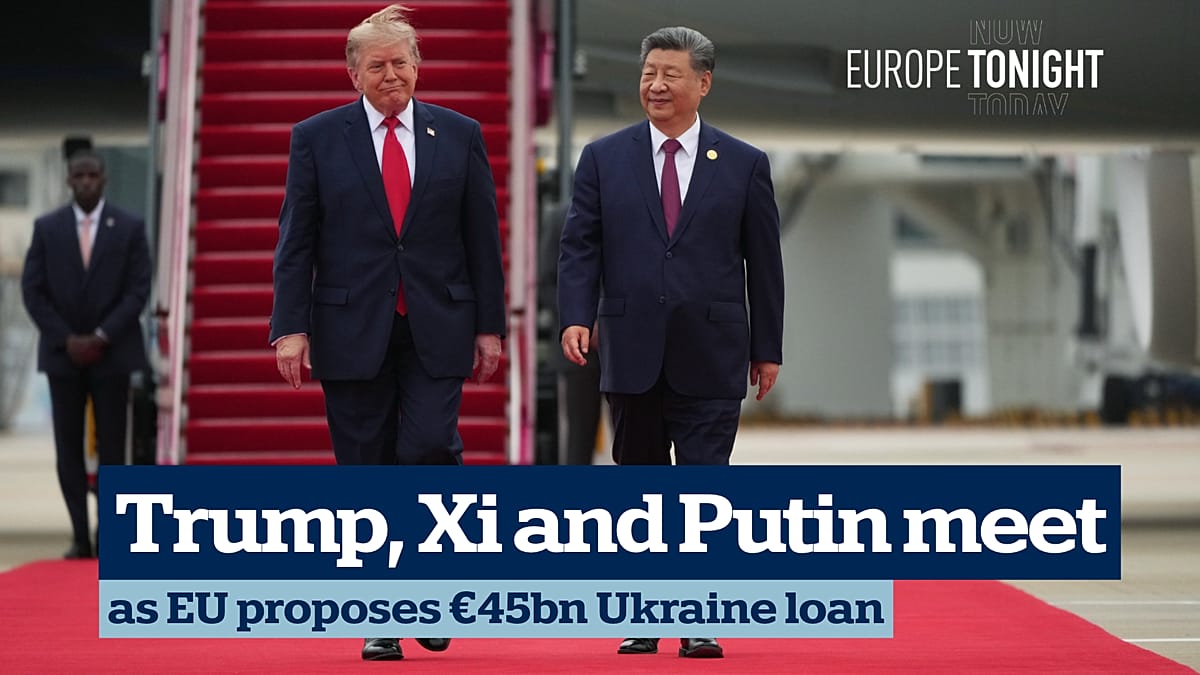
In a separate development, US President Donald Trump has arrived in Shenzhen, China, for the APEC summit, where he is set to take part in a high-stakes, unprecedented trilateral meeting with Chinese President Xi Jinping and Russian President Vladimir Putin. The three leaders are expected to discuss major global security issues, including regional conflicts such as Ukraine and Iran, alongside trade and nuclear and AI guardrails.
The summit gives Putin a major diplomatic platform alongside the world's other two leading economic and military powers, while Beijing uses the APEC stage to project stability and economic cooperation. Speaking at a CEO summit on the sidelines of the gathering, Putin declared that "sanctions, tariffs, and export restrictions" have "outlived their usefulness and have largely lost their intimidating effect."
For analysis on this diplomatic development, we are joined by S&D MEP Sakis Arnaoutoglou and MEP Toomas Hendrik Ilves.
Tech leaders warn Europe cannot sleep through the AI revolution
Meanwhile, in an open letter titled "An Urgent Call: Europe Cannot Sleep Through the AI Revolution," 59 industry figures warn that Europe is currently competing against the United States and China with only a fraction of their capital, computing power, and scaling capacity. The tech leaders have laid out five urgent demands for European policymakers, stressing that the ongoing negotiations for the 2028–2034 EU long-term budget are critical.
According to the signatories, Europe must stop acting merely as a global regulator of technologies invented elsewhere and shift from "defence to offence" by deliberately backing European champions to compete and win globally. We will examine this push with German Minister for Digital Transformation Karsten Wildberger.
IEA chief urges global shift to electricity amid €127bn EU energy shock
Finally, International Energy Agency chief Fatih Birol has told Euronews in an exclusive interview that the world should increase electricity's share of final energy consumption to 35% by 2035, urging governments to reduce their reliance on fossil fuels ahead of COP31.
His warning comes as the European Commission estimates that disruptions linked to the Strait of Hormuz have added €127 billion to the EU's energy import bill since the start of the US-Israeli war against Iran, while industrial production across the bloc continues to fall.
For more on these stories, watch Europe Tonight on Euronews.