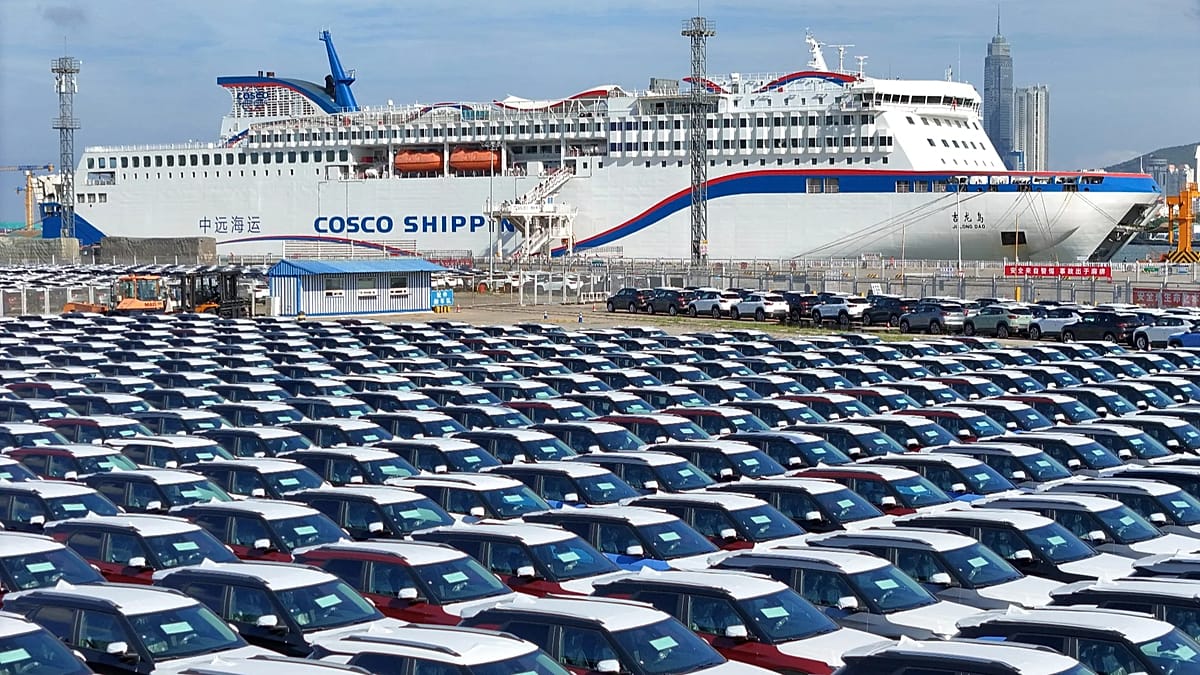
Brussels has made decarbonising domestic industry a central pillar of its Green Deal, but a new analysis reveals that over a third of the bloc's carbon footprint in 2023 was generated beyond its borders. The Traded Emissions Tracker, produced by the European Climate Foundation (ECF) and consultancy Matière, shows that 35% of EU consumption-linked emissions came from imported goods and services.
The figure underscores a growing political dilemma: while the EU invests heavily in cleaning up its factories, power plants and vehicle fleets, it continues to rely on supply chains that carry significant embedded emissions. In several member states, the import share is even steeper. Ireland, Sweden, Austria, Cyprus, Malta and Spain all saw imports account for more than 40% of their national carbon footprint in 2023, excluding trade within the EU itself.
Trade emissions rising faster than global output
The tracker, which covers 45 major economies from 2010 to 2023, finds that emissions linked to international trade have grown faster than overall global emissions. Their share widened by ten percentage points between 1995 and 2023, meaning that more than one-fifth of global greenhouse gases are now associated with cross-border commerce.
For the EU, the largest source of imported emissions is China. According to the European Commission, Beijing accounted for 27.2% of global consumption-linked emissions in 2023, compared with 7.8% for the EU. The bloc's appetite for Chinese solar panels, batteries, electric vehicles, machinery and critical raw materials has driven a trade deficit that the Commission puts at roughly €1 billion per day.
The ECF and Matière report argues that the most effective way to cut these embedded emissions is not simply to police imports at the border, but to cooperate with major trading partners—particularly China—on shared climate standards. Aligning EU and Chinese product requirements could influence trade flows equivalent to about 7% of global emissions and nearly one-third of emissions linked to international trade, the report estimates.
“International cooperation is likely to offer the greatest potential for reducing emissions linked to trade. The EU can support its trading partners in decarbonising their production and work with other major economies to establish common environmental standards,” the ECF and Matière stated.
This approach would complement existing EU tools such as the Carbon Border Adjustment Mechanism (CBAM), which places a carbon price on certain imports, and the bloc's anti-deforestation regulation, set to take effect on 30 December 2027, banning imports of commodities like cattle, cocoa, coffee, oil palm, rubber, soya and wood if their production contributed to forest loss.
However, the report cautions that reshoring production to Europe is not automatically a climate win. If European factories are themselves carbon-intensive, relocating could simply shift emissions geographically rather than eliminate them. The authors stress that meaningful progress requires deeper cooperation with trading partners, a point that resonates as EU officials prepare for an official visit to Beijing in October to discuss trade imbalances.
The findings come amid rising trade tensions between Brussels and Beijing, with some MEPs pushing for stricter EU investment rules. Yet the tracker's creators argue that a confrontational stance may be less effective than building common standards. As the EU races to update its Arctic strategy and faces growing global competition, the question of how to manage its external carbon footprint is becoming central to its climate diplomacy.