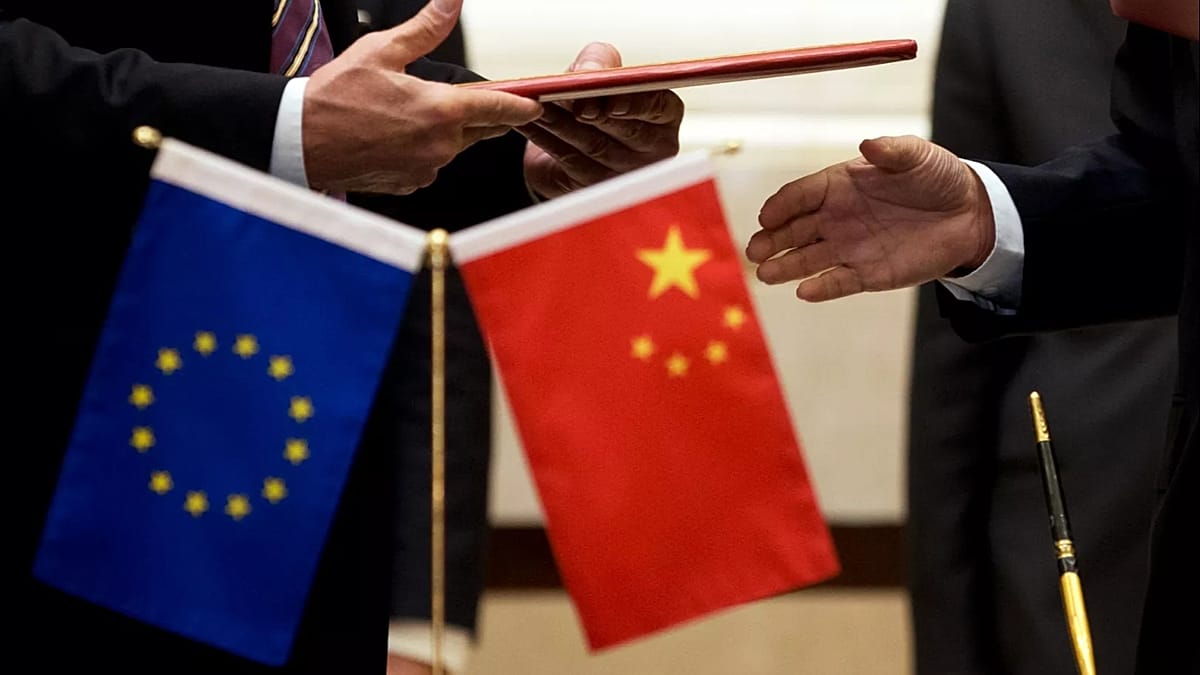
Brussels and Beijing are heading toward a prolonged trade confrontation, but the concessions Europe can realistically extract from China will depend on how much economic pain the EU is willing to endure. With an October deadline set by European Trade Commissioner Maroš Šefčovič, expectations in Brussels are low.
The EU-China trade deficit has ballooned to a record €1 billion a day in 2025, prompting European leaders to demand a rebalancing of what they call "unsustainable" economic relations. Tensions have escalated as the EU moves to protect its market, targeting Chinese companies over illegal products, public subsidies, and foreign direct investment—drawing threats of retaliation from Beijing.
Šefčovič met his Chinese counterpart, Wang Wentao, in Brussels on 29 June in an effort to defuse tensions. The two sides issued a joint statement calling for "stabilising" the relationship and making it "more balanced." But the EU's chances of meaningfully narrowing its trade gap remain slim unless Brussels dramatically strengthens its stance—and any decoupling from the Asian giant will take time and cost money.
Structural factors
Officials and experts agree that rebalancing the EU's deep, multi-layered economic ties with China would be extremely complex, facing fierce resistance because the imbalance is rooted in structural factors on both sides. China's economy remains fundamentally export-driven and heavily subsidised, meaning any concessions Beijing offers are more likely to affect market access for European firms in China than to curb Chinese exports to Europe.
"China's economic adjustments internally are unlikely to happen," Tobias Gehrke, an expert at the European Council on Foreign Relations (ECFR), told Euronews. "Beijing is stuck in a system that needs to gain export market shares. Many of its companies need to export, or they will face bankruptcies or consolidations inside."
A genuine recalibration would require China to boost domestic demand, currently squeezed by the fallout from a real estate crash and the absence of a Western-style welfare system, including public pensions. But such reforms carry political risk, and it's far from clear that stimulating Western-style consumption is compatible with the Communist Party's grip on power. For these reasons, China is unlikely to offer more than minor concessions unless forced to—and Beijing knows time is on its side.
Timing advantage
The EU's trade deficit with China roughly doubled in five years, from €182 billion in 2020 to €360 billion in 2025. No member state has run a trade surplus with China in years—not even Germany, the bloc's largest exporter. Meanwhile, entire sectors of the European economy risk being wiped out by state-subsidised Chinese imports, in what experts have dubbed the "China 2.0 shock."
Despite promises of "deeper engagement" after the EU-China summit in Beijing in July 2025, neither the EU nor its international partners have secured major concessions from China over the past year. Discussions of "global economic imbalances"—a euphemism for the China problem—have reached the G7 agenda, whose members held a video call with Chinese officials ahead of their June summit. No breakthrough emerged, though France's G7 presidency said discussions would continue.
At the last EU summit, leaders gave the European Commission a mandate to develop a diversification instrument aimed at reducing European businesses' reliance on foreign suppliers for critical goods, but the initiative will take years to develop, negotiate, and implement. Meanwhile, Brussels' product-specific anti-dumping investigations are routinely circumvented, as Chinese exporters quickly launch new products to sidestep them, and the Commission is reportedly running out of capacity to keep pace.
Europe's market leverage
As the US tightened access to its market through tariffs, export controls, and trade defence tools, China was forced to redirect exports elsewhere, mostly to south-east Asia and Europe. The EU offers Beijing a crucial relief valve for its industrial overcapacity, and a far more lucrative market than anywhere else in the Global South. That, officials argue, makes rebalancing a shared interest.
"The Chinese want the market to remain open," Alicia García-Herrero, a senior fellow at the economic think tank Bruegel, told Euronews. For her, the most realistic outcome would be an agreement on large import quotas—though she is sceptical such a system could hold over the medium term. "Even large quotas would need to be quickly increased because there is a European demand for Chinese products. Such a system would be very hard to manage, and China will eventually win in terms of market access."
China's rare earth dominance
One of Beijing's most significant sources of leverage in the talks is Europe's dependence on Chinese rare earths. The October deadline is no coincidence: it marks the end of a one-year truce between China and the US that allowed the former to continue its rare earth exports globally, including to the EU. China had restricted them during the full-blown US trade war of 2025, but a deal to lift the restrictions was reached last autumn. It is so far unclear whether the truce will continue past this October, and European industries that critically depend on rare earth supplies are calling for clarity as a matter of urgency.
In retaliation for the EU's recent 21st sanctions package against Russia, which added 14 Chinese and Hong Kong-based companies to the bloc's sanctions list for supporting Moscow's war effort, Beijing has threatened countermeasures. The EU's trade deficit with China has become a political flashpoint, with some MEPs calling for tougher action. Yet, as analysts note, the EU's leverage is limited by its own reliance on Chinese goods and the lack of a unified strategy among member states.
As the October deadline approaches, the EU faces a stark choice: accept modest concessions and manage the relationship, or escalate and risk a full-blown trade war that could hurt European consumers and industries alike. The latter would also complicate efforts to address other global challenges, from climate change to AI governance, where cooperation with Beijing is essential.
For now, the EU's best hope may be to use its market size as leverage to secure incremental improvements, while preparing for a longer-term structural adjustment. But as the clock ticks down, the gap between rhetoric and reality remains wide.