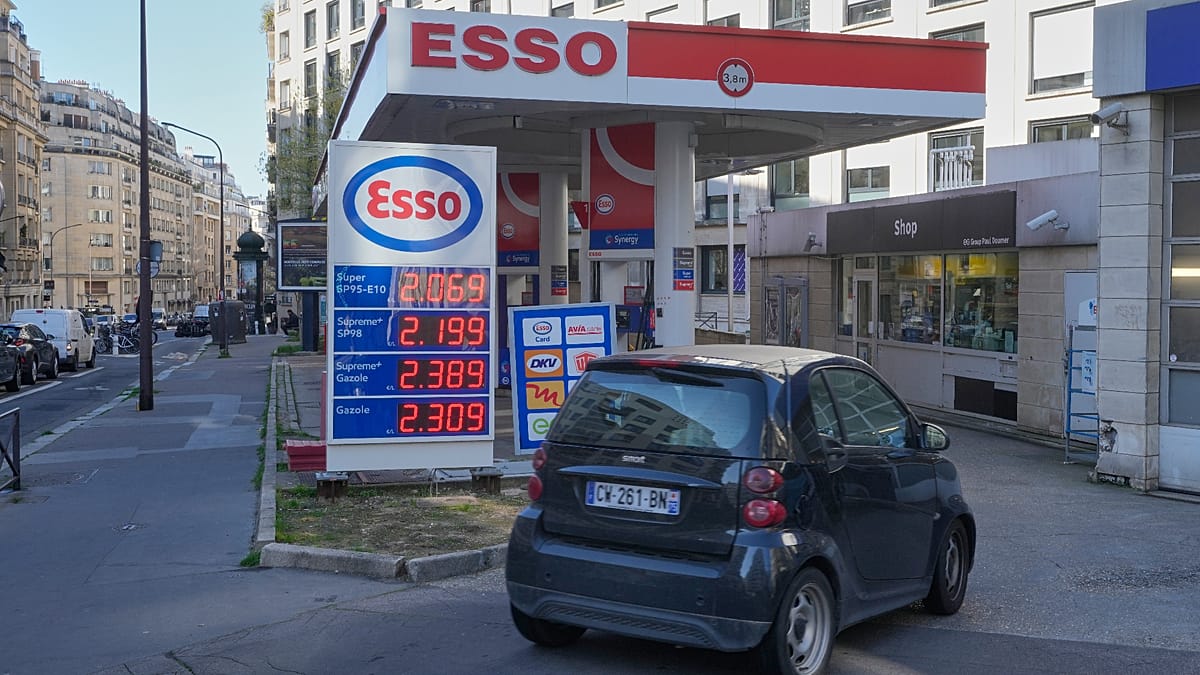
Diesel prices in Portugal are expected to climb to a fresh record on Monday, while petrol prices are set to ease slightly, according to the National Association of Fuel Retailers (ANAREC). The adjustments come after the Portuguese government revised its discount on the Petroleum Products Tax (ISP) on Friday evening.
The new tax rates effectively raise the levy on petrol by about one cent per litre, meaning the price of 95 unleaded petrol should fall by around five cents on Monday, instead of the six cents previously forecast. Diesel, however, is set to continue its upward trajectory, with the government's tax discount increase being minimal—only about 0.10 cents—leaving the predicted four-cent rise largely intact. As a result, the indicative price of a litre of diesel is expected to reach approximately €2.15, a new all-time high.
João Durão, president of ANAREC, has accused the government of "lying" to the Portuguese public when it claims it is not profiting from rising fuel prices. Speaking to journalists at a petrol station in Caminha, in the Alto Minho region near the Spanish border, Durão said the government must address what he described as "fuel smuggling from Spain," where fuel is 30 to 40 cents per litre cheaper. He warned of the loss of competitiveness this creates and insisted that the state is benefiting from the price surge, noting that "out of one euro spent on diesel, 60 cents are taxes"—a situation he says does not exist in Spain.
The gap between Portuguese and Spanish fuel prices has widened further with the introduction of a 20-cent-per-litre discount by Pedro Sánchez's government last week, aimed at mitigating the impact of price rises. Previously, seven countries had cheaper diesel and petrol than Spain, but now only Malta offers lower prices. Spain now has the second-cheapest diesel in the European Union, at €1.795 per litre, followed by Bulgaria and Hungary. Malta, which has frozen prices since 2020 at €1.34 per litre of petrol and €1.21 per litre of diesel, remains the cheapest.
At the other end of the scale, Finnish motorists pay the most for diesel at €2.477 per litre, followed by the Netherlands (€2.442), Denmark (€2.434), and Germany (€2.328). The price disparity is driving an increasing number of Portuguese drivers to cross the border to fill up, a trend that is now even more pronounced.
Cross-border fuel tourism and its economic impact
The phenomenon of fuel tourism is not new in border regions, but the current price gap has intensified it. In towns like Caminha, located just a few kilometres from Spain, local petrol stations are losing customers to their Spanish counterparts. This not only affects fuel retailers but also has broader implications for local economies, as drivers often combine fuel purchases with other shopping.
Durão's warning about "fuel smuggling" refers to the practice of transporting fuel across the border for personal use, which is legal in limited quantities but becomes problematic when done on a larger scale. He argues that the Portuguese government's tax policies are making the country uncompetitive and driving business away.
The price surge is largely attributed to the Middle East crisis triggered by the war launched by Israel and the US against Iran in February, and the resulting blockade of the Strait of Hormuz. Crude oil prices have recently risen above $100 per barrel, pushing fuel costs to record highs across Europe.
This situation is not unique to Portugal and Spain. Several European countries have introduced temporary tax cuts or discounts to cushion the impact on consumers. For instance, Italy recently extended its diesel tax cut by a week, though it signals the end of broad relief measures. The European Union as a whole is grappling with how to balance fiscal revenues with the need to protect households and businesses from energy price shocks.
In Portugal, the government's approach has been to adjust the ISP discount, but critics argue it is insufficient. The ANAREC president's accusations highlight a broader debate about the role of taxation in fuel pricing. While the government maintains it is not profiting, the numbers suggest otherwise: taxes account for a significant portion of the final price at the pump.
For Portuguese consumers, the record diesel prices are a heavy burden, particularly for those who rely on their vehicles for work or live in rural areas with limited public transport. The trend of crossing the border is likely to continue as long as the price gap remains significant.
Meanwhile, Spain's discount has made it one of the most attractive fuel markets in the EU, second only to Malta. This has not gone unnoticed by other member states, and it may prompt further policy responses across the bloc. As the situation evolves, European drivers will be watching closely to see how governments respond to the ongoing energy crisis.