For nearly three years, the European Union has treated Moldova and Ukraine as a tandem in the enlargement process, a pairing born of the urgency following Russia's full-scale invasion. But that informal coupling may be coming to an end. After both countries finally opened the first cluster of accession negotiations this week—overcoming Hungary's prolonged veto—EU leaders in Brussels have begun to signal that the two candidates could soon travel at different speeds.
Merit-Based Separation
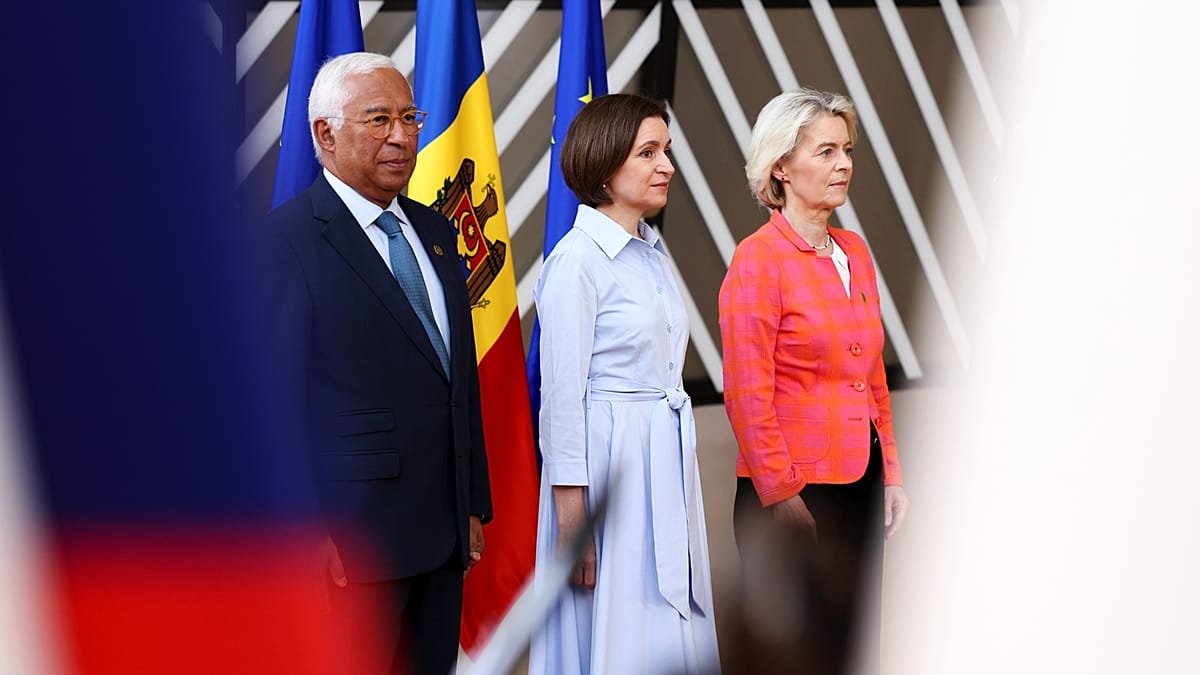
Speaking at a joint press conference after the EU-Moldova summit on Tuesday, European Commission President Ursula von der Leyen made the bloc's thinking explicit. "Once the first cluster is open, every candidate country is responsible for itself, because they have to deliver different reforms, depending on what candidate country we're talking about," she said. Then, with deliberate emphasis: "Here, I'm only speaking about Moldova."
Von der Leyen's words reflect a growing consensus in Brussels that the de facto linkage between Chișinău and Kyiv is no longer tenable. The two countries submitted their membership applications within weeks of each other in early 2022, and the EU granted them candidate status together that June. But as the formal negotiations advance, the logic of treating a country at peace and a country at war as a single unit is fraying.
European Council President António Costa praised Moldova's reform pace, noting that the government in Chișinău has approved changes "very fast." If that tempo continues, he predicted, Moldova could "rapidly" unlock the remaining five clusters of the accession process, which comprises 33 chapters grouped into six thematic clusters. So far, only the first cluster—"Fundamentals," covering rule of law, human rights, anti-corruption, and judicial reform—has been opened for both candidates.
Moldovan President Maia Sandu, who also attended the summit, was unequivocal in her demands. "The five remaining clusters should be opened immediately and with no delays," she said. "As long as we're ready, I'm sure that this is going to happen."
The Ukraine Dilemma
While Moldova's progress has drawn praise, Ukraine's path remains complicated by the war and by political obstacles within the EU. During last week's summit of EU leaders, Hungary's new prime minister, Péter Magyar, objected to a section in the joint conclusions that called for opening all clusters with Ukraine "as soon as possible." Magyar did not raise the same objection regarding Moldova. Yet to maintain equal treatment, the 27 leaders removed the same wording from the Moldova-related section as well.
Officials and diplomats in Brussels acknowledge that decoupling is now a question of when, not if. Some argue it is unfair to keep Moldova tied to Ukraine, as it creates a false equivalence between a peaceful country and one under bombardment. But there is also sensitivity about how a formal separation would be perceived in Kyiv. Ukrainian President Volodymyr Zelenskyy, who addressed the EU leaders last week, stressed that accession remains a vital security guarantee for his country. "The first cluster was recently opened, and it is fully deserved for both Ukraine and Moldova," he told them.
Brussels is keen to avoid a scenario in which Chișinău advances effortlessly while Kyiv is held back by political vetoes. One single member state can block progress, as Hungary has repeatedly demonstrated. The EU's broader geopolitical investment in enlargement—as Costa called it, "the most important geopolitical investment"—requires managing the expectations of both candidates and the member states.
Von der Leyen cautioned against a "short-sighted approach" and insisted the process remains merit-based. "When a candidate country performs the way Moldova does, it merits to move forward. A merit-based process does not mean slow. It means fair. And the fairness is that if you deliver, we have to deliver. So far I'm not worried about the process."
The coming months will test whether the EU can maintain that fairness while navigating the political minefield of enlargement. For now, Moldova appears poised to accelerate, while Ukraine's trajectory remains uncertain—a divergence that may reshape the bloc's eastern expansion strategy.