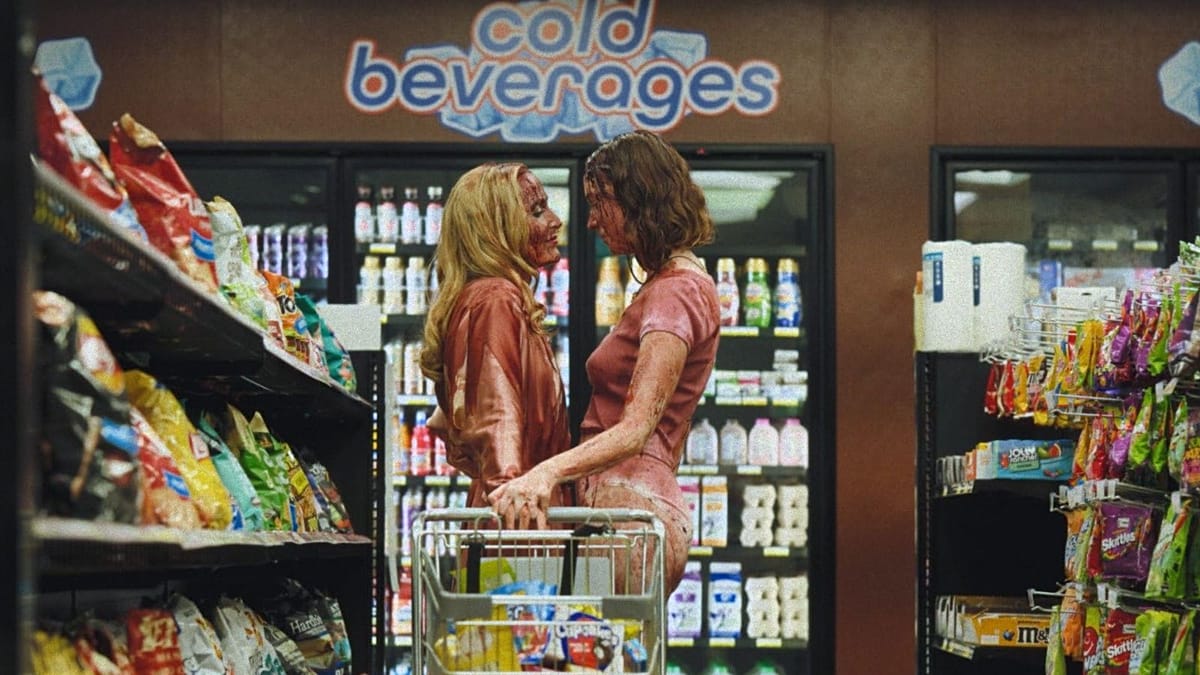
In the opening of Jane Schoenbrun's latest film, a young filmmaker confesses to her new lover, half-naked among discarded sweet wrappers, that sex has never come easily to her unless she's mentally elsewhere. It's a moment that captures the film's absurd yet intimate magic, and a reminder that to reach its orgasmic plane, viewers must also learn to let go.
Teenage Sex and Death at Camp Miasma is the third installment in Schoenbrun's Screen Trilogy, following We're All Going to the World's Fair and I Saw the TV Glow. Both earlier films used pop culture and digital communities as transformative spaces, reflecting our true selves back like psychological mirrors. This new work continues that exploration, but with a more visceral, blood-soaked edge.
The story centers on Kris (Hannah Einbinder), a rising queer director whose first feature—described as 'Psycho but from the perspective of the shower curtain'—caught the attention of indie studios. She's tasked with rebooting a classic summer camp slasher franchise called Camp Miasma. The original series, inspired by Friday the 13th, The Burning, and most prominently Sleepaway Camp, features a masked killer named Little Death (Jack Haven) who rises from a lake to slaughter mean, horny teens after being drowned for being raised as both a boy and a girl.
In 2026, that gender-bending origin story is deemed 'problematic,' ripe for a progressive, 'elevated horror' reboot. But Kris, who had her sexual awakening watching the first movie, has other ideas. She wants to sign on its original final girl, Billy Presley (Gillian Anderson), a turban-wearing recluse with a thick southern drawl and a Norma Desmond demeanor that oozes through the screen like sweet, sticky honey.
Billy still lives on the grounds of the original camp, and as Kris enters, the world collapses into a libidinous lucid dream—a dissociative space between media and reality where scenery becomes painted backdrops and a casual fried chicken dinner becomes a sensuous montage of smacking lips and dipping sauce.
Flesh and Fluids Over Analysis
Schoenbrun has a unique aptitude for allegorizing pop culture and media as transformational spaces. While another recent horror, Backrooms, used liminal spaces as metaphors for negative thought patterns, Camp Miasma's meanings aren't so easy to condense. This is perhaps the whole point. The genre's tropes—including its misogyny and transphobia—are represented with meticulous layering of potential theories, but Schoenbrun ultimately favors feelings over analysis.
As Kris struggles to balance her deep connection to the franchise with shame about its harmful elements, Billy reminds her: 'It wasn't about cultural depictions of monstrosity or gender trouble or any of that stuff. It was about two very simple things—flesh and fluids.'
Within the margins of their two opinions lies a more complicated truth that can't easily be intellectualized. Billy and Kris's relationship becomes the example—not just a love story, but a swirling, hallucinogenic embrace of animalistic urges and their contradictions.
In one particularly tense scene, where it's implied Billy was sexually assaulted as a teenager, the mood suddenly switches, melting into a montage of Little Death committing a violent massacre—heads and torsos speared with comic amounts of blood splatter—to the soundtrack of Counting Crows' 'A Long December.' As the camera pulls back, we catch a glimpse of their eyes through a slit in their TV-like helmet, the absurdity letting slip something human again.
While sometimes 'what the hell?' inducing, these tonal and stylistic whiplashes are never jarring. Instead, they coalesce into a singular vision that feels deeply personal to the director, yet recognizable—like staring into the windows of a stranger's house and seeing your own objects inside.
'I liked the danger and powerlessness,' Billy tells Kris, sharing what lures her to horror. 'It's giving in.'
In the same way, Camp Miasma is a film that urges you to give in. To run through the woods with it, bloodied and braless—because Little Death is coming, and what else is a Final Girl to do?