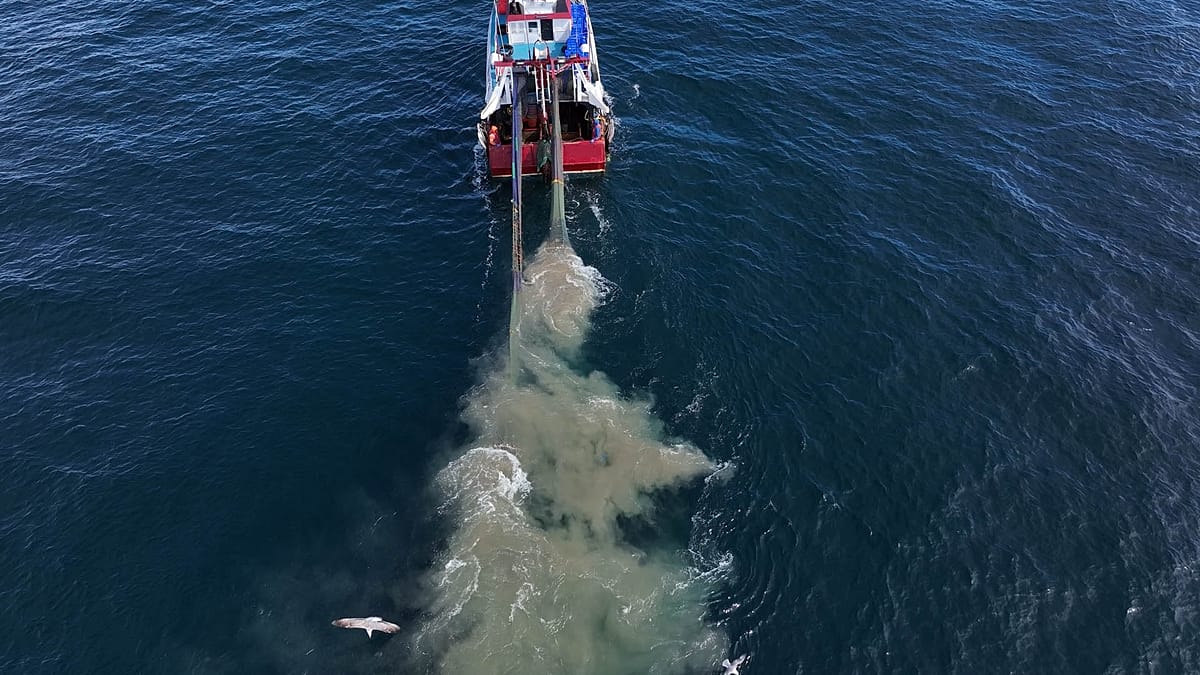
Bottom trawling, a fishing method that drags heavy nets across the seabed, is costing European society billions of euros each year—far more than the industry itself generates. A new study by National Geographic Pristine Seas, published in Ocean & Coastal Management, reveals that European-flagged bottom trawlers, supported by €1.17 billion in taxpayer subsidies, release an average of 112.4 million tonnes of CO₂ annually. The total societal cost, including climate impacts like sea-level rise and reduced labour productivity, reaches up to €16 billion—90 times the industry's annual profits of €180 million.
Despite these staggering costs, bottom trawling provides only 2 percent of the animal protein consumed across Europe and directly employs fewer than 20,000 people. Small-scale fisheries, by contrast, generate roughly three times more jobs. The industry's fragility was exposed recently when at least half the Dutch bottom trawling fleet remained in port due to soaring diesel costs amid the Iran conflict, highlighting its heavy dependence on fossil fuels.
Gökova Bay: A Model for Ocean Recovery
Türkiye's Gökova Bay, once an ecosystem on the brink due to overfishing, intense tourism, invasive species, and rising sea temperatures, became the country's first Marine Protected Area (MPA) in 2010. Nearly half of the bay was closed to bottom trawling, and no-fishing zones were established. The results have been remarkable: the bay now hosts nearly 73 percent of Türkiye's fish species, endangered Mediterranean monk seals have returned to breed, and local fishers' incomes have soared by 300 percent, according to the NGO Revive Our Ocean.
Enforcement relies heavily on community involvement. Marine rangers, many of them former fishers, patrol the 100-kilometre stretch daily. Among them is Ayşenur Ölmez, 28, who grew up fishing with her parents in Gökova Bay and became Türkiye's first female marine ranger. “I call the sea home. I call Gökova home. And to protect my home, I had to do something,” she told Revive Our Ocean last year. “I became a marine ranger so that I could fish again in the future.”
In 2017, Gökova was recognised as one of the world's 16 best Marine Protected Areas at the UN Ocean Conference in New York. Türkiye has since expanded its MPAs and no-fishing zones, building on this success.
Europe's Underperforming Marine Protected Areas
Across Europe, however, most of the 6,000 MPAs lack strong protections against bottom trawling. In Belgium, Bulgaria, France, Germany, the Netherlands, Romania, and Spain, over a quarter of all trawling time occurs inside these supposedly protected zones. Proposals to restrict bottom trawling in some UK MPAs have made slow progress, with Greenpeace noting a “stark gap between political promises and reality at sea.” Between 2020 and 2024, 1.3 million tonnes of fish were caught inside UK MPAs, 250,000 tonnes of which by bottom-towed gear.
The European Commission, under its Marine Action Plan, aims to phase out bottom trawling in EU MPAs by 2030. In 2024, Greece became the first European country to commit to banning bottom trawling in all its MPAs; Sweden followed shortly after. Yet many MPAs remain only minimally protected, the National Geographic report states.
Eliminating bottom trawling from MPAs—especially those with carbon-rich sediments—could deliver immediate emission cuts and help restore ecosystems, boosting nearby fisheries. Seasonal closures, license limitations, quotas, or trip limits could reduce trawling in protected zones. However, the report warns that careful management is needed to prevent displacement of trawling to other areas.
“While we ultimately need to reduce bottom trawling across Europe’s waters to unlock societal benefits, banning it in protected areas is a critical first step—a win for the climate, the ocean and even the fishing industry itself,” says Professor Enric Sala, National Geographic Explorer in Residence and co-author of the study.
As Gökova Bay demonstrates, policy alone is insufficient; community buy-in is essential. For Ayşenur Ölmez, the proof is in the water she patrols every day. “I became a marine ranger so that I could fish again in the future. I am extremely hopeful.”