María Corina Machado, Venezuela's leading opposition figure and Nobel Peace Prize laureate, has returned to Caracas after nearly a year in exile, immediately signaling her readiness to engage in talks with the country's interim president, Delcy Rodríguez.
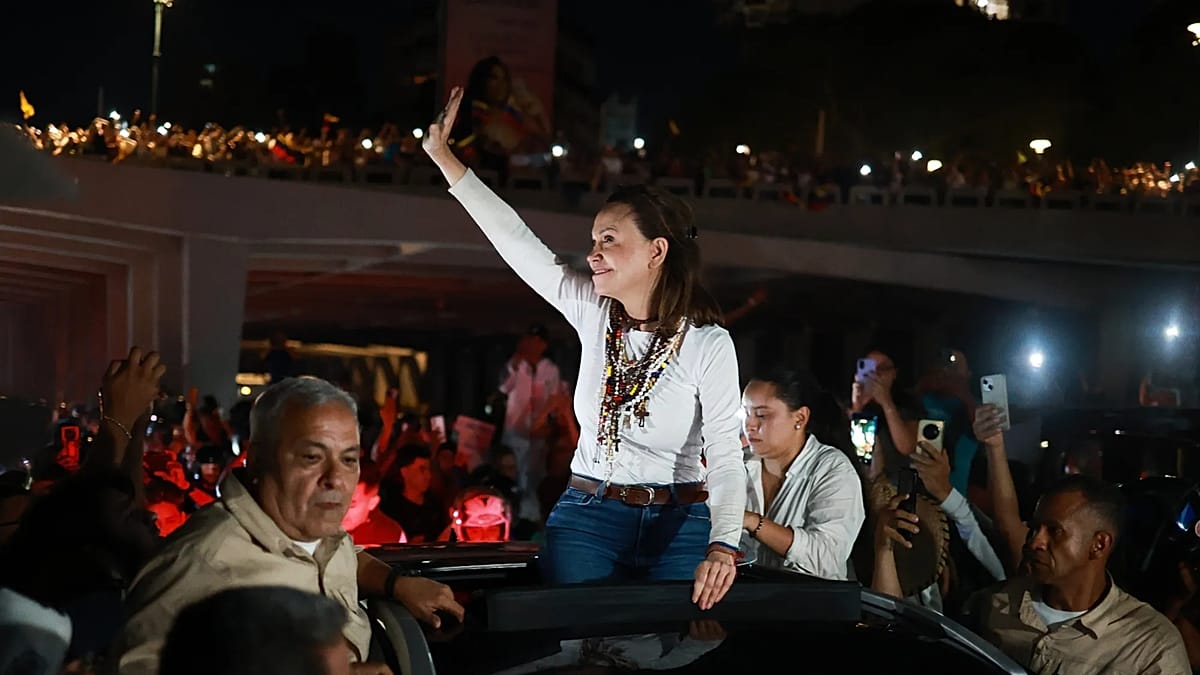
Machado landed on Sunday to a rapturous welcome, with thousands lining the roads from the airport to the capital, waving Venezuelan flags and chanting "Freedom!". Dressed in her trademark white T-shirt and jeans, she leaned out of a vehicle's sunroof to greet supporters, a scene that underscored her enduring influence despite months abroad.
On Monday, her spokesperson Claudia Macero told local broadcaster Unión Radio that Machado "has said she is willing to sit down not only with Delcy (Rodríguez), but with whoever she needs to sit down with, before the country, with full transparency and with an agenda." This marks a significant shift for a politician who had previously refused to negotiate with the government of Nicolás Maduro.
A changed political landscape
Machado's return comes at a pivotal moment. Nine months ago, Maduro was captured in a US military operation and is now imprisoned in the United States. His former vice-president, Delcy Rodríguez, assumed the interim presidency with Washington's backing, a move that disappointed many in the democratic opposition who had hoped for a more decisive break with the old regime.
From her exile in Panama, Machado had watched the US-backed transition talks from afar, in which she was not included. The interim government has promised elections but has yet to set a date. Machado's party, Vente Venezuela, is pushing for a vote in 2027 and for her to be allowed to stand as a candidate—something she was barred from in the last presidential election.
Her return also highlights the deep divisions within the opposition. While some see her as the movement's most potent symbol, others have criticized her uncompromising stance. Yet her homecoming has galvanized supporters, many of whom have personal stakes in the country's future. One supporter shouted, "María, if you come back, my daughter has to come back too!"—a reference to the millions of Venezuelans who have fled economic collapse and repression.
EU calls for dialogue
The European Union has welcomed Machado's return. "We trust that the Venezuelan authorities and all political actors will seize this opportunity to move towards an inclusive dialogue, led by Venezuelans themselves, that leads to free and fair elections," said EU foreign affairs spokesperson Anouar El Anouni. The bloc has consistently urged a peaceful resolution to Venezuela's crisis, and this statement reflects its hope that Machado's presence can catalyze progress.
Machado has been effusive in her praise for US President Donald Trump, who ordered the operation that captured Maduro. She even gave Trump the medal from her Nobel Prize. Trump, for his part, said on Sunday that he had been unaware of her return but added, "I think she is a very nice woman. She gave me her Nobel Prize, so what else can I say?" He also expressed satisfaction with Rodríguez, who has cooperated with US demands, particularly regarding oil access.
Venezuela sits atop the world's largest proven oil reserves, but production has plummeted to about one million barrels per day—far below the three million it pumped decades ago—due to corruption and mismanagement. The country's economic woes have driven an estimated seven million people to emigrate, creating a diaspora that spans Latin America, Europe, and beyond.
Last week, thousands demonstrated in Caracas and other cities demanding Machado's return and the holding of elections. Many of her party's leaders have also recently come back from exile, following a post-election crackdown that left 28 dead and more than 2,400 detained, including dozens of her associates.
Machado's return is a bold gamble. She has repeatedly tried to re-enter the country since leaving clandestinely in December to receive the Nobel Peace Prize, but was blocked at least seven times. Now that she is back, the question is whether she can translate her popularity into concrete political gains—or whether the interim government will continue to sideline her.
For the EU, which has long sought a negotiated solution in Venezuela, Machado's presence could be a catalyst. But as her return unfolds, the bloc will be watching closely to see if Rodríguez's government is genuinely willing to engage in a dialogue that could lead to free and fair elections.