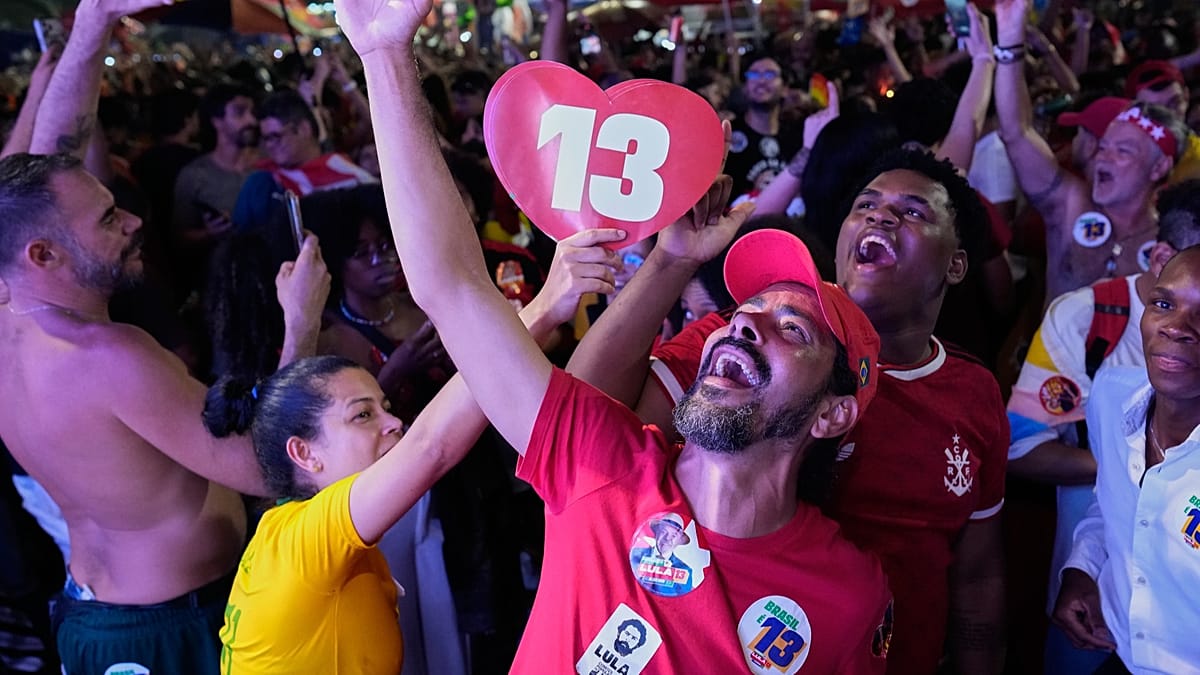
Brazil's leftist president, Luiz Inácio Lula da Silva, secured a narrow victory in Sunday's runoff election, defeating Flávio Bolsonaro by 51.8% to 48.2%. The result halts a run of seven consecutive conservative wins in Latin American presidential elections over the past 18 months, a trend that had been encouraged by Washington's endorsements and military aid.
Bolsonaro, the eldest son of former president Jair Bolsonaro, has vowed to challenge the outcome and seek its annulment, citing the Supreme Court's decision to extend voting by two hours. The younger Bolsonaro ran on a law-and-order platform and promised closer ties with the Trump administration, positioning himself as the standard-bearer of a regional shift toward hard-line politics.
Across the region, voters frustrated by organised crime and economic hardship have increasingly backed tough-talking candidates, from Peru's Keiko Fujimori to Chile's José Antonio Kast. The United States has actively supported this trend, offering endorsements, bailouts, and military assistance. Kenneth Roberts, a professor of government at Cornell University, told the Associated Press: "The US is certainly putting its finger on the scale to try to help the more hard-line right-wing elements in the region."
A setback for Washington
Brazil, as Latin America's largest economy, would have been the biggest prize for the conservative movement. Flávio Bolsonaro had pledged to join a US-led anti-cartel coalition and campaigned on his closeness to Donald Trump. But Washington's pressure may have backfired. The steep tariffs Trump imposed on Brazilian goods—in response to the prosecution of Jair Bolsonaro for an alleged coup plot—triggered a nationalist backlash, which Lula channelled into the slogan "Brazil belongs to Brazilians."
Roberts explained: "To the extent that the regional superpower becomes a threat to Brazil's democratic institutions, defending Brazilian national sovereignty also becomes a form of defending Brazilian democracy."
Lula has refused to join the US-led Shield of the Americas coalition. "We don't accept being treated like children," he said in May, after Washington designated Brazil's two largest gangs as terrorist organisations. Brazil also holds valuable leverage: the world's second-largest rare earth reserves and around 90% of global niobium output, both critical for defence industries.
"Brazil has leverage," said Monica de Bolle of the Peterson Institute for International Economics. "With Lula, the US is on shakier ground."
Challenges at home
Yet analysts caution against reading too much into a single result. Conservatives strengthened their grip on Brazil's Congress earlier this month, leaving Lula struggling to pass reforms. "Lula has his hands tied," said Guilherme Casarões of Florida International University.
The defeat of a Trump-backed candidate comes just over a week before the US midterm elections on 3 November. A CNN poll put Trump's approval rating at a record low of 32%, while an NBC News/Telemundo survey found that 68% of Latino voters disapprove of his foreign policy—a significant shift among a group that helped return him to power in 2024.
Reaction in Washington split along party lines. Donald Trump Jr attacked the extension of voting hours, while Democratic congressman Ro Khanna urged the president to respect the result. Despite the friction, both governments still have reasons to cooperate: Washington seeks access to Brazil's rare earths, and Lula wants tariff relief.
"Lula is pragmatic enough to work out some kind of modus operandi with the Trump administration," said Will Freeman of the Council on Foreign Relations, adding that the Bolsonaros' allies in Washington were likely to lose influence after the family's second straight defeat.
For European observers, the outcome carries broader implications. The continent has watched Latin America's political swings with interest, particularly as the EU seeks to finalise the Mercosur trade agreement and diversify its supply of critical minerals. Lula's victory may offer a more predictable partner in Brasília, even as his domestic constraints limit his room for manoeuvre.