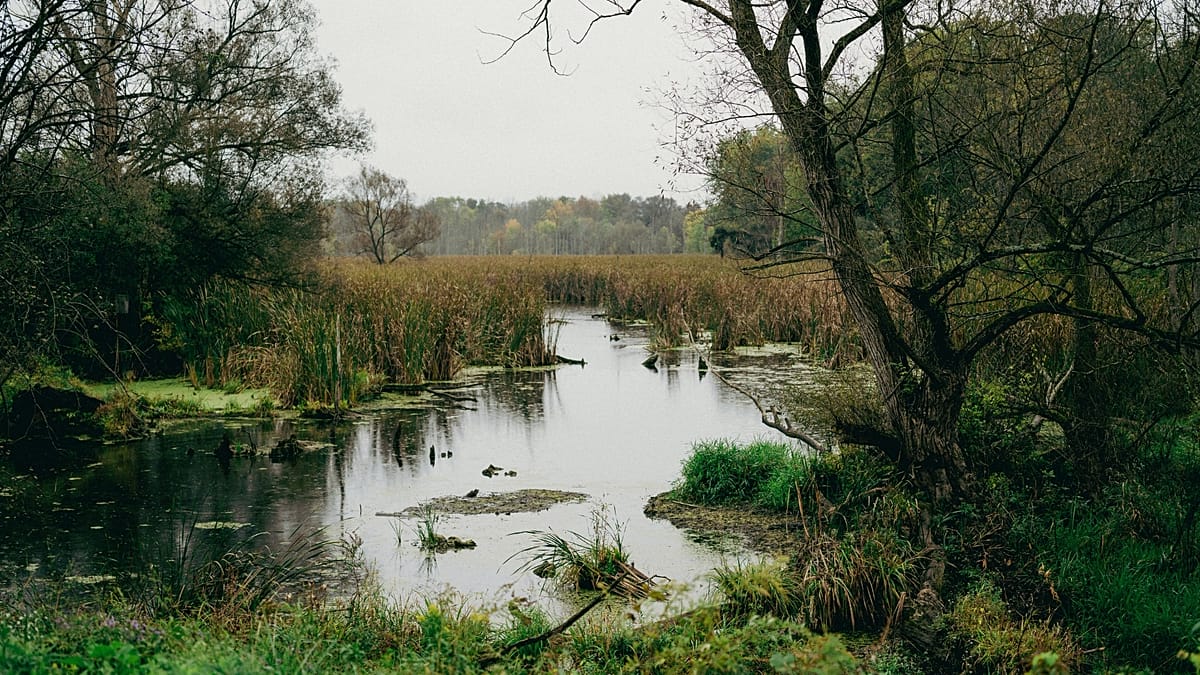
When defence planners talk about barriers, they rarely mention bogs. Yet the waterlogged, impassable nature of peatlands is drawing renewed attention from militaries across Europe. In the Baltic states, Poland, and even Germany, these ecosystems are being evaluated not only for their climate and biodiversity value but as strategic assets that can slow or channel an advancing force.
Estonia, Latvia, and Lithuania are examining how peatlands fit into the Baltic Defence Line, a coordinated effort to strengthen NATO's eastern flank. In Lithuania, where peatlands cover roughly a fifth of the country, the government plans to restore 6,000 hectares of bog as part of its total defence strategy. Deputy Defence Minister Tomas Godliauskas described these areas as "an integral defensive line", according to the New York Times. Rewetting is far cheaper than digging anti-tank ditches or laying minefields, and the Lithuanian Environment Ministry intends to carry out the work over 30 years, guided by the EU's nature restoration regulation.
Poland is pursuing a similar approach with its Eastern Shield, a 700-kilometre belt of defensive installations near the border with Belarus and Russia. About one-third of that barrier is planned as dense, difficult-to-traverse wilderness, including rewetted peatlands. The logic is straightforward: heavy military equipment loses speed and situational awareness in boggy terrain, and the few passable corridors can be monitored and defended more easily.
Historical Precedent and Strategic Reassessment
Professor Hans Joosten, co-founder of the Greifswald Mire Centre and a leading peatland researcher, notes that wetlands have shaped borders for centuries. "Peatlands have shaped border regions everywhere in the world," he explains. "You can see that the border between some countries – whether between Germany and the Netherlands, between Tomsk and Novosibirsk or around Lake Chad – is always formed by wetlands or peatlands. It is easier to defend these areas." For heavy military equipment, he adds, they are "almost like a minefield, only more humane."
The Prypiat peatlands between Belarus and Ukraine offer a historical case. During the 2022 Russian invasion, those marshes hampered armoured columns and contributed to the stalling of Moscow's advance on Kyiv. More than four years of war have underscored how terrain can shape outcomes, even in an era of drones and precision munitions.
Jan Peters, managing director of the Michael Succow Foundation, sees the most immediate security-policy leverage in the Baltic states and Poland. "Within Germany, that is in fact a difficult case to make," he says. "Resources can be deployed most efficiently in the Baltic states and in Poland because there, along the EU and NATO external border, there is a direct threat situation, there are still many areas that can be restored, and land prices and conflicts of interest are significantly lower than here."
Nonetheless, the issue is gaining traction in Berlin. The Bundeswehr is establishing its first foreign brigade in Lithuania, the 45th Armoured Brigade "Lithuania", which is to secure NATO's eastern flank with around 5,000 soldiers by the end of 2027. That deployment brings German forces into direct contact with the region's peatlands, forcing planners to consider how rewetting might affect both friendly and hostile movement.
Climate Meets Defence
Germany's peatland policy has long been driven by environmental goals. The federal government aims to rewet drained bogs to cut greenhouse gas emissions, store water, and protect habitats. Joosten highlights the scale: "Worldwide, 5% of all emissions come from drained peatlands. In Germany the figure is 7%, in Mecklenburg-Western Pomerania even 40%." From a climate perspective, he stresses, rewetting is not optional: "Ultimately, from a climate point of view, we have to rewet all peatlands anyway over the next 30 years. That is not optional."
The question is whether climate action can be aligned with defence needs. A spokesperson for the Bundeswehr's Federal Office of Infrastructure, Environmental Protection and Services told Euronews that natural obstacles affect the mobility of both adversary and own forces, and that rewetting could be "advantageous, but also disadvantageous for the conduct of our own operations." Since Germany serves as a hub for NATO troop movements eastward, it depends on open corridors. Rewetting must therefore be weighed against military requirements.
Peters points to the broader benefits: "That is of course the big advantage – all these positive side-effects." He lists climate action, biodiversity, and water availability, with defence now added as a further argument. The convergence of these interests could accelerate rewetting projects that might otherwise face resistance from landowners or budget constraints.
The debate also touches on historical tensions. The Prypiat marshes, for instance, have long been a natural barrier between Belarus and Ukraine. As Europe reassesses its defence posture in the wake of Russia's full-scale invasion, peatlands are no longer just carbon sinks or havens for rare species. They are becoming part of the continent's strategic geography.