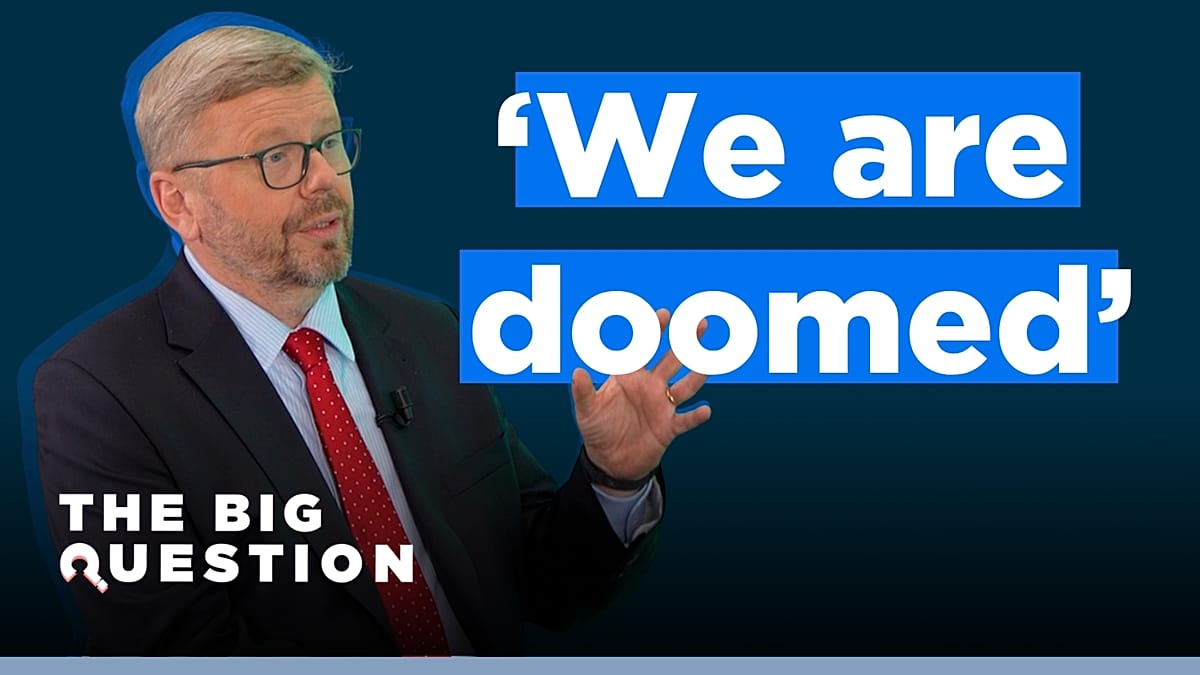
Maciej Witucki, the newly appointed president of BusinessEurope, has delivered a stark warning to European policymakers: the bloc's failure to complete its single market and accelerate the energy transition is not just an economic misstep—it is a political existential threat. In an interview with Euronews, Witucki, who previously led Poland's largest business confederation for six years, argued that Europe has all the resources it needs but lacks the will to implement what is already on the table.
“If we do not give some hope for the future, the political world in Europe will suffer,” Witucki said. “I think today we need to stay focused on what is already in the pipeline. Don't look for any silver bullets—we already have plans, just implement them.”
Energy and the Single Market: Two Fronts of the Same Battle
Witucki placed energy at the top of his agenda, describing it as the most pressing problem for European businesses. The war in Ukraine and broader geopolitical instability have accelerated the need to move away from Russian oil and gas, but the transition must be managed carefully. “We have been concentrating on the decarbonisation of the economy, which is important because nobody, after the heats of the last weeks, will claim that there is no global warming,” he said. “At the same time, we will not save it if we have no industries, no revenues, no taxes to pay for it.”
The second priority is the single market—a concept dating back to the 1980s that remains incomplete. Witucki argued that trade barriers between EU member states, many of them remnants of regulations from 20 or 30 years ago, cost the European economy hundreds of billions of euros annually. “Only Europe as a whole can compete with the other superpowers in the world,” he declared. “This is the enormous unleashed potential of Europe.”
He drew a vivid comparison: “We somehow envy SpaceX for the super rockets. The real single market is a SpaceX of Europe—it's a starship of Europe. If we really keep those barriers, we have billions of euros which are being lost, [the equivalent] of 50%.”
Homegrown Talent and the Need for a Banking Union
Despite concerns about Europe's ability to attract and retain top talent, Witucki expressed confidence in the continent's human capital. “In Europe, we have Elon Musks and we have Mark Zuckerbergs. We just don't have the SpaceX's and the Facebook's yet,” he said. “But on the talent side, on the talent pool, we definitely have what is needed and much more than our competitors. We still have very good education, we have strong universities. We also have the equity—Europe is still a rich continent.”
To harness this potential, he called for completing the banking union and the investments and savings union, which would allow capital to flow more freely across borders. “At the talent level we are the richest place in the world,” he added.
Lessons from Poland's Economic Boom
Witucki pointed to Poland's recent economic performance as a model for the rest of Europe. Over the past decade, Poland's GDP has more than doubled, driven by domestic consumption, a post-pandemic investment boom, and a deregulation push. The Polish government, he noted, launched a public deregulation initiative last year, with the prime minister meeting monthly with a leading businessman to track progress. “160 bills have been passed within three, four months from the beginning of this initiative,” Witucki said.
He attributed Poland's success partly to a youthful, can-do attitude. “We are young, and I'm not afraid of this, that we are young Europe. I would love the rest of Europe to also be younger, to say yes we can, because really the resources are there. We believe in the capability, we have been believing in the capabilities of change, so [this leads to] a much quicker adaptation to the realities.”
Witucki's message is clear: Europe's future depends not on grand new visions but on executing the plans it already has. As the continent faces rising geopolitical competition and internal political fragmentation, the cost of inaction is not just economic stagnation but a loss of faith in the European project itself. For more on how Europe can forge a cohesive identity, read our analysis on Europe Needs a Shared Story, Not a Single Memory.