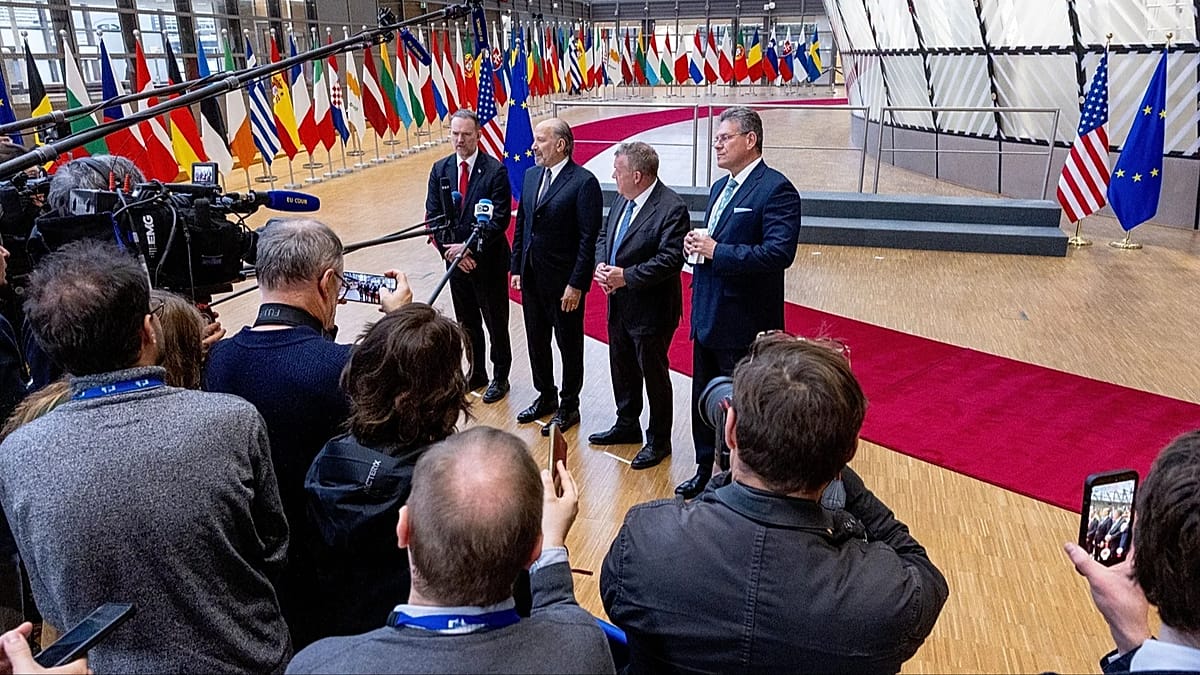
On a rainy Tuesday in Brussels, the European Commission's trade chief Maroš Šefčovič met US Trade Representative Jamieson Greer in Paris for high-stakes talks, as fresh tariff threats from Washington cast a shadow over transatlantic relations. The meeting follows US President Donald Trump's warning of up to 25% import levies on European automobiles, a move that has rattled EU capitals.
French MEP Aurore Lalucq, chair of the European Parliament's economic affairs committee, told reporters that the EU-US trade deal signed in Scotland last summer should never have been concluded. “The current US administration cannot be trusted,” she said, reflecting a growing sentiment among Socialists and Democrats in the European Parliament. Other lawmakers, wary of retaliation against their national economies, have adopted a less confrontational stance.
The trade dispute is far from resolved, with further negotiations between EU member states and MEPs scheduled for Wednesday. But the tensions extend beyond tariffs. An announcement of American troop reductions in Germany has deepened uncertainty about the US commitment to European security.
NATO Downplays Troop Withdrawal
NATO spokesperson Martin O’Donnell told Europe Today that the withdrawal of thousands of US soldiers from Germany, ordered by Trump, should not alter the alliance's defence posture. “Europe has been moving to make itself stronger for some time,” O’Donnell said. “From our NATO deterrence plans, this doesn’t change anything. We will still be able to deter and defend all NATO territory.”
Nevertheless, the move has intensified debates about European strategic autonomy. For more on this, see our analysis of Merz and Trump's clash over US troop withdrawal.
Yerevan Summit: A New Axis?
Meanwhile, in Yerevan, the first-ever EU-Armenia summit unfolded alongside the European Political Community (EPC) gathering, which brought together nearly 50 heads of state. The EPC, as always, produced no binding decisions, but served as a platform for bilateral and trilateral meetings on the sidelines.
Canadian Prime Minister Mark Carney used the occasion to position himself as a counterweight to Trump, praising multilateralism. “It’s my strong personal view that the international order will be rebuilt, but it will be rebuilt out of Europe. And so I’m very appreciative of the symbolism of this invitation,” Carney told the room. His remarks were warmly received, given that both Canada and Europe have faced Trump’s tariff and annexationist threats.
The summit also saw a tense exchange between Azerbaijani President Ilham Aliyev and European Parliament President Roberta Metsola. Aliyev accused the European Parliament of “spreading slander and lies” about his country, to which Metsola responded: “We will never change the way we work, even if it is uncomfortable.” The dispute highlighted ongoing friction over the Nagorno-Karabakh peace process. For more on Armenia's shifting alliances, read Armenia Hosts Zelenskyy and EU Leaders, Signaling Break from Moscow.
EU Targets Chinese Inverters Over Cyber Risks
In a separate development, the European Commission announced it will phase out the use of Chinese-made inverters in EU-funded energy projects, citing cybersecurity threats. The decision follows warnings that inverters from firms like Huawei and Sungrow could pose risks to Europe's power grid stability, especially as the continent shifts to renewable energy sources such as solar and wind.
“We have identified serious economic and cybersecurity risks,” an EU official told reporters on condition of anonymity, noting that the assessment drew on classified and non-classified evidence from multiple member states. The official pointed to China, Iran, North Korea, and Russia as potential sources of threats that could, in a worst-case scenario, trigger blackouts.
As Europe navigates these multifaceted challenges—from trade wars and troop withdrawals to cybersecurity and geopolitical realignments—the continent's leaders are increasingly aware that the international order is being reshaped, and that Europe must play a central role in its reconstruction.