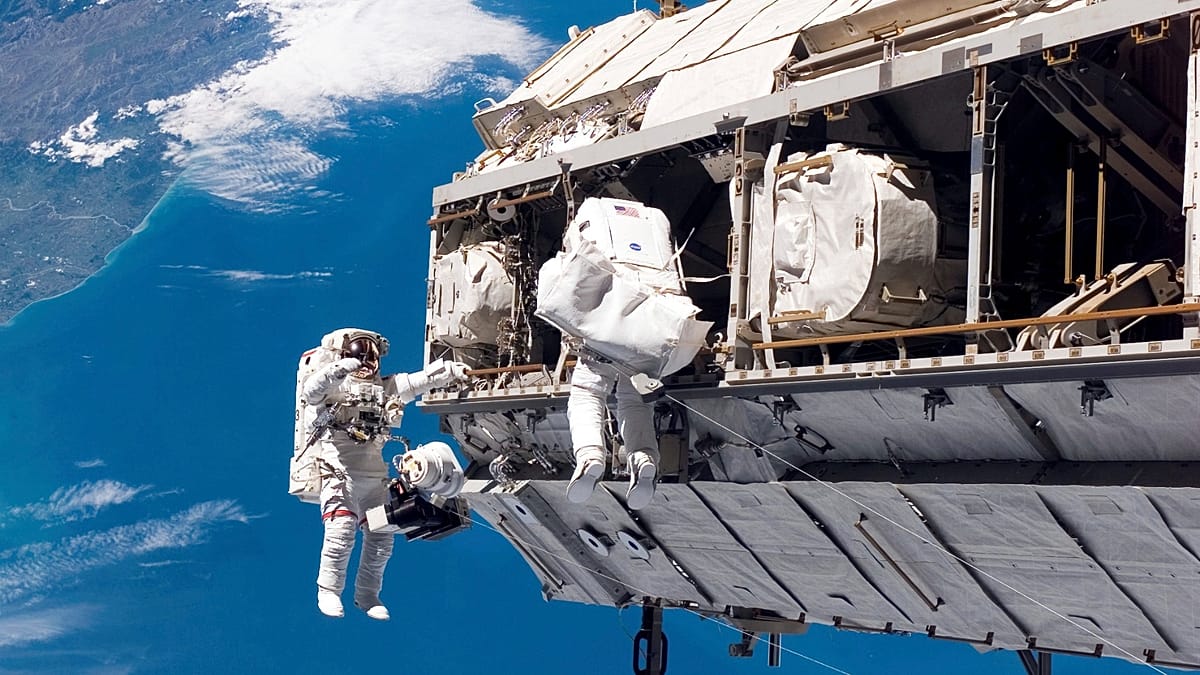
New research from European scientists reveals that the human brain maintains a persistent memory of Earth's gravity even after prolonged exposure to weightlessness. The study, published in the Journal of Neuroscience, demonstrates how decades of terrestrial experience create neural patterns that prove remarkably resistant to adaptation in space environments.
The investigation was led by Professor Philippe Lefèvre of Université Catholique de Louvain in Belgium and Ikerbasque, tracking eleven astronauts aboard the International Space Station during missions lasting five to six months. The international team sought to understand how fundamental motor skills, honed over a lifetime under gravitational force, adjust to the absence of that constant physical reference.
The Gravity Illusion in Orbit
On Earth, gripping and moving an object involves asymmetric force application. "You squeeze harder when lifting something up than when lowering it," explains Lefèvre, "because gravity only threatens to pull it from your hand on the way down." This fundamental physics shapes our most basic interactions with physical objects from childhood.
In the microgravity environment of the ISS, this logic becomes obsolete. An object released at any point will simply float away, meaning grip force should theoretically remain constant throughout movement. Researchers anticipated astronauts would quickly learn this new reality through daily experience.
Instead, they observed a counterintuitive adaptation. Rather than equalizing their grip force, astronauts began squeezing objects harder at the top of a movement than at the bottom. "The brain somehow overcompensates the expectation," Lefèvre notes, describing it as a perceptual illusion rooted in decades of Earth-based experience. The brain expects objects to feel heavy because they always have, leading to systematic overcorrection when that weight disappears.
"What we observed was that the astronaut was gripping the object more when they are at the top than at the bottom. The brain somehow overcompensates the expectation."
Remarkably, this pattern persisted throughout missions lasting nearly half a year, suggesting that gravitational memory represents one of the most deeply embedded neural adaptations humans possess. Even continuous exposure to weightlessness couldn't override what Lefèvre calls "decades of Earth-based instinct."
Rapid Relearning on Return
The research team gained rare access to astronauts just one day after their return to Earth—a logistically challenging window when crew members typically require medical attention and recovery time. Their findings revealed another surprising aspect of neural adaptation.
In initial movements back on Earth, astronauts continued applying weightless grip patterns, potentially creating hazardous situations when handling objects that could be dropped or damaged. However, within just a few dozen repetitions, their grip force normalized completely to terrestrial conditions.
"What this shows is that when they return back to Earth, they relearn the Earth environment much faster than they learn the microgravity environment," Lefèvre observes. This asymmetry in adaptation speed suggests the brain maintains gravitational motor patterns as a default setting, temporarily suppressing rather than replacing them during spaceflight.
The research contributes to growing understanding of how environmental factors shape neurological development, similar to studies showing how urban versus rural upbringing affects mental health profiles. Both demonstrate how early and persistent environmental inputs create lasting neural frameworks.
Implications for European Space Ambitions
The findings carry particular significance for Europe's role in future space exploration. With the European Space Agency participating in lunar exploration programs and planning for eventual Mars missions, understanding human adaptation to partial gravity environments becomes increasingly urgent.
"If we prepare astronauts to land on the Moon, for instance," Lefèvre explains, "they might need some specific training, because the way they are going to manipulate objects might be affected by partial gravity." The Moon's gravity measures approximately one-sixth of Earth's, while Mars' is about one-third—environments where neither terrestrial nor microgravity motor patterns would be perfectly appropriate.
This research intersects with broader technological challenges of extended space missions, including power generation for lunar operations. Both represent fundamental hurdles for sustained human presence beyond low Earth orbit.
The study underscores Europe's growing contribution to space medicine and human factors research, fields where European institutions like Université Catholique de Louvain are establishing particular expertise. As international space cooperation evolves, such research informs both mission planning and astronaut training protocols.
Beyond immediate space applications, the research offers insights into neuroplasticity—the brain's ability to reorganize neural pathways based on experience. The persistence of gravitational memory demonstrates both the strength of long-term environmental conditioning and the brain's capacity for rapid context-dependent adjustment when returning to familiar environments.
As space agencies worldwide plan for longer missions with more complex operational requirements, understanding these fundamental aspects of human adaptation becomes not merely academic but essential for mission safety and success. The European-led research provides crucial data points for designing training that acknowledges both the brain's remarkable adaptability and its stubborn adherence to deeply learned physical laws.