London and Paris announced on Tuesday that around 2,800 troops from ten European countries will take part in the first exercise of a new multinational force designed to support Ukraine after a ceasefire. The drill, named Koalicja (Polish for “Coalition”), will take place in southeastern Poland from 9 to 22 November, near the town of Nowa Dęba, roughly 100 kilometres west of the Ukrainian border.
The Multinational Force-Ukraine (MNF-U), established in 2025 with an operational headquarters in Paris, is led by France and the United Kingdom. It is explicitly not a NATO operation and has little US involvement. Its mission is defensive: to support the Ukrainian armed forces, secure Ukrainian airspace, and help resume economic activity in the Black Sea region once hostilities end.
First major test for the coalition
The exercise marks a key milestone for the MNF-U, according to French General Armel Dirou, who will co-lead the drill alongside Britain’s Lieutenant General Tom Bateman. “This isn’t a hypothetical plan, it’s a real force, ready to help Ukraine once the fighting stops,” UK Defence Minister Wes Streeting said in a statement.
The joint statement from the French defence ministry said the exercise will “allow the testing of the speed and efficiency at which several nations can deploy forces on land, sea and air to support Ukraine once hostilities have finished.” Troops from Belgium, Estonia, Germany, France, Lithuania, the Netherlands, Poland, Spain, Sweden, and the UK will participate in air and land operations. France will provide the largest contingent with 1,100 soldiers, while the UK will send 300.
In addition to the land exercise, a maritime simulation will be led by Turkey from Istanbul to test preparedness for potential mine-clearing operations in the Black Sea. Turkish troops will not take part in the Polish drill.
Reassurance, not provocation
Bateman stressed that the MNF-U is not a peacekeeping or ceasefire monitoring mission. “It is not designed for offensive operations. Its purpose is to provide reassurance and support the regeneration of Ukraine’s armed forces, strengthening their ability to deter and, if necessary, defend against future Russian aggression,” he said.
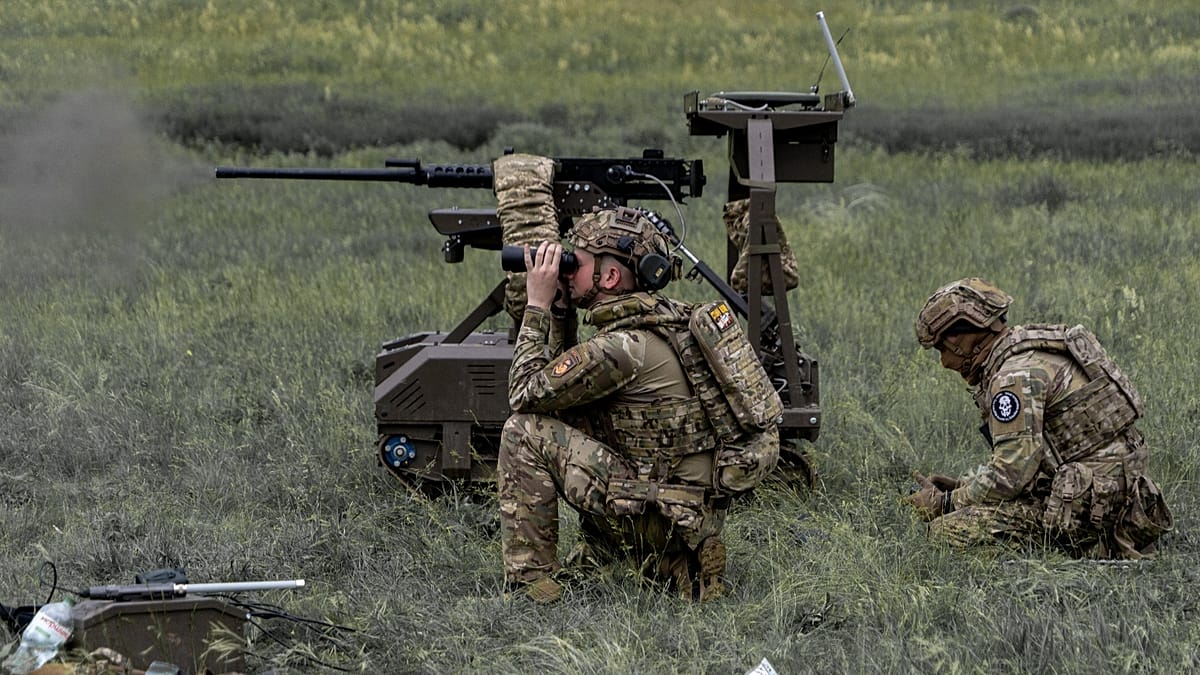
The exercise will focus on coordination, movement of personnel and equipment, and integration of different national forces. Only light equipment, such as drones, will be deployed for anti-drone and self-defence exercises; no tanks or heavy weaponry will be used. Dirou emphasised that the drill is not a show of force. “We are not going to flex our muscles,” he said.
Nevertheless, Moscow is likely to watch the proceedings closely, as the war approaches its fifth year with no decisive breakthrough on either side. The MNF-U’s deployment is contingent on a ceasefire agreement, which remains elusive. The exercise comes amid broader European efforts to support Ukraine, including the EU’s recent acceleration of €45 billion in aid. At the same time, Poland is grappling with its own internal political tensions, as seen in the ongoing constitutional crisis between the government and the president.
The choice of Poland as the venue is significant, given its frontline role in supporting Ukraine and its proximity to the conflict. The drill will also test the ability of different European militaries to work together, overcoming logistical and cultural differences. As Dirou noted, the aim is to prepare for a real mission, not just to rehearse a scenario.
With the war grinding on and peace talks stalled, the MNF-U’s first exercise sends a clear signal of European readiness to stabilise Ukraine once the guns fall silent. Whether that moment comes soon remains uncertain, but the preparations are underway.