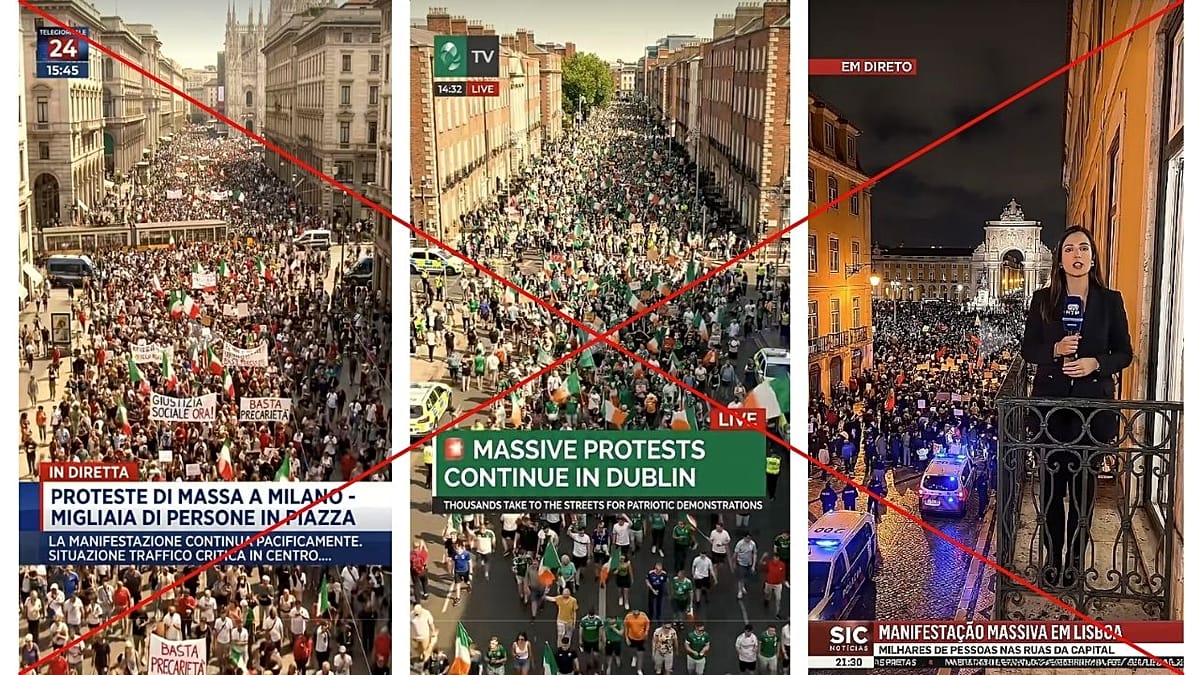
A wave of AI-generated videos depicting mass protests in European cities has been circulating on TikTok, with many viewers apparently believing the scenes are real. The clips, published over the past four months, have attracted hundreds of thousands of views, and some have been viewed more than 300,000 times.
The fact-checking team at The Cube has identified such content targeting audiences in Portugal, France, Germany, Ireland, Italy, and the UK. While the protests shown are entirely fabricated, the videos employ a range of tactics to deceive viewers into thinking they are genuine.
Fake news branding and misleading visuals
Many of the videos mimic the look of established news outlets. For example, one clip features a purported Portuguese journalist holding a microphone with the logo of the state broadcaster RTP, while the on-screen graphics resemble those of the private channel SIC Notícias. The setting is also implausible: the Tagus River appears where a building is shown in the video. RTP confirmed to The Cube that the journalist does not work for them and that they have no connection to the video.
Although the reasons for the alleged protests are often vague—such as anger at "the state of the country"—some videos carry explicit support for far-right parties. German clips, for instance, include captions backing the Alternative for Germany (AfD). Comments on these videos frequently call on far-right figures like André Ventura of Portugal's Chega, the French National Rally, and Germany's Alice Weidel to address issues such as migration.
Most videos end by urging viewers to share their opinions or state the city they are watching from, a tactic designed to boost engagement.
Experts warn of polarization and manipulation
Bruna Martins dos Santos, from the global organization WITNESS, which studies generative AI and deepfakes, told The Cube that the primary purpose of such content is to manipulate public perception and amplify societal polarization. "Audiences engage with these videos primarily because synthetic imagery taps directly into pre-existing political anxieties and cultural grievances," she said.
Martins dos Santos noted that the videos rely on three common misinformation techniques: emotional language, AI-generated content, and polarization. "Topics like immigration, nationalism, and societal decline evoke strong emotional responses," she explained. "This effect is especially pronounced on short-form video platforms where visual impact and emotional resonance precede context, leading viewers to process the spectacle—the crowd size, flags, and chanting—long before questioning its authenticity."
Social media recommendation algorithms amplify this dynamic by pushing provocative content to users most likely to engage with it. AI makes production cheap and scalable, driving views and follower counts.
Platform responsibility and regulatory gaps
TikTok labels such videos as AI-generated and claims to ban content that is "misleading about matters of public importance." However, some clips slip through. Martins dos Santos said this could indicate a violation of TikTok's own rules and a failure in its detection tools. Under the European Digital Services Act, platforms must take effective measures against content that could negatively affect "civic discourse and electoral processes."
"While the continued presence of these videos does not automatically establish a policy breach, it raises critical questions about the effectiveness of TikTok's detection mechanisms, labelling standards, and recommender algorithms," she added. TikTok did not respond to a request for comment.
The spread of such synthetic content comes amid a broader wave of misinformation across Europe. For instance, a pro-Russian network has been spreading fake German ballot fraud videos, and AI-generated pundits are populating German YouTube political channels. These developments highlight the growing challenge of distinguishing real from fabricated content online.
While the AI-generated protests are fictional, real demonstrations have taken place across Europe recently, from Spain's Ceuta crisis to other social and political issues. The contrast underscores the potential for synthetic media to distort public understanding of actual events.