If you could board a time machine, would you set the dial for the past or the future? For decades, pop culture has leaned toward the past—Marty McFly's skateboard, the Terminator's mission, the endless loops of Groundhog Day. But a new theoretical analysis suggests that nature may have a strict one-way policy.
Hongsheng Zhang, a physicist at the University of Jinan in China, has published a paper (currently awaiting peer review) arguing that in a wide class of theoretical universes, travelling into your own past is impossible. The argument is surprisingly simple, relying not on exotic matter or quantum effects but on the fundamental geometry of spacetime.
The staircase of light
In Einstein's relativity, light travels along null geodesics—paths that define the boundaries of causality. Zhang's insight is to imagine spacetime as a stack of layers, each representing a moment of time. Light itself can move along these layers, but any object with mass—whether moving slower or faster than light—must cross them in the same direction. It's like climbing a staircase where each step is a moment in time; you can go up, but you can never step down.
“The whole content is bookkeeping about directions,” Zhang told ScienceAlert. If you can only ever move upward, you can never return to a step you've already left. This holds true regardless of the universe's contents, making the proof remarkably robust.
Two loopholes
Physicists call paths that loop back in time “closed timelike curves.” Einstein's equations allow them in certain exotic scenarios, such as near the core of a spinning black hole. Zhang's work identifies exactly two ways such loops could exist.
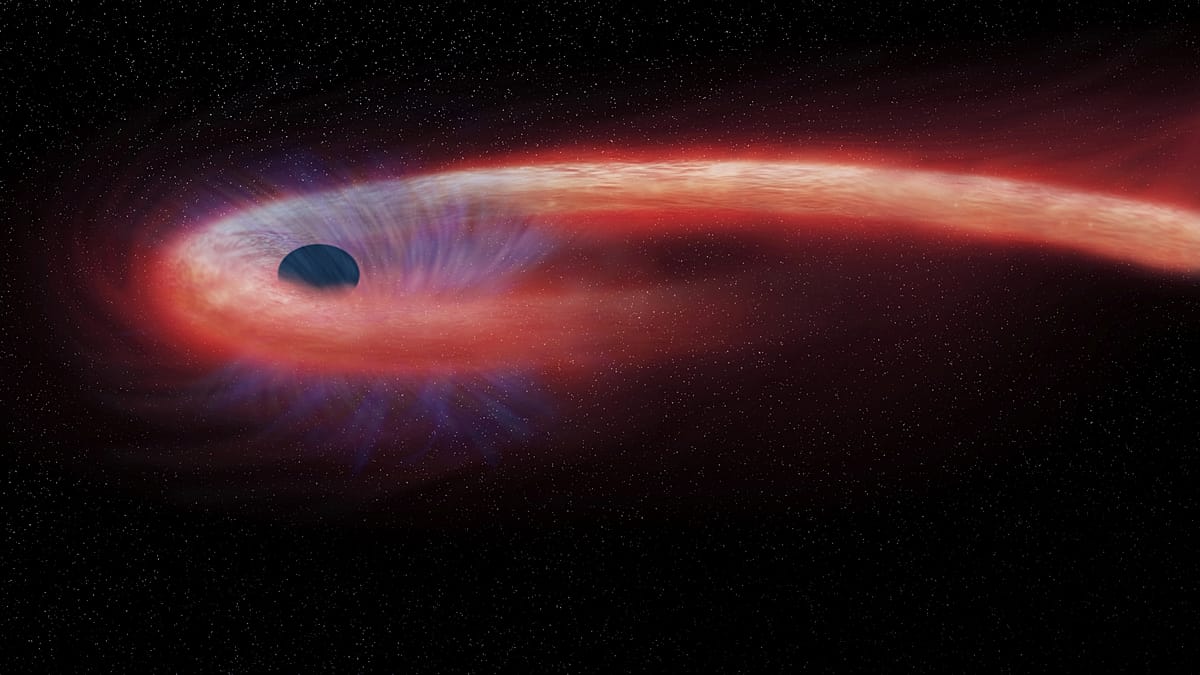
The first is twist. Normally, light rays travel parallel to each other, forming neat surfaces. But if spacetime is twisted—like the strands of a rope—those surfaces can't form, and the staircase loses its one-dimensional structure. This happens near a spinning black hole, where the rotation drags spacetime around with it, an effect measured by NASA's Gravity Probe B around Earth in 2011. Close enough to the singularity, the drag is so strong that moving forward in time becomes a circle. A traveller on that circle would experience time normally, but would return to the exact moment they left. Physicist Brandon Carter first showed such loops exist in 1968.
The second loophole is topology. Even if the staircase is perfectly built, the universe itself might be shaped so that the top step connects back to the bottom—like the impossible staircases in M.C. Escher's drawings. You keep climbing, but you end up where you started. Most theoretical time machines, including those based on wormholes, rely on this trick.
What about our universe?
Zhang's theorem does not settle whether our own universe permits time travel to the past. “What it does not do is tell us whether nature permits any of this. That remains open, and it is the question I would most like to see answered,” he explained.
Meanwhile, trips to the future are already a proven phenomenon. Einstein showed that moving at high speed or sitting in strong gravity slows your clock relative to others. Astronauts aboard the International Space Station return to Earth a few thousandths of a second younger than they would have been, according to the European Space Agency. For those dreaming of a holiday in the past, the message is clear: pack for tomorrow, not yesterday.
As Europe's travel industry gears up for another record year—with global arrivals expected to hit 1.57 billion in 2026—the only time machine most of us will board is a plane to a future destination. And if you're looking for a place to go, Prague, Kraków and Istanbul top the latest solo travel ranking. Just don't expect to come back any younger than you left.