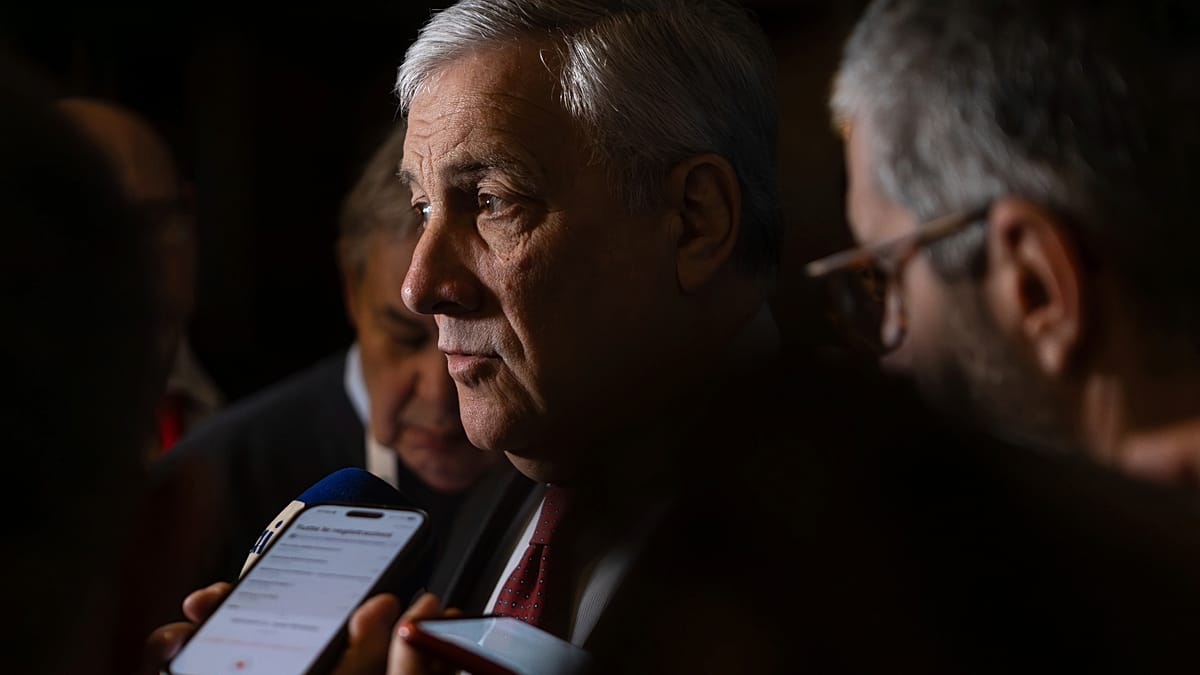
Italian Foreign Minister Antonio Tajani has revealed that he is the target of a sustained cyberattack, which he attributes to his country's backing of Ukraine. In a social media post on Saturday, Tajani said that "cybercriminals" had been distributing his personal information on the dark web for several days, and that they were "seeking further information, effectively exposing me to new threats and intimidation."
The minister added that his family had also been targeted. He framed the attack as politically motivated, writing: "Our stance on Ukraine is the political reason why I have been targeted: for these criminal organisations, defending the freedom of a sovereign state and taking a clear stand in favour of a nation’s democracy and independence is dangerous."
Prime Minister Giorgia Meloni expressed solidarity with Tajani in a statement released on Saturday. "The sale of confidential information concerning public officials is a cause for great concern and must be tackled with the utmost determination," she said.
Brenner Base Tunnel company also hit
The disclosure comes as the company behind the Brenner Base Tunnel project—a 55-kilometre rail link between Innsbruck in Austria and Fortezza in Italy—confirmed that it too had suffered a cyberattack in recent weeks. BBT SE said the incident occurred on 17 October, and that the company had quickly "activated its cyber security protocols, immediately isolating the affected systems and enlisting the support of external cyber security specialists to carry out the necessary forensic analysis."
The attack reportedly involved the theft of non-public data through unauthorised access to the company's internet-connected network. The tunnel, once completed, will be one of the longest rail tunnels in the world, forming a key part of the Scandinavian-Mediterranean corridor that connects northern Europe with the Mediterranean.
The timing of these attacks raises concerns about the vulnerability of critical infrastructure and public figures in Europe. Cybersecurity experts have warned that state-linked groups and criminal networks are increasingly targeting both government officials and infrastructure projects. The incident also echoes broader trends, such as the growing calls for stronger cyber deterrence across the continent.
While the Italian authorities have not publicly attributed the attack on Tajani to a specific actor, the minister's remarks suggest a clear political motive. Italy has been a vocal supporter of Ukraine since Russia's full-scale invasion, providing military and humanitarian aid. This stance has made Italian officials a potential target for pro-Russian hackers, a pattern seen across Europe.
The attack on BBT SE, meanwhile, underscores the risks facing large-scale infrastructure projects. The Brenner Base Tunnel is a flagship European project, co-financed by the EU, and its disruption could have significant implications for cross-border transport and trade. The company has said it is cooperating with cybersecurity specialists and relevant authorities to assess the full extent of the breach.
These incidents are part of a wider wave of cyber threats affecting European institutions and companies. From disruptions to air travel to attacks on supply chains, the continent is grappling with an evolving security landscape. The European Union has been working on new cyber resilience rules, but implementation remains uneven across member states.
For now, Tajani has vowed to continue his work despite the threats. "I will not be intimidated," he said, adding that Italian security services are monitoring the situation. The full impact of the attacks on the Brenner tunnel project remains unclear, but the company has assured the public that safety and construction schedules are not currently at risk.